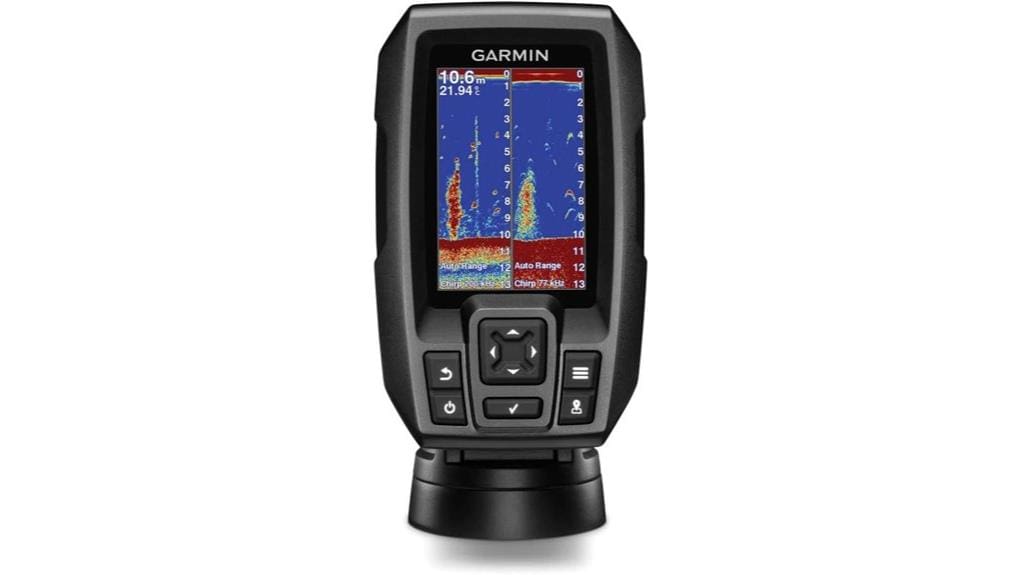

You’ll get a compact, rugged CHIRP and ClearVü fishfinder that’s optimized for kayaks, small boats, and anglers who want simple, dependable performance. The 3.5" 480×320 screen and tactile keys make operation quick, while CHIRP sharpens target separation and ClearVü shows structure cleanly. It runs on a 12V battery, mounts multiple ways, and includes a flasher and waypoint marking. It’s limited by screen size and mapping features, and the rest of the review explains setup, performance, and value.
Some Key Takeaways
- Compact 3.5" 480x320 CHIRP fishfinder offering clear arches and improved target separation over single-frequency units.
- Built-in ClearVü side-imaging provides near-photographic structure detail for locating brush, rock, and schools.
- Portable, battery-powered design with multiple mounts (tilt/swivel, transom, trolling-motor) and IPX7 water resistance.
- Simple keyed interface, waypoint marking, and flasher mode make it beginner-friendly for kayak, shore, and ice anglers.
- Trade-offs include small screen, limited mapping/chart features, and minimal wireless connectivity compared with advanced units.
Garmin Striker 4 at a Glance: Who It’s For and What It Does
Think of the Garmin Striker 4 as a compact, no-nonsense fishfinder aimed at anglers who want reliable sonar without a steep learning curve. You get focused functionality: CHIRP and ClearVu sonar, waypoint marking, and a flasher for vertical work. It targets target anglers seeking straightforward performance and low setup fuss. Portability benefits are clear — light weight, multiple mounts, and battery operation let you move between boats, kayaks, and ice holes. The keyed interface is tactile and simple, so you’ll spend time fishing, not fiddling. Evaluatively, it’s optimized for freedom-minded users who value dependable, minimalist tools. It’s an excellent choice for kayak anglers looking for portable, easy-to-install electronics.
Key Hardware and Display Features That Matter on the Water
When you're on the water, the Striker 4’s hardware and display choices directly affect how quickly you spot structure, interpret returns, and act on fish targets. The 3.5-inch 480x320 LCD packs clear pixels into a compact footprint, readable in bright sunlight if you angle the bezel and boost contrast. Tilt/swivel, transom and trolling-motor mounts give flexible sightlines and stable mounting. Weight and IPX7 rating mean rugged portability and water resistance. The keyed interface is simple; button durability matters for repeated wet-hand use. You’ll trade larger screen real estate for nimble installation and minimal power draw. For kayakers and beginners, pairing the unit with appropriate kayak mounting options and basic accessories makes setup and use much easier.
Sonar Performance: CHIRP, ClearVü, and Flasher Real-World Results
Although compact, the Striker 4’s sonar suite delivers surprisingly detailed returns: CHIRP gives you crisper fish arches and better target separation than traditional single-frequency units, ClearVü produces near-photographic side imagery of structure and schools, and the built-in flasher provides fast, readable updates for vertical jigging or ice work. In practice, CHIRP reduces signal clutter and isolates individual fish in mixed returns; ClearVü lets you map brush, rock, and thermoclines with clarity; the flasher gives immediate bite feedback. You’ll appreciate consistent target separation at range and a predictable, low-noise presentation that lets you fish freely and confidently. Designed with paddlers in mind, it pairs well with compact marine GPS gear for kayakers like those just starting out and looking for dependable navigation and fishfinding in a small package marine GPS gear.
Installation, Power, and Mounting Options : Setup Tips and Pitfalls
Good sonar returns only matter if the Striker 4 is installed and powered correctly. You’ll position the transducer placement for clear CHIRP/ClearVü returns—aim for undisturbed flow, away from turbulence and prop wash. Secure the tilt/swivel or transom mount; check for mount corrosion risk in saltwater and use stainless fasteners. Route the power/data cable with purposeful cable management to prevent chafing and interference. Follow battery maintenance: stable 12 V source, clean terminals, and periodic voltage checks. Test on the trailer before launch. These practical steps minimize signal loss and downtime so you stay free to fish. Consider adding a reliable current charts reference to plan trips and understand local waterways.
Value Verdict: Strengths, Weaknesses, and Who Should Buy It
Because it balances affordability with capable sonar tech, the Striker 4 delivers strong value for anglers who want reliable fish-finding without a steep learning curve. You get CHIRP clarity, ClearVu detail, and a compact IPX7 housing that supports portable convenience and quick installs. Strengths: crisp target separation, waypoint mapping, low power draw, and simple keyed controls. Weaknesses: tiny 3.5" screen, limited mapping compared with chartplotters, and minimal wireless features. Who should buy it: budget conscious anglers, shore and kayak fishers, and anyone wanting a no-frills, dependable unit that won’t tie you down. The site also offers essential accessories for chart plotters and kayakers, including mounts and portable power solutions for a complete chart plotter setup.
Some Questions Answered
Does It Support External GPS Antenna Connections?
No — you can’t attach an external antenna to the Striker 4. It has an internal GPS receiver, so external antenna connector options aren’t provided. You’ll get reliable position fixes without extra hardware, but if you want antenna flexibility or improved reception in marginal conditions, you’ll need a different unit or an external GPS integrated through compatible multifunction displays. Evaluate trade-offs between simplicity and modular expansion before committing.
Can I Update Software via Wi‑Fi or Bluetooth?
No — you can’t perform wireless updates via Wi‑Fi or Bluetooth on this unit. The Striker 4 lacks built‑in Wi‑Fi and has pairing limitations that prevent over‑the‑air firmware installs. You’ll need to update software using a wired connection: download updates to an SD card or connect via USB/cable per Garmin’s instructions. This is restrictive but reliable; plan cable access for firmware maintenance and waypoint/data transfers.
Is It Compatible With NMEA 2000 or NMEA 0183 Networks?
No — it doesn’t support NMEA 2000 or NMEA 0183. You won’t get native NMEA compatibility or direct network integration with the Striker 4; it’s a standalone fishfinder with CHIRP/ClearVu sonar and waypoint features but no onboard NMEA gateway. If you need data sharing across instruments, you’ll have to add an external device or gateway that translates outputs into NMEA networks, which adds cost and complexity but preserves your system freedom.
What Battery Life Can I Expect With Common Lithium Cells?
Expect roughly 200–400 hours of battery endurance using common lithium cells (CR123A-type) at idle/standby, and about 20–60 hours under active CHIRP/ClearVü use, depending on cell chemistry, discharge rate, and backlight settings. You’ll get longer runtime with high-capacity, low self‑discharge cells and conservative screen brightness. Swap cells proactively for multi-day freedom on the water; carry spares and monitor voltage to avoid abrupt shutdowns.
Are Replacement Transducers and Mounts Available From Garmin?
Yes — you can get replacement transducers and mounts from Garmin and aftermarket sources. You’ll find Garmin mounts and OEM transducers that match the Striker 4’s connectors and performance specs, plus Aftermarket transducers offering different beam angles or stainless housings. Evaluate compatibility (connector type, frequency, CHIRP support) and mounting style (tilt/swivel, transom, trolling motor). You’ll retain functionality or trade off features depending on chosen option.