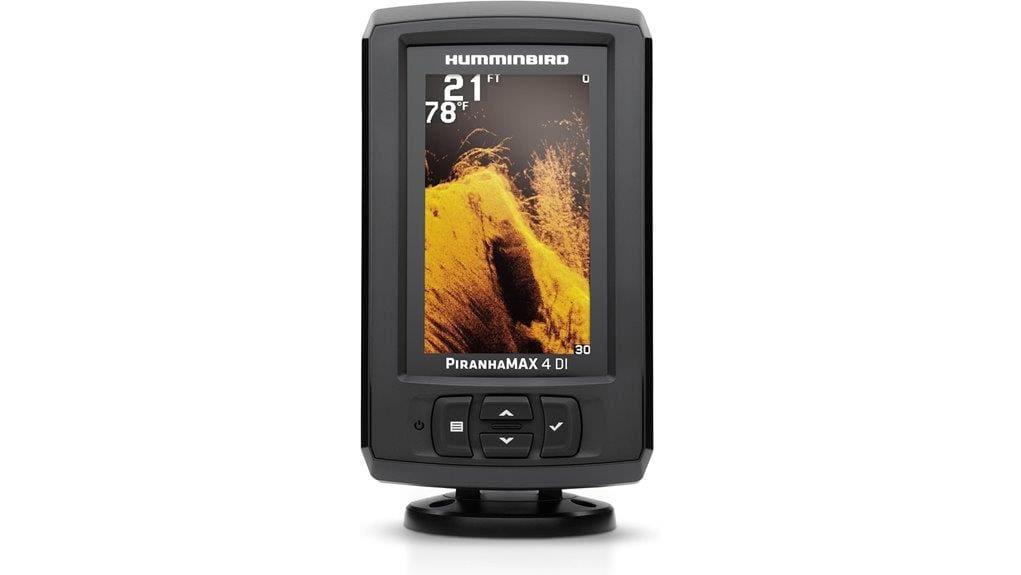

You’ll find the PiranhaMAX 4 is a compact, entry-level fish finder that’s built for solo anglers and small boats. It uses a 4.3-inch color display with a transom-mounted DI/Dual Beam transducer to give clear down imaging and selectable narrow/wide sonar. Controls are simple and setup is quick, though the screen limits detail and continuous use can drain small batteries. It’s reliable for target and structure ID, and keep going to learn mounting, placement, and run-time tips.
Some Key Takeaways
- Compact 4.3" color display provides readable sonar and simple controls ideal for solo anglers and small boats.
- Includes XNT 9 DI T transducer delivering Down Imaging and Dual Beam for clear structure and area context.
- Down Imaging shows sharply defined timber, brush piles, and rock beds; Dual Beam adds narrow-versus-wide detail.
- Simple interface and tilt-swivel mount enable quick installation and easy on-water adjustments.
- Limitations: small screen, basic features (no networking/advanced mapping), and noticeable battery drain on portable installs.
What the PiranhaMAX 4 Is and Who It’s For
The PiranhaMAX 4 is a compact, entry-level fish finder that combines a 4.3-inch color LCD with Down Imaging and Dual Beam sonar to give a clear, actionable view under your boat. You’ll get straightforward imaging and simple controls suited for solo anglers or small-boat users who value autonomy on water. It’s designed for immediate use with minimal setup, though you should check for compatibility issues with aftermarket mounts or power systems. Expect modest battery life demands, basic software updates from Humminbird, and accessible customer support if you need troubleshooting. It’s practical, limited, and liberating for focused fishing trips. It’s a good match for kayakers and beginners looking for affordable, user-friendly fish finder gear.
Key Specs and Included Hardware (Display, Transducer, Mount)
Because you’ll be relying on clear visuals and reliable hardware, the PiranhaMAX 4 pairs a 4.3-inch color LCD with a transom-mounted XNT 9 DI T transducer and a tilt-and-swivel mount to deliver compact, ready-to-install sonar capability. You get concise Display specs: 4.3-inch color, redesigned interface, and readable contrast for daylight use. The included XNT 9 DI T provides Down Imaging and Dual Beam support; Transducer compatibility is native to the unit, so you won’t need adapters. The tilt-and-swivel mount secures the head for steady viewing and fast adjustment. Package is straightforward, minimal, and installation-focused. It’s a popular choice for small boat and kayak users looking for reliable, compact electronics and kayak mounts.
Real-World Performance : Down Imaging, Dual Beam, and Fish ID
When you push the PiranhaMAX 4 onto water, its Down Imaging delivers sharply defined returns that make timber, brush piles, and rock beds easy to distinguish from fish targets. You’ll get clear targets with high contrast; Down Imaging reveals structure and fish shadows with minimal interpretation. Dual Beam lets you toggle narrow detail versus wide-area context, aiding clutter differentiation around complex bottoms. Fish ID+ simplifies target identification of likely targets, but watch shallow resolution limits at very low depths. Features are efficient, though continuous sonar use can cause noticeable battery drain on smaller boats. Performance is direct, predictable, and utilitarian. If you’re mounting the unit on a kayak, a proper kayak fish finder mount will keep the display stable and accessible.
Usability, Setup, and Mounting Tips for Anglers
Although simple on the surface, setting up the PiranhaMAX 4 for reliable operation requires attention to transducer placement, power wiring, and menu calibration. Mount the XNT 9 DI T where the hull flow is clean; avoid prop wash and turbulent areas. Use the tilt-and-swivel mount to aim the beam straight down, then perform a quick calibration to align depth and sensitivity. Plan cable routing to keep power and transducer leads secure, strain-relieved, and away from bilge pumps or ignition noise. Use the redesigned interface to set fish and depth alarms, then test readings in shallow water before heading offshore. For kayak anglers, consider mounting options that prioritize portability and stability to match your craft and paddling style.
Pros, Cons, Price Guide, and Who Should Buy It
If you want a compact, budget-friendly fish finder that delivers clear down imaging and reliable dual-beam sonar, the PiranhaMAX 4 is a strong choice—its 4.3" color display, Fish ID+ and customizable alarms give you essential situational awareness without complexity. Pros: accurate down imaging, dual-beam flexibility, simple interface, tilt/swivel mounting. Cons: small screen limits map/sonar detail, limited battery life expectations on portable installs, no networking or advanced mapping. Price guide: entry-level MSRP, street price varies by retailer; expect affordable replacement cost. Who should buy: solo anglers or small-boat users valuing simplicity. Check software updates, customer support, warranty terms. For kayak anglers, choosing the right battery type is important to get the best run-time and safety from a portable install.
Some Questions Answered
Does It Support External GPS or Charts Through Upgrades?
No — you can’t add external GPS or charts to the unit. The PiranhaMAX 4 lacks external mapping hardware support, and Humminbird hasn’t provided firmware expansion to enable chart plotting or GPS input. You’ll get Down Imaging and Dual Beam sonar, fish and depth alarms, but not external mapping capabilities. If you want external mapping and GPS, you’ll need a different model that explicitly supports external mapping interfaces and firmware expansion for charts.
Can It Record Sonar Logs for Later Review?
No, it can’t record sonar logs for later review. You won’t get built‑in sonar archiving or log playback on this unit; it lacks internal recording and external storage support for captured sonar files. You can use live Down Imaging and Dual Beam views, plus Fish ID+ and alarms, but you won’t be able to save sessions for post‑trip analysis or replay on the device. Consider higher‑end models for archive/playback needs.
Is the Unit Compatible With Trolling Motor Mounts?
Yes — you can mount it to many trolling motors, but check mounting compatibility first. You’ll normally use the included tilt-and-swivel transom mount; trolling motor installs often require shaft adapters or aftermarket brackets to secure the transducer and head. You’ll want shaft adapters sized to your motor, and confirm cable routing and vibration isolation. If you prefer freedom, opt for adjustable shaft adapters or third-party trolling-motor mounts for reliable, secure installs.
What Is the Waterproof Rating or Ingress Protection Level?
The unit doesn’t carry a formal IP rating; Humminbird describes a water resistant design instead. You’ll find it built to resist splashes and light rain for typical boating use, but not guaranteed for submersion. For IP comparison, IP67/68 would indicate immersion protection which this unit lacks. If you need true waterproofing for heavy exposure or submersion, choose gear specified with an IP rating to match your freedom to push limits.
Does It Accept Transducers With Different Frequencies?
Yes — you can use other transducers if they match the unit’s electrical and connector specs. Check frequency compatibility first: the PiranhaMAX 4 expects transducers in its supported frequency range for proper sonar interpretation. Verify transducer wiring and pinout before swapping to guarantee power, ground and signal lines align. Don’t assume plug-and-play; mismatched frequencies or wiring can yield incorrect readings or damage. Consult wiring diagrams and spec sheets before installation.