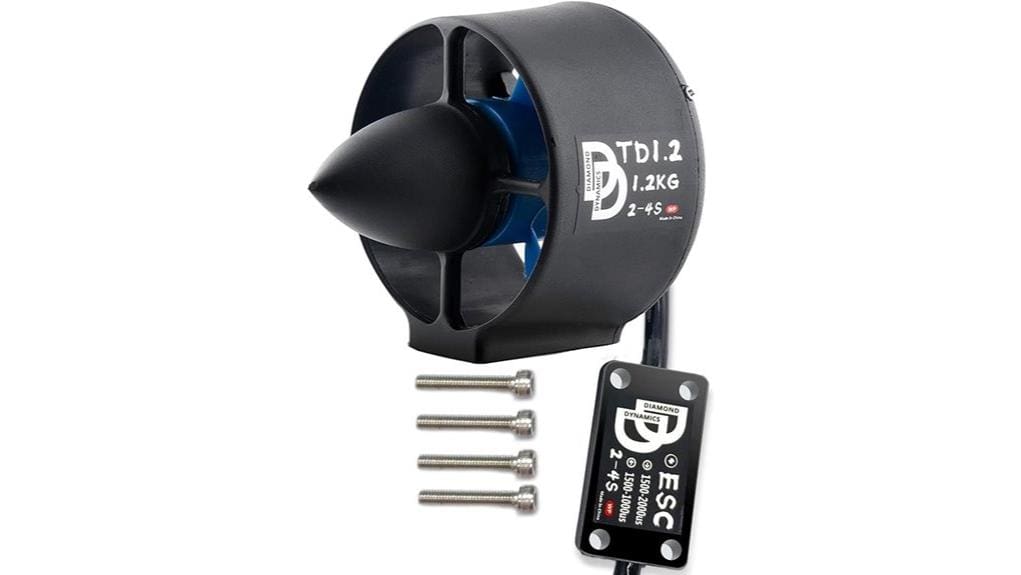
You’ll find the DIAMONDDYNAMICS 1.2kg thruster is a compact, waterproof brushless module designed for small ROVs, RC boats, and instruments where size, efficiency, and serviceability matter. It uses a sealed motor with precision bearings, a nylon fiberglass housing, composite propeller, and a bi‑directional waterproof ESC supporting standard PWM ranges. It’s rated to 100 m, delivers about 1.2 kg thrust at 12 V, and favors endurance over raw power — continue for installation, performance, and tradeoffs.
Some Key Takeaways
- Compact, sealed brushless thruster delivering about 1.2 kg static thrust at 12 V, suited for small ROVs and RC boats.
- Waterproof to 100 m via motor encapsulation and O-ring interfaces, with modular base for easier field servicing.
- PWM-compatible waterproof ESC supports 1500–2000 µs forward and 1500–1000 µs reverse ranges for simple integration.
- Nylon fiber–glass composite housing and precision bearings improve corrosion resistance, efficiency, and lower acoustic signature.
- Limitations include modest thrust for larger ROVs and need for careful battery management and regular seal inspections.
What the DIAMONDDYNAMICS 1.2kg Thruster Actually Is and Who It’s For
Think of the DIAMONDDYNAMICS 1.2 kg thruster as a compact, waterproof brushless propulsion module designed for small ROVs, RC boats, and underwater instruments that need reliable lateral or vertical thrust. You’ll find it’s aimed at marine robotics applications where size, efficiency, and durability matter. You can integrate it into DIY platforms and commercial prototypes, and hobbyist builders will appreciate the modular base and robust composite housing. You’ll enjoy operational freedom thanks to sealed motor encapsulation and straightforward control via PWM-compatible ESCs. Use it when you need predictable, maintainable thrust without bulky installations or complex system changes.
Key Specs and Build Details: Motor, Waterproofing, Propeller, and ESC
Start by looking under the shell: the thruster packs a sealed brushless motor, precision bearings, and a powerful composite propeller into a compact nylon fiber-glass composite housing, all intended to deliver 1.2 kg of thrust at 12 V with high efficiency and long service life. You’ll appreciate full waterproofing to 100 m via motor encapsulation and O-ring interfaces; the modular base eases assembly and sealing. The ESC is a bi-directional, full-waterproof unit with 1500–2000 µs (forward) and 1500–1000 µs (reverse) PWM ranges. Design minimizes propeller noise and addresses thermal management through conduction to the composite housing. This thruster is well suited for small watercraft and accessories like bilge pumps used by beginner kayakers.
Real-World Performance: Thrust, Efficiency, Depth Use, and Durability
Although compact, the DIAMONDDYNAMICS thruster delivers measurable real-world performance, producing roughly 1.2 kg of static thrust at 12 V while maintaining high electrical-to-propulsive efficiency through its brushless motor and optimized propeller geometry. You’ll get predictable thrust curves for station-keeping and transit; efficiency preserves battery life during long sorties. Noise levels are low compared with brushed alternatives, aiding stealthy imaging and minimizing disturbance. Full waterproofing and motor encapsulation support operation to 100 m, with molded composite and bearing choices enhancing corrosion resistance. Follow a simple maintenance schedule: inspect seals, bearings, and prop for wear after heavy use or extended deployments. For kayak users, pairing the thruster with an electric bilge pump can enhance safety during extended trips by helping manage unexpected water ingress.
Installation, Controls, and Compatibility With ROVs or DIY Projects
When integrating the DIAMONDDYNAMICS underwater thruster into an ROV or DIY platform, plan mounting, power, and control interfaces up front to guarantee reliable operation and serviceability. You’ll attach the modularized base using stainless hardware and custom mounting brackets to allow alignment and swap-out in the field. Route power cabling with strain relief and waterproof connectors to the 12 V ESC; keep cable runs short to minimize voltage drop. Use the bi-directional waterproof ESC with standard PWM (1500–2000 µs forward, 1500–1000 µs reverse) tied into your flight controller or RC receiver. Test neutral calibration and waterproof seals before deployment. For kayakers and beginners using deck-mount setups, consider mounting flexibility to allow easy removal and access for maintenance.
Should You Buy It? Pros, Cons, Alternatives, and Buying Recommendations
If you need a compact, 12 V, brushless thruster that’s built for repeated underwater use and easy field servicing, the DIAMONDDYNAMICS unit is worth considering because it combines a sealed motor, high-precision bearings, and a modular base for rapid replacement and alignment. You’ll get reliable 1.2 kg thrust, 100 m waterproofing, and a full-waterproof ESC with PWM control. Pros: durable composite housing, serviceable modularity, efficient power usage. Cons: limited thrust for heavy ROVs, depends on rigorous battery management, potential prop-induced noise levels. Alternatives: higher-thrust rated thrusters or integrated pod systems. Buy if you value compact, serviceable freedom. If you’re repairing or modifying housings on site, having basic plastic welding skills and a proper kit can make field servicing much easier.
Some Questions Answered
What Is the Thruster's Exact Weight in Air?
The thruster’s exact weight in air is about 1.2 kg. You’ll evaluate buoyancy characteristics knowing the unit displaces water according to that mass and its composite housing; use the depth rating (100 m) to confirm seals and pressure effects on buoyancy at operating depths. You’ll account for motor encapsulation and materials when calculating net buoyant force, and you’ll adjust mounting ballast or flotation to achieve neutral or slightly negative trim.
Does It Include Mounting Hardware and Screws?
No, it doesn't include mounting hardware or screws. You’ll need to source brackets and fasteners to suit your frame, plan for secure cable routing, and design for buoyancy adjustments to preserve trim. Use corrosion-resistant stainless or titanium fasteners, lock washers or threadlocker, and isolate electrical connections with waterproof glands. You'll want to test placement in a pool to verify thrust alignment, cable runs, and that your buoyancy adjustments keep the vehicle neutrally stable.
What Connector Type Does the ESC Use?
The ESC uses a waterproof connector on its potted housing; you’ll hook into a sealed multi-pin plug for signal and power. If your setup needs different terminations, you can request custom wiring to swap pins, lengths, or add inline seals. You’ll get reliable, pressure-rated connections compatible with the thruster’s full waterproof technique and motor encapsulation, minimizing leak risks while preserving PWM control ranges and bidirectional ESC functionality.
Is There an Available Spare Propeller or Service Kit?
No official spare propeller or service kit is listed, so you’ll need to source generic replacements. For propeller maintenance, inspect blades after each deployment and follow suggested service intervals based on hours and damage. Track spare availability through the vendor or third-party suppliers; replacement cost typically reflects composite construction and ranges modestly. You’ll want spare parts on hand to preserve mission freedom and minimize downtime during field operations.
What Warranty Period and Support Options Are Offered?
Warranty duration is typically 12 months from purchase; you’ll get customer support and technical assistance for defects within that period. The manufacturer provides a service guarantee covering motor, waterproofing, and ESC faults under normal use. For extended needs you can request paid repairs or spare parts; contact channels include email and designated service centers. Keep proof of purchase and operation logs to expedite technical assistance and warranty claims.