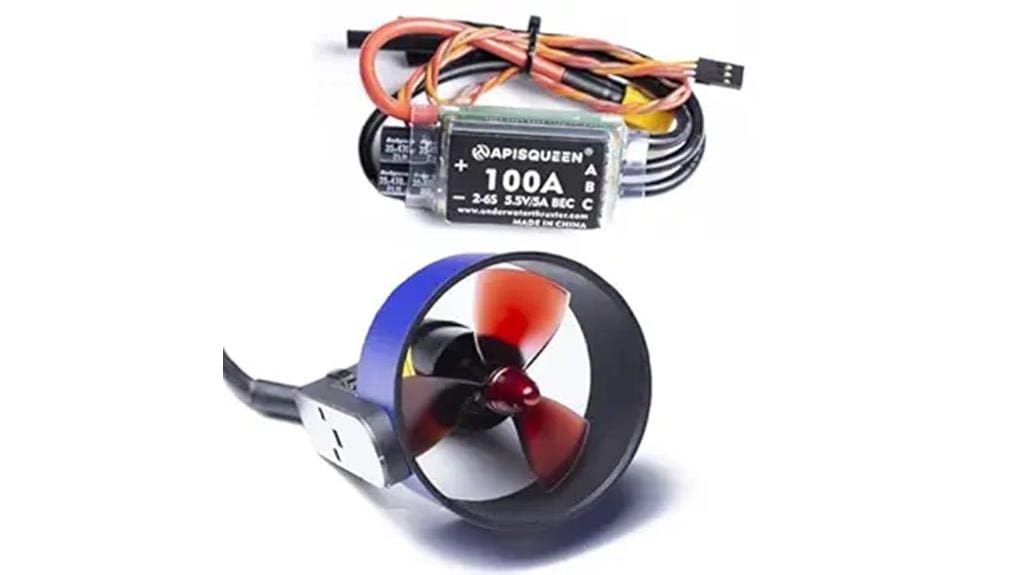

You’ll get a compact 12–24V, ~800W U5 thruster that delivers up to ~7 kg thrust with the included 100A bi‑directional nano‑waterproof ESC; it’s optimized for freshwater inflatables, small ROVs, and reinforced‑transom kayaks. Performance scales with voltage but heats and cavitates near 24V, so monitor current and battery sag. ESC needs calibration and PWM/remote input; wiring and mounting must be robust. It’s not seawater‑safe, and the next section covers installation, limits, and tuning.
Some Key Takeaways
- Delivers up to ~7 kg thrust across 12–24V, with peak thrust near the upper voltage but diminishing returns near 24V.
- Includes CCW motor assembly, 80 mm CW prop, and a 100A bi-directional nano-waterproof ESC (freshwater use only).
- Current draw and motor heating rise nonlinearly toward 24V, raising cavitation, noise, and thermal risk.
- ESC requires calibration via controlled throttle sweep; accepts PWM, remote, or microcontroller inputs.
- Suitable for inflatables, small ROVs, and kayaks with reinforced mounting; avoid seawater and monitor battery/thermal behavior.
U5 Thruster at a Glance: Specs, Package Contents, and Voltage Limits
Although compact, the U5 underwater thruster delivers focused performance for lightweight vessels and ROVs. You get a CCW motor assembly, 80 mm CW propeller, and a 100A bi-directional ESC with nano waterproof technology. Voltage support spans 12–24V operational range (up to 29.4V peak), so you’ll choose batteries accordingly. Note freshwater-only construction; no anti-corrosion treatment enforces strict waterproof limitations and forbids seawater use. The ESC is required for motor operation and accepts PWM control, remote, or microcontroller inputs. You’ll appreciate modular propeller options and straightforward packaging that keeps integration fast and freedom-focused. This setup pairs well with kayak power pole accessories and essential gear for kayak-mounted propulsion.
Real-World Performance: Thrust, Efficiency, and Handling at 12–24V
Measure thrust and current carefully across the 12–24V range to understand how the U5 performs under real loads: you’ll see thrust peak near the upper voltage while current draw and motor heating rise nonlinearly. You’ll observe a roughly proportional thrust performance increase from 12–20V, then diminishing returns and thermal limits toward 24V. Watch for prop cavitation at high RPMs which reduces effective thrust and raises noise. Monitor battery aging effects: internal resistance growth inflates current for given voltage, lowering sustained output. Handle torque reactions and mounting stiffness; secure mounts keep control predictable and maximize usable efficiency during long deployments. For safe long-term operation and rescue readiness, pair the thruster with appropriate static rescue ropes and follow best-practice mounting and maintenance.
Installation and Control: ESC Setup, PWM Inputs, and Recommended Battery Choices
Having characterized thrust, current, and thermal behavior across 12–24V, you’ll now set up the ESC and vehicle power so the U5 responds predictably under load. You connect the included 100A bi-directional ESC, confirm waterproofing limits, then perform ESC calibration using a controlled throttle sweep and neutral-centering procedure so PWM endpoints match your transmitter or microcontroller. Use a stable 24V LiPo for peak performance; verify wiring minimizes voltage drop. Observe Battery maintenance: balance-charge, store at proper voltage, and monitor under load for sag. Test motor direction (CCW variant) and propeller fit before first submerged run. For safety and preparedness when operating on the water, consider carrying a personal locator beacon for kayakers.
Compatibility and Use Cases: Which Inflatables, Kayaks, and ROVs It Suits (and Why Not Seawater)
When you pick a platform for the U5 thruster, prioritize freshwater craft with modest mounting space and power capacity: inflatable tenders, small ROVs, and kayaks with reinforced transoms fit well because the U5 delivers up to 7 kg thrust on a 12–24V supply while requiring a 100A bi-directional ESC and solid 24V LiPo source for peak performance. You’ll mount it using robust mounting adapters to distribute load on soft hulls; kayaks need transom plates or bracket kits. Avoid seawater entirely—the unit lacks anti-corrosion treatment, and salt exposure accelerates failure despite any external corrosion prevention you apply. Our shop also recommends considering hard-shell inflatables for better long-term mounting stability on recreational craft.
Pros, Cons, and Buying Guidance: Who Should Buy the U5 and What to Watch For
If you need a compact, freshwater propulsion unit that delivers up to 7 kg of thrust on a 12–24V supply and you can provide a 100A bi-directional ESC plus a robust 24V LiPo, the U5 is a sensible, cost-effective choice for small inflatables, kayaks with reinforced transoms, and compact ROVs; otherwise look elsewhere. You'll get high power density, simple integration, and included ESC with nano waterproofing. Downsides: freshwater-only construction, splash-proof ESC not for prolonged submersion, and limited propeller size. Buy if you value portability and DIY control. Check maintenance intervals and warranty considerations before purchase. Consider also pairing the thruster with compact navigation and safety gear like a handheld GPS for kayaking handheld GPS.
Some Questions Answered
Is the Propeller Reversible for Different Rotation Directions?
No — the propeller itself isn’t designed as a reversible shaft component; you’ll use Bidirectional control via the included ESC to reverse thrust. You’ll install the 80 mm CW propeller on the CCW motor variant as supplied, and the ESC provides reversible motor rotation electronically. You’re free to change prop models or swap shaft hardware, but by default you rely on ESC bidirectional control rather than a mechanically reversible shaft for direction changes.
Can Multiple U5 Thrusters Be Synchronized on One ESC?
No — you can’t reliably synchronize multiple U5 thrusters on one ESC. Each U5 requires its own ESC for proper communication protocols and independent phase alignment; tying motors in parallel will cause uncontrolled commutation, timing conflicts, and possible failure. Use individual ESCs, feed them the same PWM or higher-level controller signal, and implement a master sync or CAN/serial link if you need coordinated thrust while preserving safety and motor longevity.
What Maintenance Intervals Are Recommended for Freshwater Use?
You should perform monthly checks and an annual overhaul: monthly checks include visual inspection for debris, propeller integrity, motor shaft play, ESC connectors and battery leads, and drying/silicone lubrication of exposed seals; log hours. Every 12 months do an annual overhaul—disassemble, clean bearings, inspect windings and magnets, replace worn seals and bearings, test ESC full functionality and waterproofing, and run load tests. Keep records so you can operate freely and safely.
Are Replacement Propellers or Spare Parts Available Separately?
Yes — you can buy replacement propellers and spare parts separately. You’ll source 80 mm replacement propellers matching CW/CCW orientation and individual components like motor housings, seals, and the 100A ESC. Verify compatibility with the U5 CCW variant and 12–24V system; parts exposed to water should be swapped frequently. Keep spare parts on hand to preserve operational freedom and minimize downtime during field deployments.
Does the ESC Support Onboard Telemetry or RPM Feedback?
No — the ESC doesn’t provide onboard telemetry or direct rpm feedback to your controller. You’ll get standard PWM speed control and bidirectional motor drive, but the included 100A ESC only offers basic splash-proof operation and high-performance MCU control without exposed telemetry outputs. If you need rpm feedback or telemetry, you’ll have to add an external sensor (hall-effect/tachometer) or swap to a telemetry-capable ESC that exposes RPM, voltage, current, and status data.