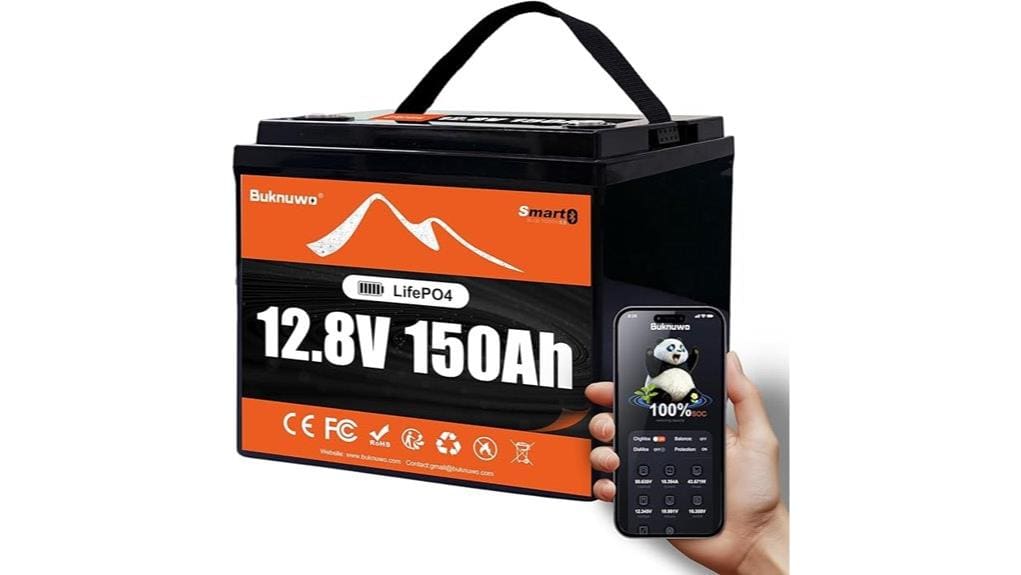

You’ll get a 12.8V, 150Ah LiFePO4 pack (1,920Wh) with a 100A BMS, Bluetooth telemetry, and ABS dust/light-waterproof housing; about 95% is usable (~1,824Wh), so expect ~3.5 hours at 500W or ~1.7 hours at 1,000W. The BMS enforces over/under/short/thermal cutoffs, charge only above 0°C, and continuous output is 100A. Cycle life ranges into thousands (6,000–15,000 depending on DOD). Continue for installation, expansion, and safety specifics.
Some Key Takeaways
- 12.8V 150Ah LiFePO4 delivers 1,920Wh nominal (≈1,824Wh usable) and reliably runs ~3.5h at 500W or ~1.7h at 1,000W.
- Integrated 100A BMS protects against overcharge, over-discharge, overcurrent, short-circuit, and thermal events.
- Bluetooth 5.0 telemetry (≈10 m) provides SOC, voltage, current, temperature, and fault logging with ~±1–5% accuracy.
- Very long cycle life (≈15,000 cycles at 60% DOD; ≈6,000 cycles at 80% DOD) with low self-discharge.
- Installation needs 100A-capable cabling, proper fusing, temperature-aware charging (>0°C), and matched packs for expansion.
What the 12.8V 150Ah Bluetooth LiFePO4 Battery Actually Includes
Inside the 12.8V 150Ah Bluetooth LiFePO4 battery you'll find a 12.8V, 150Ah LiFePO4 cell pack (1,920Wh) housed in an ABS plastic, dustproof and light-waterproof case, a 100A integrated BMS that provides overcharge/over-discharge/short-circuit/overcurrent/overheat protection plus automatic temperature cut-offs, and a Bluetooth 5.0 module for real‑time SOC, voltage, current, power and temperature monitoring via iOS/Android (≈10 m range). Your packaging contents list the battery, user manual, and basic accessories included: terminal bolts, insulated covers, and a safety sticker. You get clear specs, robust protections, and plug‑and‑play freedom for diverse installations.
Real-World Performance: Range, Runtime, Charging and Cycle-Life Expectations
When you size this 12.8V 150Ah LiFePO4 pack for real-world use, expect about 1,920Wh of usable energy and up to ~95% usable capacity under normal conditions (roughly 1,824Wh), versus about 50% usable for comparable lead‑acid packs. In practice you’ll get predictable runtimes: at 500W continuous draw expect ~3.5 hours; at 1000W, ~1.7 hours. Charge taper behavior reduces current near full SOC—plan longer top-up times. Cycle-life scales with depth-of-discharge: ~15,000 cycles at 60% DOD, 6,000 at 80% DOD. Watch temperature effects: charge only above 0°C and derate output at extremes for safe, free operation. This makes these packs especially useful for kayaker backup applications where reliable, lightweight power is important.
Connectivity, BMS and Safety: How Bluetooth, Protections and Limits Behave in Use
Leveraging an integrated 100A BMS and Bluetooth 5.0, this LiFePO4 pack gives you real‑time visibility and automatic protection so you can monitor SOC, voltage, current, temperature and fault status from a phone within ~10 m while the BMS enforces overcharge, over‑discharge, overcurrent, short‑circuit and thermal cutoffs. You’ll use Bluetooth diagnostics to read precise telemetry (±1–5% variance) and log events. The BMS limits continuous output to 100A, interrupts faults instantly, and prevents deep discharge. Thermal management combines cell-level sensing with automatic charge/discharge derating above safe thresholds, preserving lifespan and keeping your freedom to operate safely.
Installation and Expansion: Wiring, Parallel/Series Setups, and System Compatibility
Getting your LiFePO4 bank wired correctly is critical for performance and safety, so plan cable routes, terminal sizing, and breakers before you connect cells in series or parallel. You’ll size conductors to handle the 100A+ peaks given the 100A BMS, minimize voltage drop, and use fused positive feeds and a common-mode grounding scheme. For parallel or series expansion (up to 4S4P), match capacity, age, and voltage. Implement equal-length leads and regular pack balancing checks via the BMS/Bluetooth telemetry. Verify inverter/charger compatibility with 12.8V LiFePO4 charging profiles and temperature cut-offs for safe, autonomous operation. Also consider marine-grade mounting and adhesive options used by kayakers for secure installation in wet or vibration-prone environments, such as marine adhesives.
Who Should Buy It : Use Cases, Tradeoffs, and Final Recommendation
Although compact and rugged, this 12.8V 150Ah LiFePO4 pack best suits users who need high-cycle, maintenance-free energy with predictable performance—think off-grid homeowners, RVers, marine operators, and UPS/solar integrators who value up to 95% usable capacity, ~1920Wh of energy, and a BMS-rated 100A continuous protection. You should buy it if you run off grid workshops, build portable powerstations, or need reliable UPS backup with long cycle life and low self-discharge. Tradeoffs: 41.4 lb weight and ABS case reduce ultra-light portability; charging temp limits require warm environments. Final recommendation: excellent for freedom-seeking, safety-conscious installers. Many kayakers and beginner paddling enthusiasts also rely on compact emergency power solutions when venturing offshore, especially for charging navigation lights and communication devices, which is why we include products for emergency power.
Some Questions Answered
Can This Battery Be Shipped as Air Cargo Internationally?
No — you generally can't ship this battery by air cargo internationally without special arrangements. LiFePO4 cells over certain capacities face strict air transportability and carrier restrictions; 12.8V 150Ah (1920Wh) exceeds many airline/ICAO limits. You'll need approved packaging, documentation, operator approval, and possibly cargo‑only routing with specific hazardous‑goods compliance. Consult carriers and current IATA/ICAO regulations, declare properly, and secure written carrier restrictions waivers before booking.
What Accessories Are Included With Purchase (Cables, Terminals, Mounting)?
You get basic installation hardware: four mounting brackets with screws, M8 threaded copper terminals with nylon nuts, and a short positive/negative cable pair. Protective covers for the terminals are included. The package excludes long run cables, fuses, or a charger — you’ll need those for custom setups. Documentation lists torque specs, safety clearances, and recommended fuse ratings so you can install confidently and maintain safe, reliable operation.
Is the Bluetooth App Firmware Updatable and Who Provides Updates?
Yes — the Bluetooth app supports firmware updates for the battery’s BMS. You’ll get app updates and OTA frequency notices from the vendor support channel; updates are pushed over-the-air and you can request firmware rollback if an issue arises. You’ll see version, changelog, and safety notes in the app. Apply updates in a safe environment (stable power, temperature within spec) to avoid bricking or unexpected behavior.
Can the Battery Be Charged Below Freezing With a Heated Enclosure?
Yes — you can charge below freezing if the battery stays within the optimal charging range using a heated enclosure. For cold weather performance, keep charging temperature between 0°C and 45°C (32°F–113°F); the BMS has automatic high/low temperature cut-off to protect cells. Use a controlled heater, monitor SOC and temperature via Bluetooth, and make sure enclosure prevents condensation. That combination maintains safety and preserves cycle life while giving you operational freedom.
Are There CErtifications (Un38.3, CE, Rohs) or Safety Test Reports?
Yes — you’ll get UN38.3 reports and CE/RoHS confirmations; the manufacturer also provides Independent lab testing summaries. You can request copies showing safety-test results, cell chemistry verification, and BMS protection validation. Reviews note thermal, vibration, and short‑circuit test data, plus EMC compliance for CE. Keep the reports for transport, customs, and system integration; they support safer installations and regulatory freedom when expanding or exporting systems.