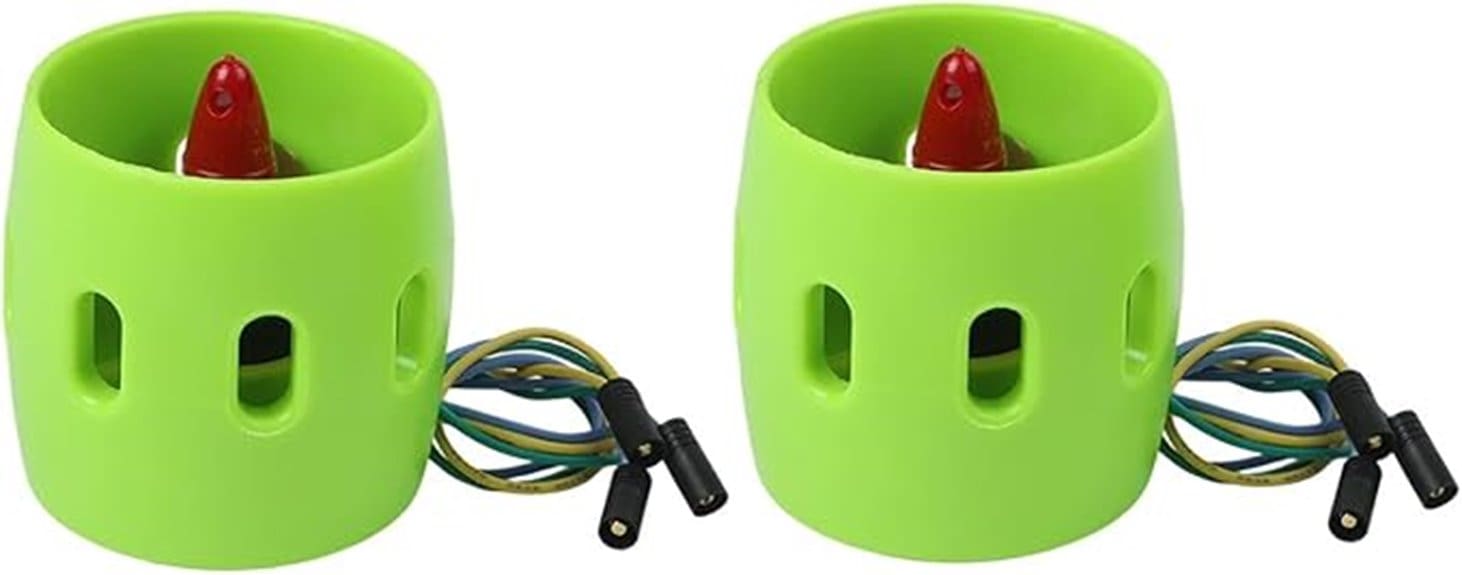

You’ll get a compact, corrosion-resistant 12–24V brushless thruster that’s good for hobby ROVs, small boats, and kayak assist; it delivers up to 200W with ~20A ceiling and shows better electrical efficiency and lower battery heating at 24V versus 12V. Expect modest peak thrust, short supplied cables, and limited depth certification—check seals and bearing alignment for longevity. The unit’s CW/CCW options help balance yaw, and more detailed performance, mounting, and durability notes follow. When considering paddle board motor efficiency review, it's essential to assess how different power options can impact performance on the water. Models with higher voltage ratings often provide a notable increase in thrust while minimizing energy loss. Additionally, examining the weight-to-thrust ratio will help you determine the ideal setup for extended paddle boarding excursions.
Some Key Takeaways
- Produces up to 200 W and 20 A, with similar thrust at 24 V using roughly half the current compared to 12 V.
- Better electrical efficiency and reduced battery heating at 24 V, improving runtime and thermal stress.
- Corrosion-resistant PLA/PC housing and sealed brushless design suit hobby salt/freshwater use, but depth certification is unclear.
- Compact 74×75 mm footprint, selectable CW/CCW pairs, and short 25 cm cable—add strain relief and verify prop rotation before mounting.
- Good value for hobby ROVs, small boats, and kayak assist, but limited top-end thrust and limited warranty for professional use.
Performance and Power: Real-World Thrust, Efficiency, and Current Draw at 12V vs 24V
One clear way to compare 12V and 24V operation is to measure thrust versus current at fixed propeller pitch and RPM, since the thruster delivers up to 200 W and draws a maximum of 20 A. You’ll record that at 24V you get similar thrust with roughly half the current, improving electrical efficiency and reducing battery heating under load. At 12V you’ll draw more current for the same mechanical output, increasing thermal stress and limiting runtime. Monitor for propeller cavitation onset as load and RPM change; cavitation degrades thrust and efficiency regardless of voltage, so optimize pitch and speed accordingly. For kayakers and beginners, pairing the thruster with appropriate bilge pumps and battery management gear helps ensure safe and reliable operation.
Build, Materials, and Durability: Corrosion Resistance, Depth Rating, and Mechanical Quality
Because the thruster uses corrosion-resistant PLA and PC housings and a sealed brushless motor design, you can expect reasonable resistance to saltwater and freshwater environments for most hobby and light-prototype applications. You’ll want documented corrosion testing data; absent that, inspect material sourcing and certification to verify UV and salt tolerance. Evaluate seal longevity by checking O-ring specs, adhesive types, and strain relief on the 25 cm cable. Mechanical tolerances are tight for a compact 74×75 mm unit, but confirm concentricity and bearing preload to avoid premature wear. Overall, the build balances weight, durability, and serviceability for freeform projects. For kayak repairers and DIY builders, consider compatibility with common plastic welding techniques and materials when planning installations or modifications.
Installation and Configuration: CW/CCW Options, Cable Length, Mounting Tips, and Wiring
Start by choosing the correct rotation and cable orientation for your setup: select CW, CCW, or a matched CW/CCW pair to counteract torque and stabilize yaw, and confirm the propeller direction relative to the motor shaft before final mounting. Mount using lightweight brackets that align the 74x75 mm footprint, minimizing asymmetry. Keep the supplied 25 cm cable short but strain-relieved—use a clamped loop or grommet to prevent cable strain at the housing. Wire phase leads per controller labeling; verify polarity and ESC settings for direction. Test static thrust and adjust prop direction or pairing to optimize steering authority and balance. Consider adding a dedicated beach wheel attachment point to make integrating the thruster with beach wheel kayaker gear easier.
Use Cases and Compatibility: Which Boats, ROVs, and Rigs This 200W Thruster Suits Best
When matching this 12–24V, 30–200W brushless underwater thruster to a platform, consider payload, hull form, and required thrust rather than treating it as a general-purpose drop-in; its 300KV, 20A ceiling and compact 74×75 mm footprint make it best suited for small electric ROVs, lightweight RC boats and model ships, kayaks or dinghies with auxiliary propulsion, and small tow/inspection rigs where continuous duty at modest speeds is needed. You’ll pair it with lightweight frames, low-drag hulls, or modular skids. Kayak compatibility is strong for trolling-assist setups. Drone integration works for surface drones and small VTOL recovery rigs, given power and mounting constraints. For beginner paddlers using inflatable or drop-stitch kayaks, pairing the thruster with lightweight frames and simple controls yields the easiest retrofit and best battery life.
Pros, Cons, and Buying Verdict: Value, Alternatives, and Who Should (or Shouldn’t) Buy This Pair
Although compact and reasonably powerful for its size, this 12–24V, 30–200W brushless underwater thruster pair targets niche light-duty marine roles rather than general-purpose propulsion. You get lightweight, corrosion-resistant construction, selectable CW/CCW pairing, and a 200W nominal output that suits kayaks, RC rigs, and small ROVs. Downsides: limited top-end thrust, short cables, and unclear depth certification versus commercial submersibles. Consider marine legislation for mounting, wiring, and safety if you intend commercial use. Value is good for hobbyists and modders; pros should weigh alternatives with higher continuous torque and longer warranties. Check warranty coverage before committing. Our store focuses on gear for paddlers and beginners, so we often recommend products tailored to kayak anglers.
Some Questions Answered
Does the Motor Include an Electronic Speed Controller (ESC)?
No, it doesn't include an electronic speed controller (ESC). You’ll need to source a waterproof ESC compatible with 12–24V and up to 20A, and you'll perform throttle calibration during setup to match the motor's 300 KV characteristics. Choose an ESC rated for underwater use or house it in a sealed enclosure, verify throttle range and direction (CW/CCW), and test under controlled conditions to guarantee reliable, safe operation and freedom in deployment.
Can the Cables Be Extended or Replaced for Custom Routing?
Yes — you can extend or replace the cables for custom routing, but you should use waterproof connectors and follow proper sealing procedures. You’ll cut and solder or crimp, add custom sleeving for abrasion and UV resistance, and protect joints with heatshrink and potting where needed. Keep wire gauge to handle 20 A, maintain waterproofing at hull penetrations, and test continuity and insulation before full deployment to preserve reliability and depth rating.
Are Spare Propellers or Seals Available Separately?
Yes — you can order spare props and seal kits separately for maintenance and customization. You’ll get replacement propellers sized to the thruster and seal kits containing O‑rings and gaskets matched to the housing. That lets you swap damaged props, refresh seals before deep deployments, or change performance profiles. Verify CW/CCW compatibility and materials (PLA/PC) when ordering, and keep torque and shaft tolerances in spec during installation to avoid leaks.
What Warranty or Return Policy Does the Manufacturer Offer?
You’ll get a limited manufacturer warranty; warranty duration is typically 12 months from purchase, covering defects in materials and workmanship. You’re allowed a return window of 14 days for unused, undamaged units; faulty items qualify for repair, replacement, or refund within the warranty duration. You’ll need proof of purchase and clear photos; you’re responsible for return shipping unless manufacturer authorizes prepaid label for warranty claims.
Is the Unit Safe for Continuous Operation at Maximum Current?
No — you shouldn’t run it continuously at maximum current. Continuous 20 A operation stresses thermal management and accelerates bearing wear; heat buildup in the PLA/PC housing and motor windings can reduce lifespan and seal integrity. You can operate near peak briefly, but for sustained duty you should derate the motor, add active cooling or duty cycling, and monitor temperature and bearings to preserve performance and maintain safe, reliable freedom of operation.