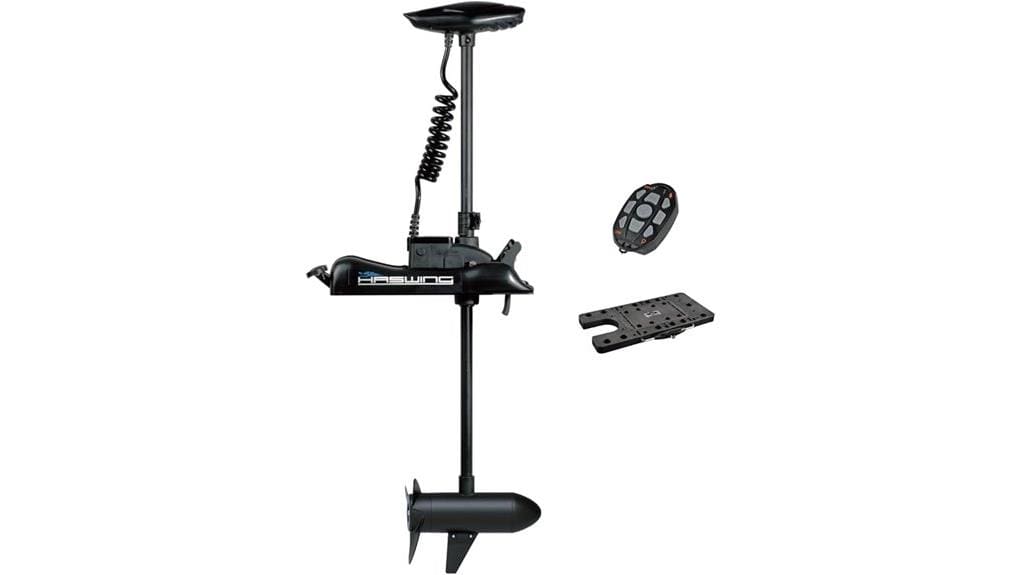
You’ll get a rugged 55 lb, 12V bow‑mount trolling motor that’s built for precise low‑speed control and reliable steering on small to medium boats. The 54" alloy shaft keeps the prop submerged in chop and the 360° steering plus variable speed give crisp, predictable handling. Quick‑release mounting and stow/deploy hardware speed installation, while battery monitoring and corrosion checks are essential. Keep going and you’ll find detailed notes on performance, setup, and alternatives.
Some Key Takeaways
- 55 lb thrust 12V bow-mount motor suited for 14–20 ft boats, offering dependable slow-speed trolling control.
- 54" cast aluminum shaft maintains prop submersion in chop and prevents ventilation on downwind legs.
- Variable-speed control with cruise hold and 360° steering provides precise, linear heading and speed adjustments.
- Quick-release bow bracket, stow/deploy pedal, and replaceable three-blade prop simplify use and maintenance.
- Good mid-power value for mixed salt/fresh use with routine corrosion prevention and proper battery management.
Quick Verdict: Is the HASWING Cayman 55LB 12V Worth Buying?
If you need a reliable, mid-power bow-mount motor for serious angling, the HASWING Cayman 55LB 12V delivers a focused blend of thrust, control, and durability that makes it worth buying. You’ll appreciate precise variable-speed control, 360° steering, and a 54-inch alloy shaft that keeps the prop submerged without fuss. Maintenance’s straightforward: follow battery maintenance best practices and routine prop checks to preserve runtime and torque. Quick-release mounting and stow/deploy hardware free you to move fast. Warranty coverage gives added confidence; inspect terms for saltwater use limits. Overall, it’s a practical, freedom-forward choice for serious anglers. It’s also well-suited to kayakers using solar power with solar chargers to extend time on the water.
Key Specs and What They Mean for Anglers
Because you’ll be relying on this motor in variable conditions, understanding the Cayman’s core specs—55 lb thrust, 12V system, 54" cast aluminum shaft, three‑blade prop with up to 1,200 rpm, and a durable brush motor—lets you match performance to real-world needs: 55 lb of thrust suits small-to-medium boats and heavy-load situations like trolling with live bait, the 12V platform determines battery selection and runtime planning, the long alloy shaft guarantees consistent submersion in chop and when running downwind, and the replaceable three‑blade prop plus brush motor balance efficiency, torque, and serviceability for anglers who demand controllable speed and reliable pushing power.
You’ll prioritize battery monitoring to avoid mid-trip failures and schedule charge cycles; the shaft length and quick-release mount simplify trim for diverse waters. Regular prop care—inspection, clearing fouling, replacing fins—preserves rpm and thrust, while the brush motor’s serviceability keeps maintenance straightforward and field-repairable. New kayakers should also consider essential bilge pumps for quick water removal in small craft and emergencies, especially models suited for kayakers and beginners.
Real-World Performance: Thrust, Speed Control, Steering, and Battery Life
Having matched the Cayman’s specs to your boat and gear, let’s look at how that translates on the water: 55 lb of thrust gives predictable slow-speed control for trolling and confident acceleration against wind or tide, while the 54" shaft keeps the prop submerged in chop without excessive ventilation. You’ll notice tight, linear response from variable speed control and cruise hold that maintains speed over seams. 360° steering feels direct; inputs translate to precise heading control. Watch prop efficiency at higher RPMs — it affects range. Good battery management (monitor LED levels, plan amp-hour budgeting) extends your day afloat. Consider pairing a chart plotter and accessories designed for kayak use to improve navigation and situational awareness chart plotter gear.
Installation, Mounting, and Controls: Bow Mount Setup, Remote/Foot Control, and Deployment
Get the transom clamp and quick-release bracket aligned and you'll save time during the initial bow-mount setup. You position the 54" shaft, set the adjustable depth collar, and tighten the motor stabilizer before securing the lift handle. Route power and check the LED power display. Pair the remote and wireless foot controller via straightforward wireless pairing; confirm the reset key functions. Use the stow/deploy pedal to practice silent deployment and folding. Inspect fasteners and apply corrosion-resistant grease to prevent hardware corrosion, then test 360-degree steering, cruise control, and variable-speed response under real load. For kayak outings, don't forget to bring a compact hand pump and spare tubing as part of your essential gear.
Who Should Buy It and Best Alternatives by Use Case (Saltwater vs Freshwater, Boat Size, Budget)
If you fish from a medium to large bow-mounted boat and need a durable, 12V trolling motor that handles both saltwater and freshwater, the HASWING Cayman 55LB is a practical choice—its 54" aluminum shaft, 55 lb thrust, and 360° electric steering give you the reach and maneuverability to control drift and position on boats roughly 14–20 ft, while the brush motor and corrosion-resistant features suit occasional saltwater use with routine maintenance. You’ll appreciate precise speed control and cruise for freedom on water. Choose it for mixed-use; prioritize regular freshwater maintenance and saltwater corrosion prevention. For tighter budgets, consider Minn Kota Endura or Motorguide Start as budget friendly alternatives matched by boat size matching. Also consider pairing your motor with an appropriate dry bag to protect batteries and electronics from splashes and unexpected capsizes.
Some Questions Answered
Does It Come With a Warranty, and What Does It Cover?
Yes — you get a manufacturer warranty; the warranty duration is typically 1–2 years depending on region and retailer, so check your documentation. It covers defects in materials and workmanship for the motor, shaft, electronics and controls, plus accessory failures under normal use. Coverage exclusions apply: damage from misuse, saltwater corrosion without proper maintenance, modifications, improper installation, and wear items like propeller fins, batteries, seals and cosmetic damage aren’t covered.
Can the Motor Be Used With a Trolling Battery Charger?
Yes — you can use a trolling battery charger with the motor’s 12V battery, but you’ll check battery compatibility and follow charging safety. Use a charger matched to the battery chemistry (lead‑acid/Gel/AGM) and amp output appropriate for capacity. Disconnect loads or follow manufacturer guidelines to avoid backfeed into electronics. Monitor voltage and temperature during charging, and use proper marine‑grade connectors to keep connections secure and corrosion‑free for reliable, free‑ranging use.
Are Replacement Props and Parts Sold Separately?
Yes — replacement props and parts are sold separately. You’ll find prop availability for the three-blade prop and replaceable fin through dealers and OEM channels; parts pricing varies by region and vendor. You can order shaft collars, stow/deploy pedals, and LED modules individually to maintain freedom on the water. Check authorized resellers for up-to-date stock and exact cost, and keep serial/model info handy to guarantee correct fitment.
Is the Remote Waterproof or Water-Resistant?
Yes — the remote is water-resistant, not fully waterproof. You’ll get a sealed casing that protects electronics from splashes and light spray while you’re on the water, and the unit supports extended range wireless control. You can confidently use it in rain or rough wakes, but you shouldn’t submerge it. For long-term freedom and reliability, rinse with fresh water after salt exposure and avoid prolonged immersion to preserve seals and electronics.
Can the Shaft Length Be Shortened or Customized?
Yes — you can shorten the shaft, but do it carefully: shaft customization is practical using aftermarket shaft adapters or by trimming the 54" cast aluminum shaft and reinstalling the depth collar. You’ll need proper tools, corrosion-resistant fasteners, and to maintain structural integrity and wiring length. Use shaft adapters to avoid cutting when possible, and test steering, depth adjustment, and prop clearance thoroughly so you keep reliable performance and freedom on the water.