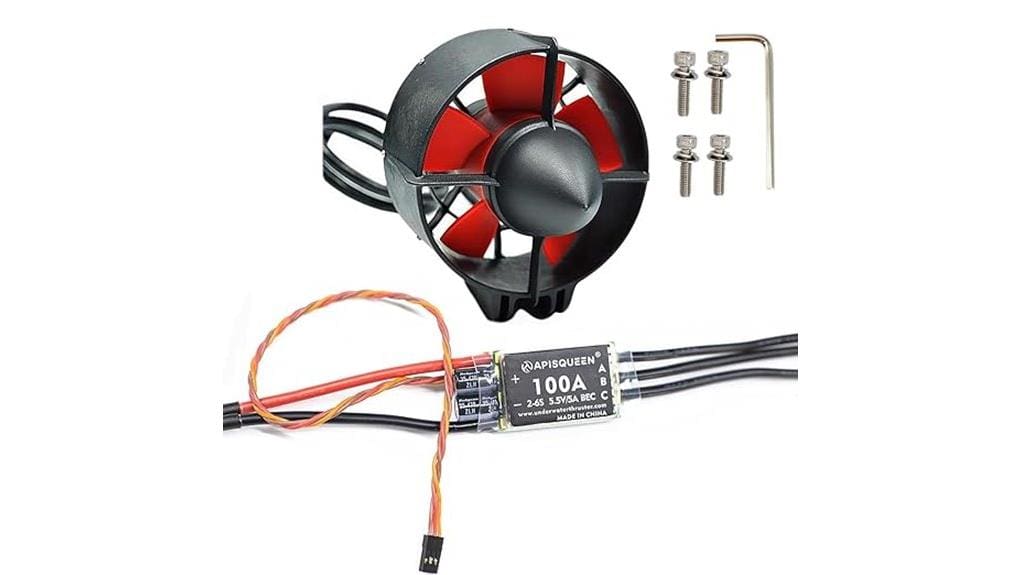
You’ll get a compact, waterproof 12–16 V U92 thruster delivering about 10.7 kg static thrust from a 300 KV brushless motor, paired with a mandatory 100 A bi-directional ESC for safe reverse and throttle control. It’s ideal for hull-mounted work, kayaks, or small ROVs when you use 3–4S LiPo packs, marine connectors, and proper mounting to avoid shaft misalignment and leaks. Expect heat at full throttle; continue for setup, thermal, and maintenance best practices.
Some Key Takeaways
- Produces peak static thrust ~10.7 kg (23.6 lb) per unit, suitable for kayaks, SUPs, inflatables, and small ROVs.
- Designed for 12–16 V (3–4S LiPo); avoid 24 V to prevent motor overload and overheating.
- Includes mandatory 100 A bi-directional ESC; requires PWM control and high-discharge LiPo batteries.
- Expect higher efficiency and lower heat at moderate throttle; full-throttle increases amp draw, cavitation, and temperature.
- Waterproof motor needs proper mounting, strain relief, drip loops, and regular O-ring and connector maintenance for reliability.
Performance and Thrust in Real Use
When you push the U92 12V 300KV thruster to its limits, expect up to 10.7 kg (23.6 lb) of static thrust per unit, driven by a waterproof brushless motor optimized for hull-mounted or ROV applications. You’ll gauge real use by systematic load testing to confirm thrust curves across throttle, map cavitation patterns at operating RPMs, and verify propeller balance to minimize vibration. You’ll watch the noise signature for stealth or comfort, adjusting mount and fairing to reduce broadband and tonal components. You’ll value reliable, repeatable data so you can deploy confidently and keep your craft free and fast.
Power, ESC, and Battery Requirements
After verifying thrust and vibration characteristics, you’ll need to match the U92’s electrical system to your power source and controller to get reliable, safe operation. You should use 12–16 V (3–4S LiPo) packs; avoid 24 V to prevent motor overload. Choose battery chemistry that delivers high discharge and low internal resistance for sustained thrust. The included 100 A bi-directional ESC is mandatory—it handles current and provides bidirectional control. Feed the ESC with standard pwm signaling from an RC transmitter or microcontroller. Monitor amp draw and temperature; make certain wiring and connectors match current ratings to preserve freedom of operation. For reliable field use, pair the thruster to high-quality marine batteries and consult current charts for planning and safety.
Installation and Waterproofing Tips
Because the thruster and ESC have different immersion limits, plan your mounting and cable routing to keep the ESC splash-proof but out of prolonged submersion while placing the U92 itself fully underwater. Mount the U92 on a rigid bracket that preserves shaft alignment; misalignment increases wear and leaks. Use marine-grade connectors and route cables with drip loops and strain relief to protect the ESC. Apply dielectric grease at connectors and inspect O-rings regularly for seal maintenance. Secure fasteners with threadlocker and cover exposed wiring with heat-shrink tubing. Test assembly in shallow water first, monitor for leaks, then proceed to full deployment. Also consider installing a small manual bilge pump for emergency water removal and regular maintenance checks.
Efficiency, Run Time, and Thermal Behavior
Although the U92 delivers a robust peak thrust of 10.7 kg, its electrical-to-propulsive efficiency and run time depend directly on battery voltage, propeller load, and duty cycle; you’ll see best efficiency on 12–16 V (3–4S LiPo) within moderate throttle ranges, while sustained full-throttle runs dramatically increase current draw and heat. You’ll get longer run time by cruising at partial throttle, minimizing cavitation and turbulent prop wash that waste power. Monitor battery aging—internal resistance rises, reducing available capacity and increasing heat. The ESC and motor run hot under heavy loads; allow cooling periods and avoid 24 V to prevent overload. Consider adding a strobe light for visibility and safety during low-light kayak outings.
Final Verdict and Who Should Buy the U92 12V 300KV Thruster
Understanding how the U92 performs under load and how heat and battery selection affect run time helps set realistic expectations for buyers. You’ll appreciate the U92 if you need compact, reliable thrust (10.7 kg) for kayaks, SUPs, inflatables, or ROVs and you’ll stick to 12–16 V LiPo setups with a 100 A bi-directional ESC and PWM control. It’s not for 24 V systems or users avoiding basic maintenance. Check maintenance schedules, monitor ESC immersion limits, and review user feedback for field reliability. If you value freedom, simple integration, and predictable performance, the U92 is a solid, mission-focused choice. Consider pairing it with orienteering compasses and other small-boat accessories to round out your kayak setup.
Some Questions Answered
Can the Thruster Rotate Clockwise (CW) Instead of CCW?
No — the U92 is CCW by design, but you can achieve reversible rotation via direction control: you’ll need a bi-directional 100 A ESC and proper PWM signals to command reverse. The motor itself is sealed CCW, so you’re relying on the ESC to invert phase/power to spin CW. Don’t run it at 24 V; follow 12–16 V limits, respect waterproofing, and guarantee the ESC isn’t submerged long-term.
Is a Propeller Included With the U92 Thruster?
No, a propeller isn’t included with the U92 thruster. You’ll receive the U92 12V CCW thruster, 100 A ESC and a screw; additional propeller options must be purchased separately. When selecting one, match shaft size, pitch and diameter to your platform and motor KV. Installation tips: secure propeller with correct fastener torque, verify CW/CCW compatibility, balance the blade, and test thrust at low power before full deployment.
Can I Use a 24V Battery With This Motor?
No — you shouldn’t use a 24V battery with this motor. Battery compatibility is 12–16V (3–4S LiPo); 24V risks motor overload and failure. Don’t attempt direct Voltage conversion to 24V. If you need higher system voltage for range or efficiency, use a proper DC-DC converter or redesign with a thruster rated for 24V, and make sure ESC, waterproofing, and control PWM match the new specs to keep operation reliable and safe.
Is the ESC Safe for Continuous Underwater Submersion?
No — you shouldn't continuously submerge the ESC. It’s splash-proof and nano waterproof for brief exposure, but it lacks waterproof certification and long-term immersion rating. You’ll need to guarantee robust thermal management and keep the ESC in a dry compartment or sealed enclosure with heat paths to avoid overheating. For freedom to operate underwater long-term, use a properly rated, fully potting-encapsulated ESC or external waterproof housing.
Does the Package Include Mounting Hardware and Brackets?
No, the package doesn't include mounting hardware or brackets. You'll get the U92 thruster, 100 A ESC, and a single screw only; mounting compatibility depends on your platform and you’ll need to supply custom brackets. Choose bracket materials for corrosion resistance (stainless steel or marine-grade aluminum) and guarantee hole patterns match the U92 flange. You'll design or buy mounts that accommodate the thruster's weight, thrust vector, and intended craft attachment points.