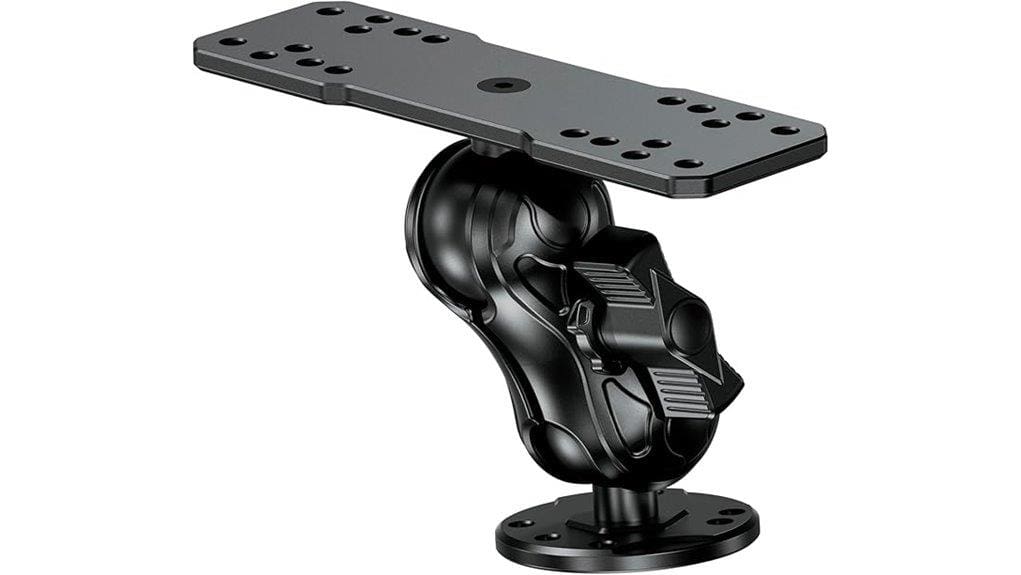

You’ll find this CNC‑machined 6061‑T6 aluminum mount gives you a rigid, corrosion‑resistant platform for 7"–12" fish finders, using a C‑size 1.5" ball and AMPS‑pattern plate for broad compatibility. The Grade III hard‑anodize and powder‑coated arm reduce pitting and galvanic issues versus raw metal, and the 3.5" double‑socket arm provides full 360° adjustment. It doesn’t include screws, so you’ll need marine fasteners and sealant. Continue for installation tips, compatibility checks, and tradeoffs.
Some Key Takeaways
- CNC‑machined 6061‑T6 aluminum construction offers superior strength and reduced failure points versus plastic mounts.
- Includes C‑size 1.5" TPU ball base, 3.5" double‑socket arm, and 6.25"×2" rectangular plate for AMPS compatibility.
- Grade III hard‑anodize and powder coat provide strong corrosion resistance for marine environments.
- No screws included—use marine‑grade stainless fasteners, sealant, and reinforce thin substrates during installation.
- Pros: 360° adjustability and low profile; cons: potential transducer cable crowding and need for periodic anodize/fastener checks.
Build vs. Buy: Why This Aluminum C-Size 1.5 Ball Mount Might Be the Right Choice
While you can cobble together generic components, choosing this CNC-machined 6061-T6 aluminum C-size 1.5" ball mount saves time and reduces failure points: it combines a pre-drilled, AMPS-pattern round base, a 3.5" double-socket arm with full 360° adjustment, and a versatile rectangular plate, all finished for marine environments and designed to accept common Garmin, Lowrance, Humminbird and Raymarine units—so you get a purpose-built, corrosion-resistant assembly that avoids fitment and strength issues typical of DIY setups. You’ll weigh DIY fabrication against a clear cost comparison: reduced installation hours, predictable strength, corrosion protection, and compatibility lower long-term risk. This is an ideal choice for kayakers and beginners looking for reliable mounting solutions with transducer arm compatibility.
What’s in the Box and Compatibility Checklist for Your Fish Finder or Chartplotter
Now that you've seen why an integrated, CNC-machined C-size 1.5" ball mount is often a better choice than a DIY assembly, let’s list exactly what comes in the box and how to check fit with your fish finder or chartplotter. Box contents: 2.5" round base (C size 1.5" TPU ball), 3.5" short double-socket arm, 6.25" x 2" rectangular mounting plate. No screws or hardware included. Device checklist: confirm AMPS or device hole pattern, device size (7"–12"), RAM C-size ball compatibility, and clearance for 360° arm rotation. Verify specific model fit against Garmin, Lowrance, Humminbird, Raymarine lists. This mount is especially useful for kayakers and beginners who want reliable, lightweight gear with proven compatibility and durability for small boats and paddlers looking to upgrade their setup with fish finder basics.
Strength, Corrosion Resistance, and Real‑World Durability for Marine Use
Evaluate the mount's material quality and finishes to judge long‑term strength and corrosion resistance under real marine conditions. You’ll find 6061‑T6 aluminum alloy for base and plate, CNC machined with Grade III hard anodize, and a powder‑coated arm; those choices resist pitting and galvanic attack better than untreated metals. Expect high static strength and predictable fatigue life, but monitor for marine fatigue in vibration‑rich installations. Insist on salt testing data or perform accelerated exposure checks; examine seams, fastener holes, and coating continuity. With proper maintenance the system delivers durable, freedom‑oriented service life in harsh saltwater environments. For sea kayakers and beginners, consider compatibility with common kayak accessories and mounting standards to ensure easy installation and use.
Installation Scenarios and Mounting Tips for Boats, Kayaks, and Flat Surfaces
Materials and coatings set the baseline for longevity, but proper installation determines everyday performance on boats, kayaks, and other flat surfaces. You’ll mount the round base or rectangular plate to clean, structural surfaces; use deck reinforcement where substrate is thin or flexes. For kayaks, position the base to avoid interference with a kayak transducer and routing of transducer cable. Pre-drill using the AMPS pattern, countersink fasteners, and use marine-grade stainless screws with sealant. Adjust the 3.5" double-socket arm for line-of-sight and vibration isolation. Torque hardware to spec, inspect seals periodically, and retorque after initial use. For best long-term results, choose mounts made from corrosion-resistant materials used by kayak enthusiasts like aluminum alloy that balance weight and strength.
Pros, Cons, and Comparable Alternatives to Consider Before You Buy
Although the mount’s CNC-machined 6061-T6 aluminum components and ball-and-socket arm deliver strong, corrosion-resistant support for a wide range of fish finders, you should weigh specific tradeoffs: it offers excellent rigidity and 360° adjustability but lacks included fasteners and may require deck reinforcement or custom hardware for some kayak installations. Pros: robust anodized parts, AMPS-compatible base, low-profile footprint, minimal impact on battery life when mounted. Cons: no screws, potential screen glare depending on placement, possible signal interference if transducer cabling is crowded, and a predictable maintenance schedule for anodize and fastener checks. Alternatives: composite RAM-style, stainless steel, or low-cost plastic mounts. Consider choosing mounts made of aluminum alloy for long-term corrosion resistance and strength.
Some Questions Answered
Will This Mount Interfere With Sonar Transducer Signals?
No — you won’t see meaningful signal attenuation from this mount if you maintain proper installation clearance. The aluminum components sit above the device and won’t block sonar beams when the transducer has unobstructed water access. You should position the transducer with recommended clearance from metal, avoid placing the plate directly in the sonar path, and use correct mounting height. Proper installation preserves full sonar performance and minimizes any attenuation risk.
Can I Use a Different Size RAM Ball With an Adapter?
Yes — you can use a different size RAM ball with ball adapters, provided the adapter matches the C size 1.5" TPU ball on this mount. You’ll need alternative hardware rated for marine use and compatible thread/ball standards. Installors should verify fit, load capacity, and corrosion resistance; test full rotation and locking under operational loads. Using adapters gives freedom to mix components, but prioritize secure clamping and proper torque for safety.
Are There Any Warranty or Return Policy Details?
There’s typically a limited warranty covering manufacturing defects for a defined period; check seller terms for exact duration. You’re expected to inspect on receipt and report issues promptly. Returns are allowed within the stated return window if items are unused and complete, though screws/hardware omission won’t qualify as missing parts. You’ll need proof of purchase and may be responsible for return shipping unless defect is confirmed by the seller.
Can I Paint or Customize the Anodized Finish?
Yes — you can paint the anodized finish, but it needs proper surface preparation. You'll sand the hard anodized layer lightly, de-grease, and apply a self-etching primer designed for aluminum to guarantee adhesion. Use marine-grade paint or powder coat for durability; powder coat requires professional equipment. Color customization is allowed, but be aware you’ll void corrosion warranties and must maintain coatings for long-term marine exposure.
Is Vibration Isolation or Damping Included or Available?
No — vibration isolation or damping isn't built in. You can add rubber isolation pads between the round base or rectangular plate and your mounting surface, and fit aftermarket spring dampening adapters on the arm's ball joints if you want extra shock control. You'll retain full adjustability while reducing vibration; choose marine-grade rubber and corrosion-resistant spring dampers rated for RAM C size 1.5" ball systems for reliable, freedom-preserving performance.