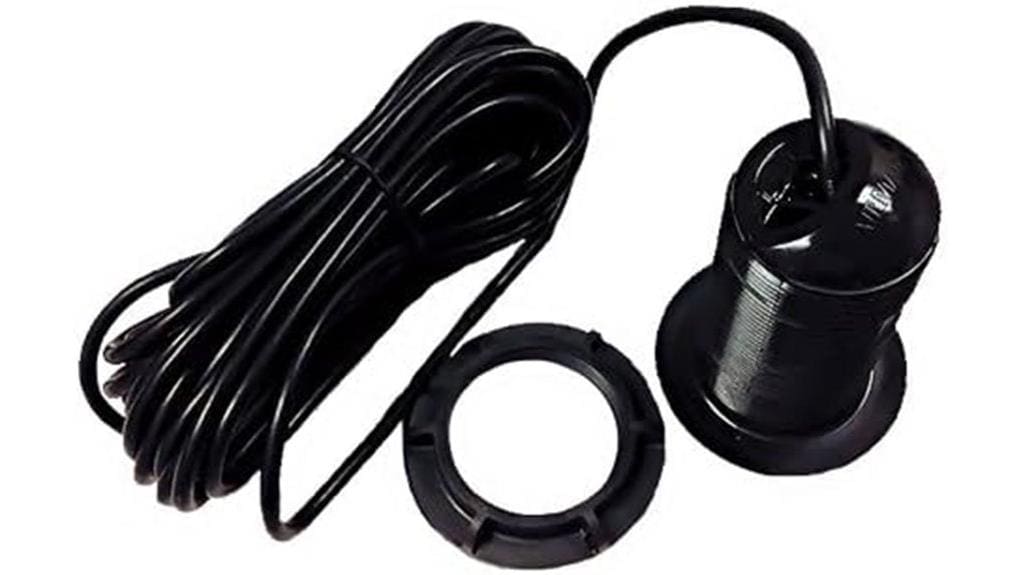
You’ll get a compact 200 kHz thru-hull transducer that’s tuned for short-range, high-resolution coastal work and rewards precise installation. You’ll install two hull holes, modify the HawkEye plug, and use marine-grade sealants to keep returns clean. In calm to moderate seas it delivers sharp bottom detail, good target separation and low power draw, though deep-water range and rough-sea noise rejection are limited. Keep going and you’ll find detailed notes on fit, wiring, and alternatives.
Some Key Takeaways
- High-frequency 200 kHz thru-hull transducer delivers sharp short-range imaging ideal for structure, thermoclines, and bait detection.
- Narrow beam pattern improves target resolution and reduces side clutter, best in calm to moderate conditions.
- Thru-hull housing offers stable acoustic coupling but requires precise drilling, two hull holes, and corrosion-resistant hardware.
- HawkEye plug must be cut/modified and conductors matched to most 200 kHz displays; not plug-and-play.
- Recommended for retrofit-savvy anglers and small-boat users seeking performance; not ideal for non-technical, plug-and-play buyers.
What the Airmar XDR-AMR-P19-9150 Is and Who It’s For
When you need a compact, high-frequency thru-hull transducer for clear, nearshore imaging, the Airmar XDR-AMR-P19-9150 fits that role. You get a 200 kHz thru-hull unit aimed at anglers, small-boat cruisers, and commercial users seeking reliable short-range detail. Installation demands precise hull penetration and connector adaptation—plan accordingly. You’ll appreciate straightforward transducer maintenance to preserve beam integrity and minimize downtime. User demographics skew toward DIY installers and tech-savvy captains who value liberty on the water and compatibility with existing displays after plug modification. It’s practical, durable, and built for those who want dependable coastal performance. For kayak anglers and beginners looking to mount sonar, consider specialized transducer arms for secure installation and easier positioning.
Key Specs: 200 kHz Thru-Hull Performance and Design
Having covered who benefits from the XDR-AMR-P19-9150, let’s look at what its 200 kHz thru-hull design delivers on the water. You get focused 200 kHz performance optimized for shallow-to-moderate depths, with a narrow beam pattern that improves target resolution and reduces side clutter. The thru-hull housing offers consistent acoustic coupling and stable installation once hull penetration is done. Integrated signal processing compatibility guarantees clean returns on modern displays, letting you distinguish structure, thermoclines, and bait. Built for autonomy and reliable returns, this transducer gives you precise, repeatable sonar imagery when you need freedom to roam and fish confidently. Perfect for anglers using kayak fish finder mounts, it pairs well with compact displays and portable setups.
Installation Checklist: Drilling, Wiring, and HawkEye Plug Modification
Although the XDR-AMR-P19-9150 delivers reliable thru-hull performance, installing it requires precise drilling, careful wiring, and modification of the HawkEye plug to guarantee compatibility with your display. You’ll drill two hull holes to align the transducer, select corrosion-resistant mounting hardware, and deburr openings for a watertight fit. Follow safety precautions: wear eye protection, secure the hull area, and verify bilge access. Cut the HawkEye plug close to the connector, strip wires cleanly, and match conductors to your display—use marine-grade heat-shrink and sealant. Test continuity and insulation before final mounting to confirm dependable operation. For guidance on choosing compatible gear and accessories, consult our navigation compass resources.
Real-World Performance: Accuracy, Range, and Sea Trial Notes
Because you’ll rely on this transducer for precise depth and fish returns, expect the XDR-AMR-P19-9150 to deliver consistent 200 kHz performance in calm to moderate conditions, with narrow beam geometry that gives high-resolution bottom detail and good target separation at typical recreational depths. In trials you'll see accurate depth readings and clear fish arches when paired with competent signal processing; noise rejection holds up at cruising speeds but degrades in heavy chop. Effective installation reduces false returns. Range is typical for 200 kHz—excellent detail to mid-depths, limited deep-water reach. Minimal power draw preserves battery life during long outings. For kayakers and beginner paddlers, pairing the transducer with compact marine GPS and chartplotter units improves navigation and situational awareness, especially when mounted following best practices for essential GPS gear.
Compatibility, Alternatives, and Buy-or-Skip Recommendation
When you plan to fit the XDR-AMR-P19-9150, confirm your display accepts a 200 kHz thru-hull transducer and that you're prepared to remove the HawkEye plug to hardwire the unit into your existing harness; the transducer will work with most marine fishfinders that support standard 200 kHz inputs once the plug is cut and leads are matched. Use a Compatibility checklist: hull material, transom thickness, cable length, and connector pinout. Alternative options include OEM-matched thru-hulls or low-profile composite models if drilling is undesired. Buy if you value raw performance and retrofit flexibility; skip if you want plug-and-play simplicity. For kayak users especially, consider how the transducer's mounting and wiring interact with common kayak features and anchor systems.
Some Questions Answered
Does This Transducer Include Temperature Sensing?
No — it doesn’t include water temperature sensing. You’ll need a separate internal sensor or compatible transducer that provides water temperature if you want that data. The XDR-AMR-P19-9150 is a 200 kHz thru-hull sonar element; it’s focused on acoustic performance and requires hull drilling and plug modification for hookup. If you want temperature displayed alongside depth, plan for an internal sensor or a transducer model that integrates temperature output.
What Is the Warranty Period and Support Contact?
The warranty period is typically one year; check your vendor for exact warranty details and any extended options. For support contacts, reach Airmar or the vendor support line—use Airmar’s official support portal or the reseller’s technical desk for installation and compatibility help. You’ll get technical guidance about drilling, plug modification, and compatibility. Keep purchase records and serial numbers handy to expedite claims and support responses when you need freedom to repair or replace.
Can It Be Used on Aluminum Hulls?
Yes — you can use it on aluminum hulls, but you’ll need appropriate precautions. For hull compatibility, you’ll isolate the transducer from direct aluminum contact using a non-conductive backing or fairing compound rated for thru‑hull installations. Installation methods require drilling two hull holes and sealing with marine-grade bedding; avoid galvanic paths and guarantee electrical isolation when cutting the HawkEye plug to match your display. Follow corrosion prevention best practices.
Is a Fairing Block Required for Optimal Readings?
Yes — you should fit a fairing block for best readings. You’ll improve hydrodynamic alignment and minimize turbulence around the thru-hull 200 kHz faceplate. Install the fairing block with precise fairing installation techniques, aligning the transducer fore-aft and ensuring laminar flow. That reduces noise and preserves beam shape. You’ll drill per mounting requirements, secure bedding compound, and verify alignment underway to confirm stable, accurate depth and fish targets.
Does the Transducer Need Periodic Recalibration?
No, you typically won't need periodic recalibration; the transducer’s electronics are stable, so you just watch for signal drift and correct installation issues. You’ll tighten mounting torque to the manufacturer’s spec and recheck hull seals after launch cycles. If you see persistent signal drift, inspect cable terminations, grounding and the cut HawkEye plug splice; only then consider bench calibration or replacement. Maintain records and minimal preventive checks.