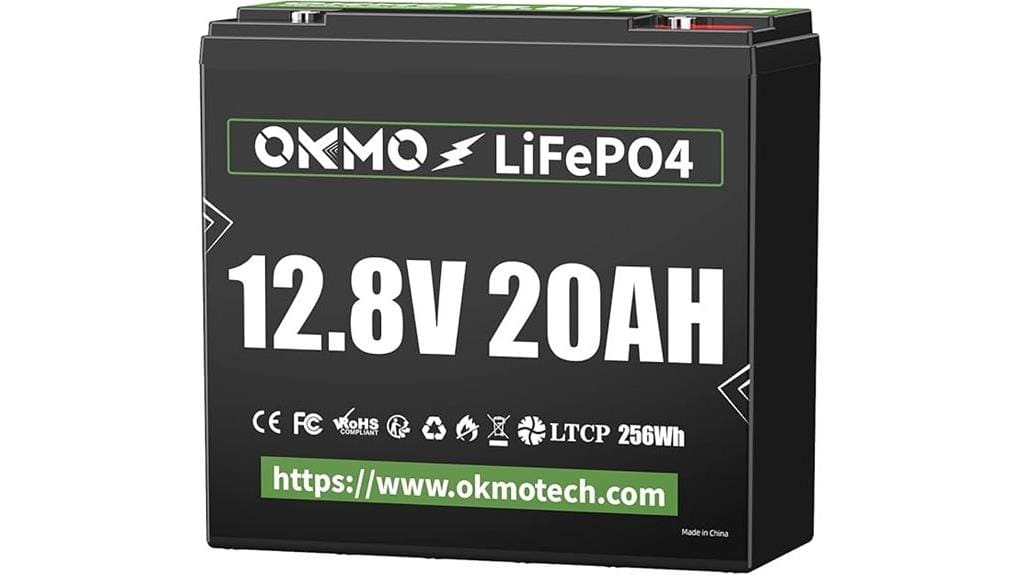

You’ll get a reliable 12V 20Ah LiFePO4 pack that delivers about 20Ah usable capacity, low internal resistance, and stable voltage under load while weighing roughly 5.7 lb. The integrated 20A BMS provides overcharge, over-discharge, overcurrent and temperature protection plus cell balancing. Expect roughly 4,000–5,000 cycles with minimal capacity loss, making it a lightweight, long‑life alternative to lead‑acid for scooters, solar, RVs and portable gear — keep going to see sizing, wiring and application tips.
Some Key Takeaways
- True usable capacity is about 20 Ah at 12 V, with consistent delivery due to LiFePO4 chemistry and built-in BMS.
- Weight ~5.7 lb makes it noticeably lighter and more portable than equivalent lead‑acid packs.
- Integrated 20 A BMS provides overcharge, over‑discharge, overcurrent, short‑circuit, and temperature protection.
- Expected cycle life ~4,000–5,000+ cycles, offering much lower lifetime cost than lead‑acid alternatives.
- Suitable for scooters, kayaks, RV backup, and small solar systems; size and wiring must match peak currents and fuses.
What 12V 20Ah LiFePO4 Batteries Actually Deliver (Capacity, Weight, and Cycle Life)
While specs say 12V 20Ah, you’ll actually get a stable 20 amp-hours of usable capacity thanks to LiFePO4 chemistry and a built-in BMS that prevents harmful deep discharge; the cell design and management let the pack deliver consistent voltage under load so rated capacity is reliable. You’ll see actual capacity close to spec in tested discharge profiles. Gravimetric energy and pack density favor portability—about 5.7 pounds—so practical runtime per kilogram is strong. Expect real world cycles of 4000–5000+ with minimal expected degradation versus lead‑acid. Data-driven users gain predictable runtime, repeatable performance, and modular expandability.
Battery Safety, Longevity, and Built‑In Protection (LiFePO4 Advantages + 20A BMS)
Having established that a 12V 20Ah LiFePO4 pack reliably delivers its rated capacity and thousands of cycles, you should next examine how the chemistry and onboard electronics protect that performance over time. LiFePO4 cells inherently resist thermal runaway; their iron-phosphate structure prevents chain reactions common in other chemistries. The integrated 20A BMS enforces overcharge, deep-discharge, overcurrent, short-circuit, and temperature cutoffs, extending usable life to 4,000–5,000 cycles versus lead‑acid. Active cell balancing equalizes cell voltages during charge, preventing capacity drift. Together these features give you a compact, low‑weight pack that’s safe, reliable, and freedom‑friendly for varied deployments.
Performance in Real Uses : Scooters, RVs, Solar, Kayaks, and Toys
Frequently, a 12V 20Ah LiFePO4 pack delivers predictable, high-efficiency performance across scooters, RV systems, solar setups, kayaks, and toys because its 20A BMS and low internal resistance support sustained discharge currents and rapid recharge with minimal voltage sag. You’ll see scooter range improvements versus lead-acid, consistent toy performance under repeated loads, and reliable RV cold start capability even after storage. In solar load management it maintains stable voltage for inverters and charge controllers. Kayak mounting benefits from the 5.7 lb weight and secure mounting points. Portable charging becomes practical for off-grid freedom and short recharge turnarounds. These batteries are especially useful for GPS backup applications for kayakers and beginners.
How to Size, Connect, and Expand (Series/Parallel, Charging, and Installation Tips)
Because capacity, voltage, and discharge current determine real-world performance, you should size and wire 12V 20Ah LiFePO4 packs based on load current, desired runtime, and system voltage requirements. Calculate amps = watts/12V, then multiply by hours for Ah needed; parallel cells to increase capacity, series to raise voltage. Use appropriate wire gauge for peak current and place fuses per string—fuse sizing equals max continuous current ×1.25. Match terminal types for low-resistance connections and secure cells with mounting brackets. Use balancing chargers for multi‑battery banks to prevent imbalance and monitor voltage sag under load to avoid overdraw.
Price vs Value : Who Should Buy This Battery and Alternative Options
Sizing and wiring choices you make directly affect total system cost and long‑term value, so weigh upfront price against lifecycle metrics when choosing a 12V 20Ah LiFePO4 pack. You’ll assess a clear cost breakdown: higher initial price vs ~4,000–5,000 cycles, ~5.7 lb portability, integrated 20A BMS, and low maintenance. Buyer profiles: mobile users (scooters, kayaks), off‑grid campers, and makers who prioritize weight, safety, and expandability benefit most. If budget constrained, consider sealed AGM for low upfront cost or larger Ah LiFePO4 for fewer units. Match lifecycle cost to your freedom‑driven use case. This pack is ideal for waterborne users who need reliable, lightweight emergency power with an emphasis on safety and portability.
Some Questions Answered
Does This Battery Come With a Warranty and How Long Is It?
Yes — you get a warranty; the warranty length is typically 1–3 years depending on seller, and it covers manufacturing defects under clear service terms. You’ll want to check the specific listing for exact duration, claim procedure, and exclusions. The service terms usually require proof of purchase, proper installation, and adherence to specified charge/discharge parameters. Follow those guidelines to preserve coverage and maximize the battery’s long cycle life and reliability.
What Are the Exact Physical Dimensions for Tight Mounting Spaces?
The exact physical dimensions are 7.6 x 5.2 x 3.3 inches, so you can plan for a compact footprint in tight mounting spaces. You’ll appreciate that the 5.7 lb unit accepts standard mounting brackets and clears terminal access for easy wiring. Use those dimensions to verify clearance, airflow, and vibration isolation. If you need series/parallel expansion, account for extra space around each pack for brackets and cable routing.
Can I Use It Indoors Without Ventilation or Special Precautions?
Yes—you can use it indoors without ventilation or special precautions. LiFePO4 chemistry has negligible off-gassing and very low thermal runaway risk, so indoor storage and regular operation don't require forced ventilation. You should still follow basic safety: avoid mechanical damage, keep it dry, and use the built-in 20A BMS. Ignore ventilation myths; they overstate risk. For long-term safety, store at ~50% SOC in a cool, dry place.
Are There Recommended Chargers or Brands for Optimal Performance?
Use chargers with LiFePO4 profiles and 14.4–14.6V float cutoffs; Victron Smart and Renogy DC/DC units meet that spec and work well. You’ll want a charger with 20A or lower current for single 20Ah cells, BMS-compatible charge termination, and temperature compensation. Victron Smart offers app monitoring and precise voltage control; Renogy DC/DC gives rugged, off-grid charging. You’ll enjoy reliable cycles, safe charging, and expandable system flexibility.
How Do I Properly Dispose of or Recycle This Lifepo4 Battery?
You should never treat battery recycling like hazardous disposal in regular trash; take the battery to an authorized recycler or hazardous waste facility. Check manufacturer take-back programs, local e-waste centers, or retailers offering lithium battery recycling. Before drop-off, isolate terminals, tape them, and store in a cool, non-flammable container. Document serials and origin if required. Proper recycling recovers materials, prevents contamination, and complies with transport and environmental regulations.


