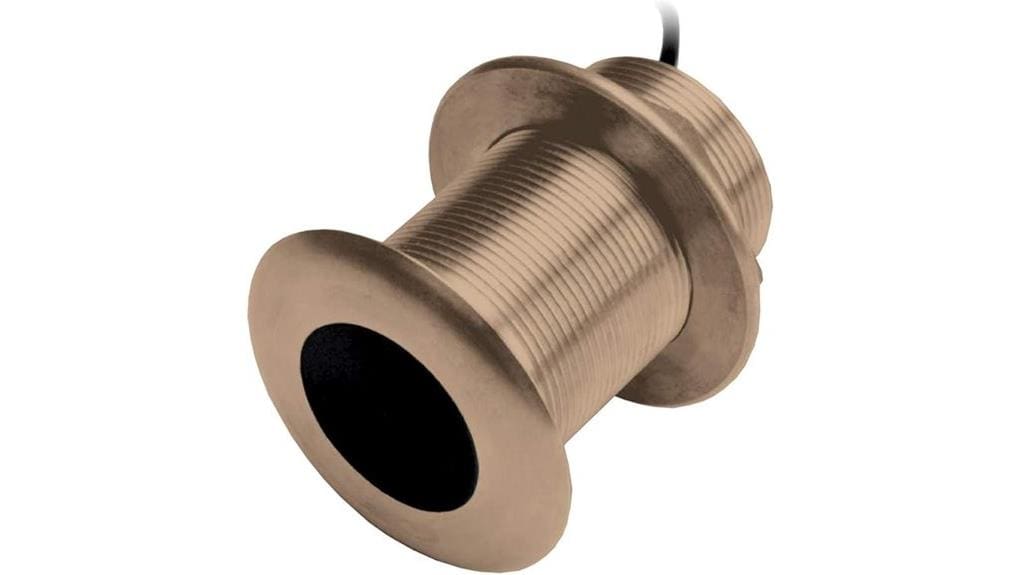

You’ll get a rugged bronze CHIRP thru‑hull tuned 95–155 kHz with 300 W output and a fixed 20° tilt that’s optimized for 16°–24° deadrise hulls. It delivers reliable depth to ~600 ft, cleaner bottom returns, and improved target separation versus single‑frequency units. Installation needs careful fairing, bed sealing, and corrosion isolation, and the 8‑pin lead requires display compatibility. It’s a solid mid‑range choice for anglers and cruisers — keep going and you’ll find installation tips and tradeoffs.
Some Key Takeaways
- Bronze thru‑hull CHIRP transducer with 95–155 kHz sweep offers reliable depth and target separation to about 600 ft.
- Fixed 20° tilt and 26°/17° beamwidths optimize bottom returns on hulls with 16°–24° deadrise.
- 300 W nominal power delivers entry‑level performance—better than single‑frequency units but below high‑end arrays.
- Requires careful thru‑hull installation, corrosion isolation, and regular maintenance due to bronze construction.
- Best for recreational anglers and small‑craft owners wanting durable, straightforward CHIRP sonar without advanced beam flexibility.
What the Garmin Airmar B150M Is and Who It’s For
The Garmin Airmar B150M is a bronze thru-hull CHIRP transducer designed for recreational boaters who need reliable depth and target separation down to about 600 ft. You’ll get an entry-level, 8-pin, 300 W sonar suited for fishing and navigation where clarity and simplicity matter. You can mount it in hulls with 16°–24° deadrise using the 20° tilt to optimize beam aiming. You’ll appreciate rugged bronze construction but must follow maintenance tips to prevent mounting corrosion and preserve signal integrity. It’s for operators who want dependable depth returns, straightforward installation, and freedom to focus on time on the water. Many kayakers and beginners consult guides on transducer arms to choose the right mounting setup for small boats.
Key Specs That Matter: Frequency, CHIRP Power, Beamwidth, and 20° Tilt
Because sonar performance hinges on a few core parameters, you should focus on frequency, CHIRP power, beamwidth, and the 20° tilt when evaluating the B150M. The 95–155 kHz CHIRP sweep and 300 W entry-level power give you balanced range and resolution; signal processing extracts targets without excessive power draw. Beamwidth (26°/17°) shapes coverage versus detail—narrower for precision, wider for area. The fixed 20° tilt optimizes contact on deadrise hulls, improving bottom returns. Good noise rejection depends on proper installation; follow installation tips, use supplied mounting hardware, and seal the thru-hull to maintain consistent performance. Essential GPS gear like marine GPS units complements sonar for safe, confident navigation.
Real-World Performance: Depth, Target Separation, and Fishing vs. Navigation
While you’ll get reliable depth readings down to about 600 ft with the B150M’s 95–155 kHz CHIRP and 300 W rating, its real-world value shows up in how it balances depth range with target definition for different tasks. You’ll notice consistent depth accuracy in varied water columns; returns remain stable as you move from shallow structure to deeper channels. For fishing, the narrower beam and CHIRP improve fish recognition and target separation over single-frequency units, letting you distinguish bait balls and individual targets. For navigation, the unit gives clean bottom returns and minimal noise, aiding safe waypoint passage. This makes the transducer a strong choice for kayakers and beginners looking for dependable gear with kayak-friendly installation and performance.
Installation and Compatibility: Bronze Thru‑Hull Mounting, Deadrise Limits, and Display Hookups
If you plan to install the B150M as a bronze thru‑hull unit, confirm your hull’s deadrise falls within the 16°–24° range and that you can access the hull interior for secure backing and fairing. You’ll drill, bed, and fasten bronze hardware per instructions to minimize bronze corrosion risk; use proper sealant and isolate dissimilar metals. The 8‑pin CHIRP lead requires checking wiring compatibility with your display and power source — verify pinouts, voltage, and connector types before purchase. Route and strain‑relieve cable cleanly through bilge space. If you want autonomy, plan installation to allow future swaps or servicing. Also consider whether your kayak or small craft will accommodate a deck-mount pump and the thru-hull installation procedure before committing to bronze hardware.
Buy vs. Alternatives: Value, Common Tradeoffs, and When to Choose the B150M
When weighing the B150M against alternatives, consider that its bronze thru‑hull design, 20° tilt and 8‑pin CHIRP profile target recreational anglers who need reliable mid‑range performance without premium pricing. You get solid target separation to ~600 ft, simple thru‑hull installation, and broad display compatibility. In a cost comparison, it undercuts high‑end ceramic or multi‑element CHIRP arrays while beating basic single‑frequency units on clarity. Tradeoffs include heavier installation, limited beam pattern flexibility, and modest peak power. Choose the B150M when you want durable, low‑hassle sonar with predictable performance and manageable long term maintenance. Our site also offers complementary gear and advice for kayak anchor systems to help you set up and stabilize your boat for better sonar readings and angling success, including product picks and tips for anchor systems.
Some Questions Answered
Is the B150M Compatible With Non-Garmin Fishfinder Heads?
Yes — the B150M can work with non‑Garmin fishfinder heads if the unit supports the same electrical protocol compatibility and CHIRP frequency range. You'll need the correct 8‑pin wiring adapter or cable and should check for signal attenuation over any adapter or long runs. Verify the third‑party display accepts 95–155 kHz CHIRP, 300 W input and 8‑pin pinout to avoid mismatches and degraded sonar performance.
Can I Repaint the Bronze Housing Without Voiding Warranty?
No — repainting the bronze housing can void the paint warranty and may be considered a cosmetic alteration that affects coverage. You’re free to customize, but altering the factory finish can hide defects, interfere with seals, or breach warranty terms. If you want a different look, contact Garmin support first, request written permission, or use removable coverings. That preserves warranty rights while letting you maintain freedom to personalize safely.
How Does Prolonged Saltwater Exposure Affect the Bronze Over Time?
Prolonged saltwater exposure will darken and roughen the bronze as patina formation occurs; you'll see a protective layer that can mask the metal beneath. If dissimilar metals or stray currents are present, galvanic corrosion can attack fasteners or the housing, accelerating pitting and material loss. You should inspect regularly, use appropriate sacrificial anodes, maintain electrical isolation, and rinse with fresh water after use to preserve integrity and freedom to cruise.
Are Replacement Parts (Anodes/Gaskets) Readily Available?
Yes — spare anodes and gasket kits are generally available from marine suppliers and Garmin/Airmar dealers. You can source sacrificial anodes sized for the B150M and aftermarket gasket kits for thru-hull installations. Order OEM parts for best fit; aftermarket parts work if dimensions match. Keep replacement anodes current to prevent galvanic corrosion and replace gaskets whenever you haul the boat to maintain watertight integrity and freedom to operate confidently.
Does the Transducer Support NMEA Networking or Wireless Updates?
No — it doesn’t provide direct NMEA compatibility or built‑in wireless updates. You’ll connect the B150M via an 8‑pin sonar cable to a compatible Garmin head unit that handles NMEA data and networking. Wireless updates or NMEA over Wi‑Fi must be managed by the display unit or external gateway. You’re free to integrate it into modern systems, but rely on the chartplotter/gateway for NMEA compatibility and Wireless updates.