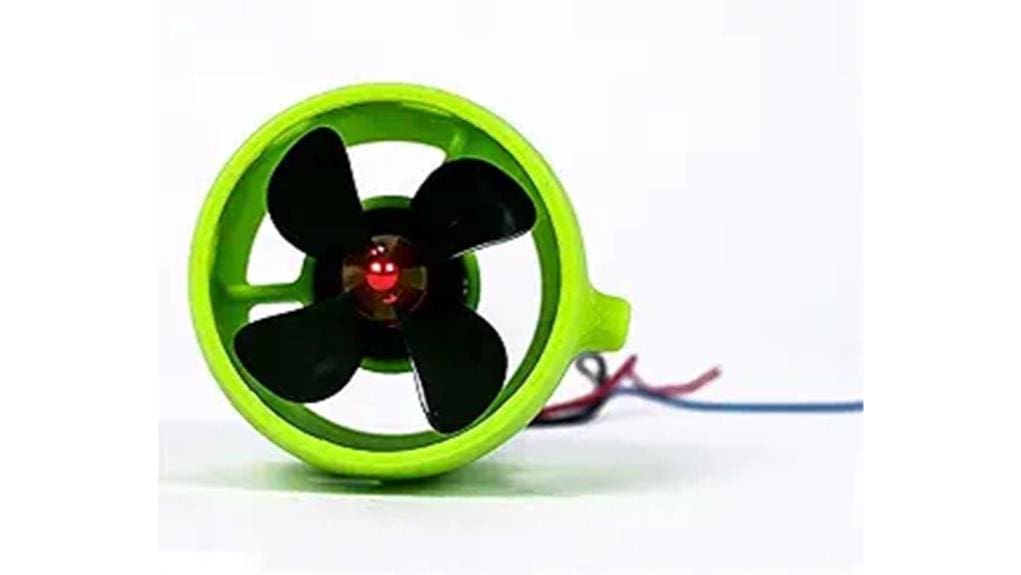

You’ll get a compact, serviceable thruster that runs on 12–24V, draws up to 20A, and delivers predictable mid‑range thrust with efficient RPM-to-thrust mapping; it’s tuned for steady low‑speed torque and will taper at high power as cavitation and flow separation occur. Construction uses corrosion‑resistant fasteners, molded nozzle protection, and waterproof potting for reliability, but sustained max loads can overheat the motor/ESC. It suits ROVs, small craft, and hobby projects—keep wiring, cooling, and mounts optimized for best results and more specifics follow.
Some Key Takeaways
- Compact 12–24V thruster draws up to 20A, delivering 30–200W suitable for small craft and ROV propulsion.
- Near-linear thrust increase at low-to-mid power, tapering as cavitation and flow separation occur at higher RPMs.
- Monitor RPM and duty cycle to avoid overheating; sustained max power raises motor and ESC temperatures.
- Robust eco-composite housing, molded nozzle, stainless fasteners, and sealed motor offer good waterproofing and corrosion resistance.
- Recommend 12–14 AWG wiring under 3 m, fuse near battery just above 20A, and vibration-isolating mounts for reliable installation.
Performance and Power: Real-World Thrust, RPM, and Efficiency for 30–200W Loads
When you run this 12–24V, 20A thruster across its 30–200W range, expect the propeller/nozzle combination to convert electrical input into high, focused thrust with relatively efficient hydrodynamic performance; you’ll measure thrust mapping that shows near-linear thrust gain up to mid-range power, then tapering as cavitation and flow separation rise. You’ll monitor RPM closely, correlating speed to delivered thrust and electrical draw. Pay attention to thermal behavior: sustained high-power runs raise motor and ESC temps, so duty cycles matter. You’ll optimize for freedom of operation by balancing power, RPM, and cooling to maintain consistent, reliable propulsion. For beginners using drop-stitch kayaks, consider mounting and ESC protection to preserve structural integrity and ensure safe, durable installation.
Build, Durability, and Waterproofing: Materials, Construction, Nozzle, and 4‑Blade Prop
Having covered how power, RPM, and thermal limits affect thrust, you’ll next look at how the thruster’s build and materials sustain that performance in real conditions. You’ll find a compact, fine-workmanship assembly using eco-friendly composites and stainless fasteners to maximize corrosion resistance while keeping weight low. The molded nozzle channels flow, boosting thrust and protecting the four-blade prop from impacts and entanglement. Seals and potting around the motor provide robust waterproofing; service points remain accessible. Expect a predictable acoustic signature thanks to balanced blades and rigid mounting, so you can operate freely without noisy, vibration-driven penalties. These features make the unit suitable for paddlers who need reliable auxiliary propulsion and simple integration with other rescue pulley gear.
Installation and Compatibility: Wiring (12V–24V, 20A), CCW Rotation, and Mounting Tips
Get your wiring and mounting right to guarantee reliable operation: this thruster runs on 12–24V and draws up to 20A, so size your supply wiring to limit voltage drop (recommend 12–14 AWG for runs under 3 m at 12V) and fuse the circuit near the battery at a rating just above 20A. Route power and signal cables separately, secure with clamps, and avoid sharp bends; proper wire routing reduces interference and wear. Confirm counterclockwise (CCW) rotation before installing. Use robust mounting brackets, isolate vibrations with rubber pads, align nozzle and propeller for free flow, and torque fasteners to spec. Pack an essential repair kit with spare propellers, seals, and basic tools to handle common field repairs and keep your kayak operational repair kits.
Use Cases and Suitability: Propulsion, Towing, Bait-Tug and Pull-Net Boats, and Hobby vs Practical Applications
Because this thruster delivers 30–200W at 12–24V with a CCW propeller and up to 20A draw, you can rely on it for a range of propulsion and towing tasks where compact, durable thrust is required. You’ll use it to propel ROVs, small lifeboats, and RC models or to tow bait-tug and pull-net rigs needing steady low-speed torque. For hobby builds you’ll appreciate compactness and simple wiring; for practical workboats you’ll value reliability and serviceability. Follow maintenance tips: flush, inspect seals, check mounts. Expect moderate acoustic signature; implement noise reduction via rubber mounts and fairing. Convertible paddling pants are useful for kayakers who want versatile gear that transitions between paddling and shore activities, offering quick-drying fabrics and adjustable convertibility to suit different conditions.
Buying Recommendation and Troubleshooting: Who Should Buy, Price/Value, Common Issues, and Seller Support
While it's compact and rated for 12–24V at up to 20A, this thruster is best for users who need a durable, mid-power propulsion solution—hobbyists building ROVs or RC boats, and operators of small bait-tug, pull-net, or auxiliary workboats requiring steady low-speed torque will get the most value. You’ll appreciate its power-to-size ratio and simple integration. Price/value favors DIY and small commercial projects; check customer reviews for real-world reliability and seller responsiveness. Common issues: overheating under continuous max load, shaft corrosion if seals fail, and connector wear. Confirm warranty details and contact seller promptly for parts or guidance. Consider pairing this thruster with appropriate personal flotation gear and a locator device when using it on small vessels to improve safety and recoverability.
Some Questions Answered
Is There a Warranty Period and What Does It Cover?
Yes — you get a limited warranty covering manufacturing defects for a set period; check the seller for exact duration. It covers motor and workmanship faults and includes corrosion coverage for unexpected material failures, not damage from misuse, improper installation, or normal wear. You’ll need proof of purchase and to contact the seller promptly for claims. They’ll advise repair, replacement, or refund per the warranty terms and limitations.
What Replacement Parts Are Available and Where to Buy Them?
You can get shaft seals, carbon brushes, propellers, nozzles, and mounting kits as replacements from the seller or specialized marine/ROV parts suppliers. Order directly from the vendor for matched parts and fast support, or buy from RC/marine shops and online marketplaces (AliExpress, eBay, Amazon) for wider options. You’ll want genuine or OEM-equivalent seals and brushes to maintain waterproofing and motor life; contact the seller for exact part numbers and fitment.
Can This Motor Be Used With a Brushless ESC?
Yes — you can use a brushless ESC if the motor is brushless-compatible and the ESC supports 12–24V and ~20A continuous current. You'll integrate sensor integration (e.g., hall sensors) only if both motor and ESC support them; otherwise use sensorless mode. Configure software control parameters (throttle curve, braking, timing) to match propeller load. Test in a controlled setup, monitor temps and current, and keep firmware tuned for reliable, free-range operation.
What Are the Noise and Vibration Levels Underwater?
Underwater noise and vibration are moderate; you’ll hear a focused acoustic signature from the propeller/nozzle combination, especially at higher RPMs. You should expect measurable vibration transmitted to your hull or frame, but compact construction and fine workmanship help limit it. Apply vibration damping mounts and isolation pads to reduce structure-borne noise and broaden usable speed range. For stealthy tasks, run at lower thrust and monitor acoustic signature with a hydrophone.
Are There Recommended Spare Propellers or Nozzles?
Yes — you should keep spare propellers and consider nozzle options for different tasks. Carry matched spare propellers sized to the original four-blade design to preserve thrust and balance. For nozzle options, choose a full shroud for protection and efficiency or a partial nozzle for improved maneuverability. Store spares, inspect for wear, and swap damaged parts promptly to maintain performance and reduce downtime while you operate freely.