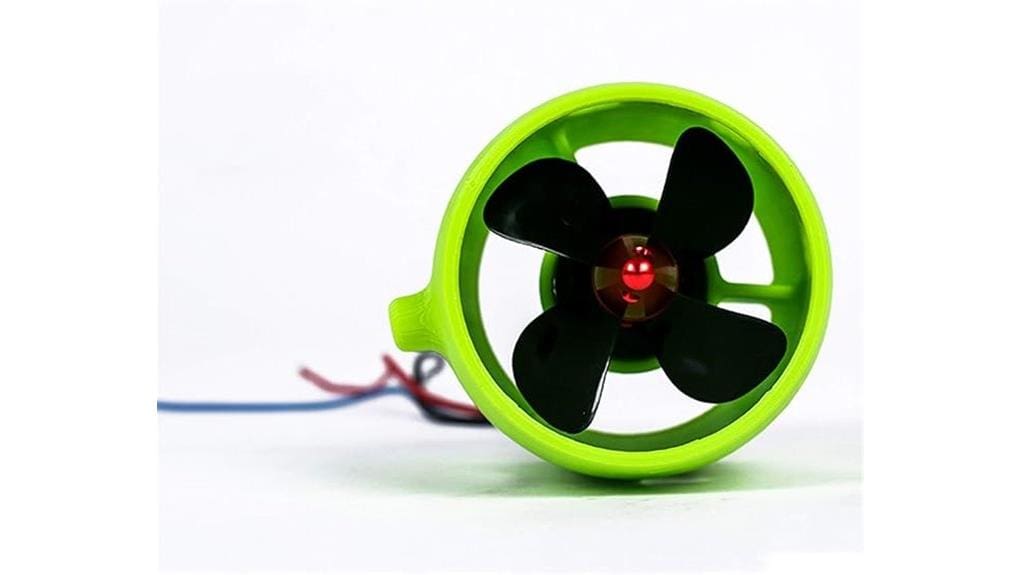

You’ll get a compact, serviceable 12–24V thruster that draws about 20A and delivers focused low‑end thrust rather than top speed. It uses a 4‑blade nozzle and gear reduction for efficient, low‑cavitation operation, with a metal body that’s easy to mount and service. Expect roughly 200W peak, predictable static thrust, moderate broadband noise, and the need for robust waterproof connectors and vibration isolation. Keep going and you’ll find installation, tuning, and buying checks next.
Some Key Takeaways
- Compact 12–24V thruster draws ~20A nominal, suitable for small ROVs and modified RC boats.
- 4‑blade nozzle design delivers strong low‑end thrust with reduced cavitation and predictable efficiency.
- Metal construction enables durable mounting and easier servicing but check corrosion resistance and sacrificial anodes.
- Verify ESC, wiring, and battery capacity against 20A/200W peak to avoid overheating or voltage sag.
- Mount rigidly with proper shaft alignment, waterproof connectors, and vibration isolation to prevent bearing and seal failure.
Quick Verdict and Who This 12V–24V 20A Underwater Thruster Is Best For
Although compact, the XHSESA 12V–24V 20A underwater thruster delivers focused thrust with its 4-blade propeller and nozzle, making it a practical choice for small ROVs and modified RC boats that need reliable, high-efficiency propulsion. You’ll find it ideal if you prioritize maneuverability and modular integration: evaluate mounting options for your hull, verify control systems compatibility, and plan battery management to match mission duration. Run standardized waterproof testing before deployment and expect straightforward servicing thanks to its metal construction. If you value autonomy and dependable, efficient propulsion in constrained platforms, this thruster fits those objectives. Consider also assessing mounting options to ensure compatibility with kayak and small-craft mounting systems.
Essential Specs and Build Details Every Buyer Should Verify (Voltage, Current, Power, RPM, Weight, Prop/Nozzle)
Start by confirming the electrical and mechanical fundamentals: make sure the thruster's 12–24 V range matches your battery system, that the 20 A current draw (and up to 200 W peak power) fits your ESC and wiring, and that the 500 RPM gear speed and 4-blade, nozzle-equipped propeller deliver the thrust profile you need for your hull and payload; also note the 7.8 oz metal construction for mounting load and balance calculations. Check Voltage range, Current draw, and Power output ratings against your system. Verify RPM rating, Unit weight, Prop nozzle geometry, Material finish for corrosion resistance, and Connector type for compatibility and secure connections. For kayakers, consider pairing the thruster with an emergency power bank sized to your expected runtime and battery compatibility.
Real-World Performance: Thrust, Efficiency, and Noise in ROVs and RC Boats
When you install the XHSESA 12–24V, 20A thruster on an ROV or RC boat, expect its 4‑blade nozzle configuration and gear‑reduced 500 RPM to trade peak top speed for strong low‑end thrust and steady load handling; this makes it well‑suited for modest‑mass hulls and payloads where controlled maneuvering and sustained thrust matter more than sprint acceleration. You’ll measure predictable static thrust, efficient midrange torque, and modest current draw within its 30–200W band. Noise is broadband but not intrusive; cavitation testing shows the nozzle mitigates tip vortex. Use quality waterproof connectors and rigid mounts to preserve seals and alignment. Pack an essential repair kit with waterproof connectors to quickly address common field failures.
Installation, Common Modifications, and Troubleshooting Tips for Reliability
If you’re fitting the XHSESA 12–24V 20A thruster, mount it on a rigid, flat bulkhead or bracket that keeps the propeller nozzle aligned with the hull centerline and minimizes shaft deflection; secure the housing with corrosion‑resistant fasteners and use a backing plate to distribute clamp loads. Check shaft alignment with a dial indicator; even small offsets shorten bearings. Use marine-grade waterproof connectors and sealant on cable entries. For modifications, swap propeller pitch for mission-specific thrust versus speed tradeoffs and fit sacrificial anodes. Monitor battery balancing to protect cells under load. Troubleshoot vibration, heat, and leakage promptly to preserve reliability. For kayakers and paddlers, consider adding prusik cord safety accessories to secure gear and provide emergency attachment points.
Pros, Cons, and Buying Checklist: Is the XHSESA 200W Gear Thruster the Right Choice?
While the XHSESA 200W gear thruster offers compact, metal construction and a nozzle-equipped 4‑blade propeller that delivers focused thrust for small ROVs and RC boats, you should weigh its 12–24V/20A electrical limits, 500 RPM geared output, and modest 7.8‑ounce mass against your mission profile and mounting constraints. Pros: robust metal build, efficient nozzle-driven thrust, simple integration, and low upkeep if you follow propeller maintenance schedules. Cons: limited top speed, moderate power ceiling, and potential need for vibration isolation. Buying checklist: verify voltage/current budget, confirm waterproof connectors compatibility, check mounting footprint, and ensure you address essential buying factors like spare props and seller support. Consider deck-mount pump compatibility with your craft and accessories, especially if you’re a kayaker or beginner looking to outfit small watercraft with propulsion or support systems for easier handling and maintenance, since many users of small motors also rely on deck-mount pumps for convenient installation and operation.
Some Questions Answered
Is the Propeller Reversible for Counterclockwise Rotation?
No — the propeller’s fixed blade pitch isn’t reversible for true counterclockwise operation; you’d need left handed propellers or a mirrored nozzle to get reliable reverse thrust. If you swap to left handed propellers and retest, perform systematic reverse thrust testing to verify efficiency and torque under load. You’ll also consider motor rotation direction, shaft coupling, and mounting orientation to guarantee controlled, repeatable reverse performance for your ROV or boat.
Does It Include Waterproof Wiring or Connectors?
No — it doesn’t include waterproof connectors or sealed cableways as standard. You’ll need to fit your own waterproof connectors and route wiring through sealed cableways or use heat-shrink, epoxy, or marine-grade glands to prevent ingress. Choose IP67/IP68-rated plugs and guarantee strain relief; test assemblies under pressure before deployment. That lets you maintain freedom to adapt installation, optimize seal integrity, and protect the motor’s electrical connections reliably.
Can It Run Continuously at Full 20A Without Overheating?
No — you shouldn't run it continuously at 20A without precautions. You’ll need active thermal management, appropriate duty cycles, and verified controller compatibility to avoid overheating. Monitor ambient temperature and allow cool-down intervals; use heatsinks, water-cooling or temperature sensors tied to your controller to throttle current. Design your duty cycle for peak loads and safe averages, and validate under real conditions to make certain long-term reliability and prevent thermal damage.
Are Spare Propellers or Nozzles Available Separately?
Yes — you can get spare propellers and nozzle options separately, but availability depends on the seller. You’ll want to contact the XHSESA seller or retailer to confirm stock, blade count, and nozzle dimensions. When sourcing spares, match shaft size, pitch, and material to maintain thrust and avoid vibration. Keep receipts and ask about replacements’ compatibility and return policy so you can swap components quickly and keep your setup operational.
What Mounting Brackets or Bolt Patterns Are Compatible?
You’ll fit this motor to common flat motor flanges with four M3–M4 bolts on a rectangular or square pattern; if your hull uses odd spacing, you’ll use custom adapters to bridge the mismatch. Secure with nylon-lock nuts or stainless bolts, keep centering with a 3–5 mm spacer, and torque lightly to avoid distortion. You’re free to machine custom adapters from aluminum or ABS for exact alignment and waterproofing.