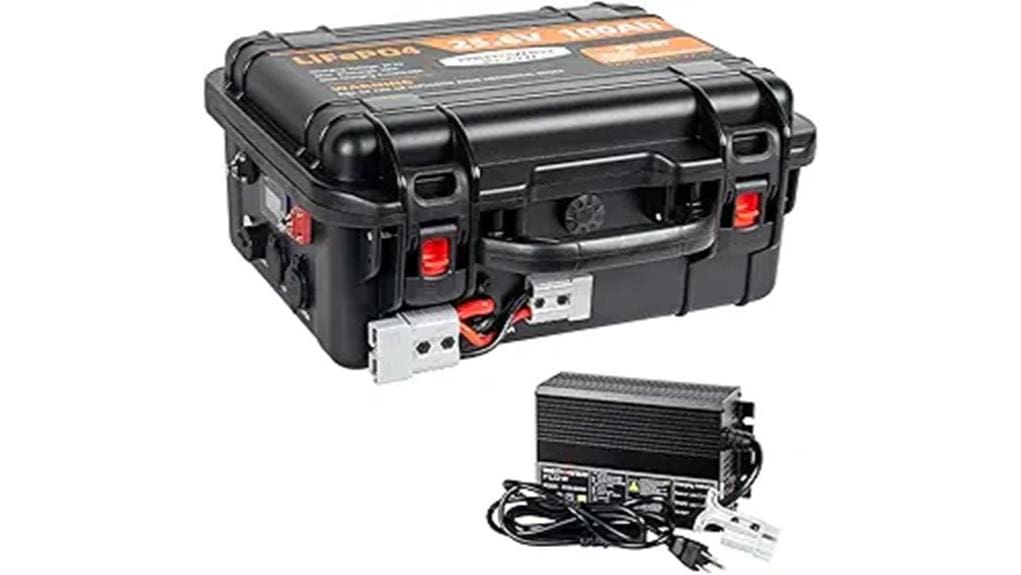

You’ll get a rugged, serviceable 24V 100Ah LiFePO4 power box with Grade‑A cells, integrated smart BMS, and a 29.2V/20A onboard charger that recharges in about five hours. High‑current M8 and Anderson outputs support trolling motors and RV loads, while USB, 24V/15A, and damp‑proof ports handle campsite gear. Bluetooth and LCD give SOC, temperature, and cycle count; thermal sensors and low‑temp cutoffs protect the pack. Keep going to see detailed performance, pros, and caveats.
Some Key Takeaways
- 24V 100Ah LiFePO4 offers long cycle life (4,000–8,000 cycles) and stable voltage for deep-cycle marine, RV, and off-grid use.
- Built-in smart BMS delivers over‑/under‑voltage, temperature, and current protection with Bluetooth/LCD SOC and cycle-count reporting.
- Integrated 29.2V/20A charger charges to full in about five hours, enabling fast shore or campsite recharge.
- Multiple outputs (M8 terminals, two Andersons, 24V/15A port, 12A plug, USB 3.0) support trolling motors, RV loads, and device charging.
- Tradeoffs: higher weight and premium price, limited low‑temp charging below −4°F, so verify warranty and serviceability before buying.
Quick Verdict: Who Should Buy This 24V 100Ah LiFePO4 Power Box
If you need a rugged, all-in-one 24V power solution for frequent outdoor use, this 24V 100Ah LiFePO4 power box is ideal: it combines a high-capacity LiFePO4 pack, a 20A charger, multiple DC outputs and robust protections in a waterproof case, so you can power trolling motors, kayaks, RV systems, or campsite electronics without extra wiring or a separate battery box. You’ll appreciate plug-and-play operation, long cycle life, and smart BMS safeguards. Recommended for mobile users who value autonomy—RV travelers, kayak campers, and solo anglers. Not geared to ultra-tight budget buyers needing lowest upfront cost. Kayakers and anglers will especially like the convenience of integrated solar charging for extended trips with solar chargers.
What’s Inside: Key Specs, Ports, and Built-In Features
While the rugged waterproof case looks simple from the outside, the interior packs a complete 24V 100Ah LiFePO4 power system: a Grade-A cell stack with integrated smart BMS, a 29.2V/20A charger, an LCD and Bluetooth monitoring module, and multiple high-current and auxiliary outputs. You get a clear battery architecture: parallel cell groups, thermal sensors, and low-temp charge cutoff. Port layout is purposeful: M8 high-current terminals (100A), two Andersons (100A/50A), a 24V/15A DC port, 12A damp-proof plug, and USB 3.0. Built-in protections, repairable design, and a compact charger make it truly plug-and-play.
Real-World Performance: Charging, Run Time, and App/LCD Monitoring
Having outlined the hardware and port layout, we'll now examine how the system performs under real-world charging and load conditions. You’ll reach full charge in roughly five hours with the 29.2V 20A charger while the BMS prevents over-charge and limits current. Expect stable voltages under load, minimal battery heating at rated draws, and rapid recovery after bursts. The Bluetooth app and LCD report SOC, temp, cycle count in real time so you’ll manage range confidently. Apply firmware updates when available to refine charge profiles and protections. Follow low-temp charging limits and monitor alerts to preserve cycles and freedom on the move. Kayakers and beginners should consider carrying an extra GPS backup battery to ensure navigation reliability on longer trips, especially when paddling remote routes with limited resupply options and the need for backup power.
Use-Case Fit: Trolling Motors, Kayaks, RVs, and Camping Scenarios
Because this power box combines a 24V 100Ah LiFePO4 pack, a 20A charger, and multiple high-current outputs in a sealed, repairable case, it directly addresses the typical power profiles and logistical constraints of trolling motors, kayaks, RVs, and campsite setups. You’ll get trolling compatibility via M8 terminals and Andersons for sustained high-current draw, enabling full-throttle runs without voltage sag. For a portable kayak you can mount a lightweight system and monitor SOC via Bluetooth. RV integration is straightforward: DC 24V/15A and charger handle onboard loads and shore recharging. For campsite power, USB and 12A ports run lights, cookers, and devices reliably. This setup is ideal for beginner paddlers who need essential gear that balances weight, durability, and ease of use.
Pros, Cons, and Buying Tips (Warranty, Durability, and What to Check)
Given how the unit meets the load and mounting needs of trolling motors, kayaks, RVs, and campsites, you’ll want to weigh specific advantages and limitations before buying. You’ll benefit from high cycle life (4,000–8,000), integrated BMS, fast 20A charging, modular outputs, and repairable design. Cons: weight, premium cost, and limited low-temp charge below –4°F despite protection. Check warranty transferability, clear cell sourcing transparency, and vendor support terms. Verify real-time SOC and cycle reporting via Bluetooth/LCD, physical mounting points, charger compatibility, and serviceability. Ask for written warranty, RMA process, and local repair options before purchase. Consider also how this battery pairs with emergency power banks used by kayakers and beginner enthusiasts.
Some Questions Answered
Can I Connect Two Units in Series for 48V Systems?
Yes — you can connect two units in series to create a 48V system, but you’ll need proper voltage balancing. You should match state-of-charge, temperature, and cycle history before series connection, use equalizing hardware or an external balancer, and guarantee the BMS supports series operation. Follow manufacturer wiring specs, use the M8/Anderson outputs appropriately, and monitor via Bluetooth/LCD to prevent imbalance or stress that could shorten life.
Is the Battery Air-Transportable Under Lithium Shipping Rules?
No — you generally can't air-transport this 24V 100Ah LiFePO4 power box as passenger aircraft cargo. Its shipping classification (UN/DOT rules) exceeds thresholds for lithium battery air shipment without special approvals. To move it by air you'll need compliance testing, proper shipping classification documentation, and stringent packaging requirements: UN-approved inner/outer packaging, state-of-charge limits, labeling, and airline/operator acceptance. Check carrier and regulatory guidance before arranging transport.
Can I Replace the Charger With a Solar MPPT Controller Directly?
Yes — you can replace the charger with a solar MPPT controller if you guarantee solar compatibility and respect charging limitations. Set MPPT settings for a 29.2V LiFePO4 charge profile, proper absorption and float voltages, and current limits ≤20A unless BMS supports higher. Confirm BMS communication (CAN/RS485 or voltage sensing) so the controller and BMS coordinate. If unsure, use a configurable MPPT and verify with manufacturer specs for safe operation.
How Heavy Is the Power Box and Does It Need Mounting?
The power box weighs about 55–60 lb (check the exact weight specs on the label), so you can carry it short distances but you’ll want help for longer moves. For mounting options, you can bolt it to a flat surface using the base mounting points or secure it with straps in a vehicle or boat. You don’t have to permanently mount it, but firm attachment prevents movement and protects connections during travel.
Are Firmware Updates for the BMS Available via the Bluetooth App?
Yes — you can receive firmware updates for the BMS via the Bluetooth app. You’ll get OTA firmware updates pushed through the app when available, ensuring Bluetooth compatibility and improved protections. Update prompts appear in-app; you’ll confirm and install them while the power box is idle. Follow on-screen instructions, keep a stable Bluetooth link and sufficient charge, and the BMS will apply updates to maintain safe, reliable operation and user autonomy.


