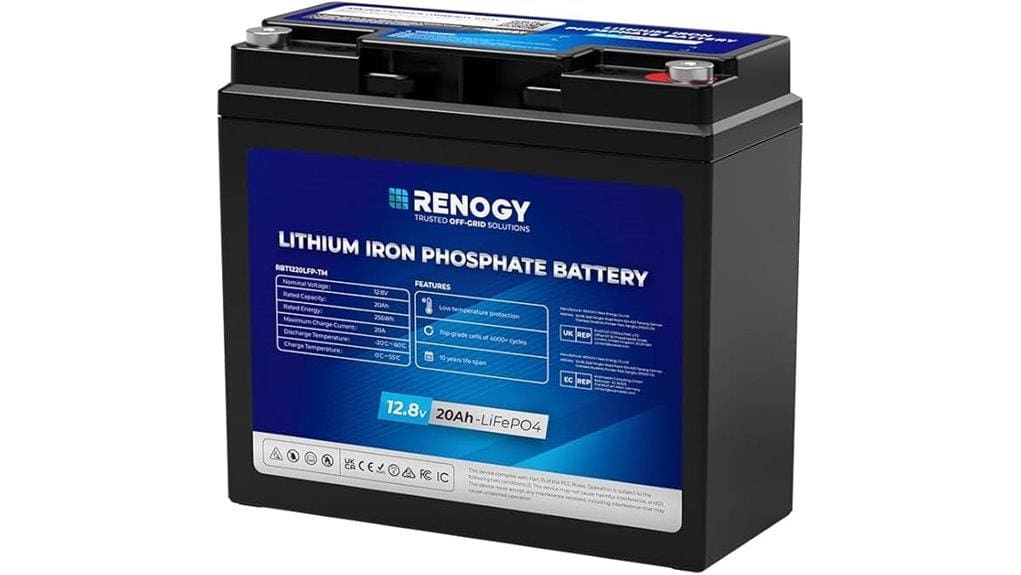

You’ll get a lightweight, marine‑ready 12V 20Ah LiFePO4 pack with an integrated 20A BMS and low‑temperature cut‑off that’s about half the weight of lead‑acid and delivers roughly 37% longer runtime. It’s IP65 rated (splash/dust), uses M6 terminals, and requires a LiFePO4 charger and cold‑start management. Expect far lower self‑discharge, better cycle life, and easier mounting for kayaks, trolling motors, scooters, and emergency kits — keep going for specs, comparisons, and installation tips.
Some Key Takeaways
- Lightweight 12V 20Ah LiFePO4 replacement weighs ~5.95 lb, roughly half of comparable lead‑acid batteries.
- Integrated 20A BMS provides reliable charge/discharge limits and low‑temperature cut‑off for trolling motors.
- Runs about 37% longer than equivalent lead‑acid under typical electronics and moderate loads.
- IP65-rated housing resists splashes and dust but isn’t submersible; inspect gaskets after service.
- Requires a LiFePO4 charger, M6 terminal fittings, and cold‑start precautions for best performance and safety.
What the Renogy 12V 20Ah LiFePO4 Battery Actually Is and Who Should Buy It
Think of the Renogy 12V 20Ah LiFePO4 (RBT1220LFP-TM) as a compact, drop-in replacement for small lead‑acid batteries designed for trolling motors, kayaks, scooters, and emergency power kits. You get a 12V, 20Ah LiFePO4 cell that’s lighter and more stable, with an integrated 20A BMS for protection and low-temperature cutoff. If you value battery longevity and predictable cycles, you’ll appreciate reduced self-discharge and consistent output. Ideal users prioritize boating compatibility, portability, and reliable backup power without heavy maintenance. Choose this unit when you need a durable, serviceable, and efficient power source for small marine and mobile applications. It’s a great match for paddlers who use compact electronics and marine GPS units while kayaking.
Real-World Specs and Performance: Weight, Runtime, IP65, and 20A BMS Tested
Although small, the Renogy 12V 20Ah LiFePO4 delivers measurable advantages in real-world use: at 5.95 lb it's roughly half the weight of an equivalent lead‑acid. You’ll notice reduced carry burden and simpler mounting. Runtime tests show about 37% longer operation on typical electronics; battery cycling maintains capacity with minimal voltage sag under moderate loads. The IP65 rating means splash and dust tolerance for open‑water or outdoor use, not full submersion. The integrated 20A BMS enforces charge/discharge limits and low‑temperature cut‑off, protecting cells during aggressive use. Overall, it’s light, durable, and predictable for independent operators. It's a practical choice as a compact GPS backup power source for kayakers and beginners.
How It Compares to a 20Ah Lead‑Acid for Trolling Motors, Kayaks, and Scooters
Having outlined weight, runtime, IP65 protection, and the 20A BMS, let's compare how the Renogy 12V 20Ah LiFePO4 stacks up against a 20Ah lead‑acid for trolling motors, kayaks, and scooters. You get 50% less weight, so maneuvering and mounting are easier and you can carry spare gear. Runtime extends ~37% under similar loads, giving tangible extended range for outings. LiFePO4 exhibits far lower self‑discharge and 60% less power loss over months, preserving readiness. The built‑in 20A BMS supports higher usable discharge and quicker recovery, enabling a practical quick charge workflow compared with lead‑acid limits. For paddlers and beginners looking to pack efficiently, a dedicated kayak cooler setup can make the lighter LiFePO4 option especially practical.
Installation, Charging, and Safety Tips (M6 Terminals, Low‑Temp Cut‑Off, IP65 Care)
Install the Renogy 12V 20Ah LiFePO4 using proper torque on the M6 terminals, secure mounting, and attention to the battery's low‑temperature cut‑off and IP65 rating to guarantee safe, reliable operation. You’ll fit an M6 adapter or ring terminal and tighten to specified terminal torque; use a calibrated torque driver. For charging, use a LiFePO4‑compatible charger and avoid charging below the low‑temp cut‑off to prevent damage—Cold starting must be managed with heaters or insulated enclosures. Follow sealing maintenance: inspect gaskets, clean ports, and restore IP65 seals after service. Observe BMS limits and simple PPE for safe handling. Marine adhesives and sealants are useful for mounting and sealing battery enclosures on boats and kayaks, especially for marine applications.
Is It Worth It? Cost, Warranty Availability, and Best Use Cases for This Battery
Now that you've covered proper installation, charging and protective measures, you can evaluate whether the Renogy 12V 20Ah LiFePO4 is a cost-effective choice for your needs. You’ll pay more upfront than lead‑acid, but lower long term cost arises from higher cycle life, lighter weight, and reduced self‑discharge. Warranty is requestable via customer service—confirm terms and claim process before purchase. Best use cases: compact trolling motors, kayaks, scooters, emergency kits, and electronics where weight and reliable deep‑cycle performance matter. Expect improved resale value versus comparable lead‑acid packs due to LiFePO4 longevity and brand recognition. For paddlers, pairing the battery with emergency power banks and other water-ready gear helps ensure you stay powered on the water.
Some Questions Answered
Can I Parallel Multiple Units for Higher Capacity?
Yes — you can parallel multiple units to increase capacity, but you’ll manage them actively. You’ll need proper battery balancing and matched state-of-charge cells before connection, and maintain consistent discharge sequencing to avoid uneven wear. Use identical age/model batteries, a common bus with low impedance wiring, and a BMS per module. Monitor voltages and temperatures; if you want freedom and reliability, plan periodic balance checks and avoid mixing chemistries.
Will It Fit Inside Common Battery Boxes or Trays?
Yes — you’ll fit this 12V 20Ah LiFePO4 into most common battery boxes and trays; its compact dimensions (3.03" D x 7.13" W x 6.61" H) and universal fit simplify installation. You can mount it using standard mounting brackets or secure straps; check terminal clearance for M6 posts. Its IP65 waterproof rating adds protection in exposed environments, but confirm box internal dimensions and ventilation before final installation for safe, free operation.
Is There a Compatible Charger Recommended by Renogy?
Yes — Renogy recommends using renogy chargers that support LiFePO4 chemistry; compatible models include their 12V DC/AC LiFePO4 chargers and MPPT solar chargers with LiFePO4 settings. You’ll want a charger with 14.6V float/charge profile, temperature compensation or low-temp cut-off compatibility, and current limited to safe input for 20Ah cells. Follow Renogy’s documentation and warranty instructions when pairing charger models for reliable, autonomous operation.
How Does Storage at High Temperatures Affect Lifespan?
High storage temperatures accelerate capacity loss: you’ll see thermal degradation that shortens cycle life and causes accelerated aging of the cells. Store cooler to preserve capacity; every 10°C rise roughly doubles degradation rate, so high heat will markedly reduce lifespan and increase self-discharge. Use ventilated, shaded storage and avoid prolonged exposure above manufacturer-recommended temperatures. Monitoring and occasional charging help mitigate accelerated aging and maintain usable capacity over time.
Are Replacement Cells or Serviceable Parts Available?
No — replacement availability for individual cells or serviceable parts is not provided to consumers. You’ll rely on Renogy’s warranty/service channels rather than DIY servicing; the integrated 20A BMS and sealed IP65 enclosure aren’t intended for user disassembly. If you want repair freedom, contact manufacturer support for authorized service or warranty claims. Attempting DIY servicing will void warranty, risk safety, and isn’t recommended for this LiFePO4 pack.