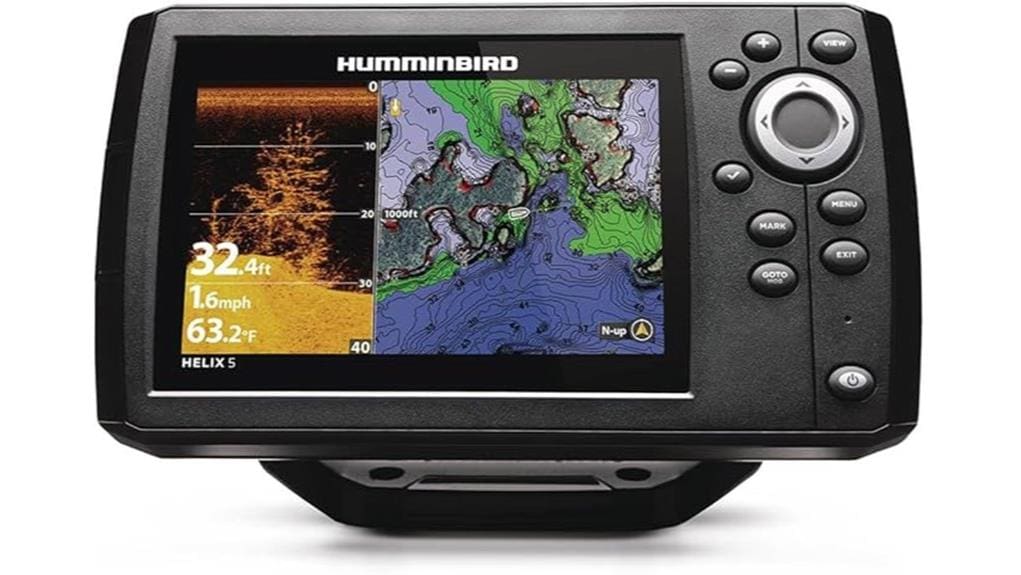

You’ll get compact CHIRP sonar, crisp Down Imaging, and dependable GPS in a kayak- and small-boat–friendly package that’s priced for value. Controls are logical and the gimbal mount keeps things stable in chop. Dual Spectrum gives you options for coverage vs. resolution, and AutoChart Live adds real‑time mapping few rivals offer at this cost. Battery life and the small 5‑inch screen are the main compromises. Keep going to see setup tips, comparisons, and buying advice.
Some Key Takeaways
- Compact 5-inch HELIX 5 CHIRP DI GPS G3 delivers CHIRP sonar and Down Imaging with notably sharper target separation than entry-level units.
- Dual Spectrum CHIRP offers selectable wider coverage or higher resolution for fish and structure detection in varied water conditions.
- Built-in GPS reliably marks and returns to waypoints; AutoChart Live enables real-time custom mapping on the go.
- Includes transom-mount transducer, gimbal bracket, power cable, and straightforward installation hardware for small boats and kayaks.
- Tradeoffs: limited screen visibility in bright sun and dependence on boat power for long trips, but strong value for feature-conscious beginners.
What the HELIX 5 CHIRP DI GPS G3 Includes and Why It Matters
The HELIX 5 CHIRP DI GPS G3 ships as a ready-to-install package: the 5-inch control head, XNT 9 HW DI T transom-mount transducer, power cable, mounting hardware and a gimbal bracket — everything you need to get sonar and GPS on the water fast. You’ll appreciate the balance of essentials and upgrade paths: transducer options suit varied hulls and fishery types, while accessory compatibility with LakeMaster, Navionics and AutoChart Zero Line cards expands mapping without fuss. Controls are straightforward, installation is quick, and the included transducer delivers usable imaging. That simplicity gives you freedom to focus on fishing, not gear. For kayak anglers and beginners, this unit pairs well with basic mounting and transducer setups commonly recommended for kayakers and beginners.
Real-World Performance: CHIRP Sonar, Down Imaging, and GPS Navigation Tested
While putting the HELIX 5 CHIRP DI GPS G3 through real fishing conditions, you’ll notice its CHIRP sonar and Down Imaging deliver sharper target separation and clearer structure detail than typical entry-level units. You’ll see fish arches and structure with improved signal clarity even in stained water, and Dual Spectrum modes let you choose wider coverage or pinpoint resolution. Down Imaging renders brush, rock, and thermoclines crisply, helping you target spots confidently. GPS performance gives dependable waypoint accuracy for marking productive holes and returning later. Overall, the unit performs like a compact, freedom-friendly tool for serious anglers on the move. It’s also a practical fit for kayakers who want lightweight, reliable GPS speed trackers and compact navigation gear on the water.
Usability and Setup: Controls, Mounting, Power, and AutoChart Live Workflow
After testing sonar and GPS performance on the water, you'll appreciate how the HELIX 5's physical controls and setup make that performance easy to access. You’ll find the button layout logical and tactile — softkeys and dedicated buttons get you to views, sonar modes, and AutoChart Live without fumbling. Mounting stability from the gimbal bracket is solid; the included hardware holds position in chop. Power options are straightforward: standard DC wiring and a simple connector make installation quick. AutoChart Live workflow is intuitive once you consult concise user manuals, letting you map and export data with confidence and speed. This makes it a practical choice for kayakers looking for reliable marine GPS gear.
Strengths and Weaknesses Compared to Similarly Priced Models
Because you’re comparing budget-friendly fish finders, the HELIX 5 CHIRP DI GPS G3 stands out for packing CHIRP Down Imaging, Dual Spectrum CHIRP, and AutoChart Live into a compact, easy-to-install unit, giving you imaging and mapping capabilities many rivals lack at this price. You’ll appreciate superior target separation and real-time mapping, letting you roam freely and trust what you see. Downsides: battery life depends on your boat’s power and can limit long backcountry runs without spare power, and the 5-inch screen visibility lags larger displays in bright sun. Overall, it’s a high-value tradeoff for portability and features. It’s a strong choice for beginner kayak anglers who need essential electronics without excessive bulk, especially when pairing with starter paddle packages.
Who Should Buy This Humminbird and Practical Buying Tips
Who should buy this Humminbird and why? You should if you want reliable, compact sonar with mapping freedom—ideal for beginners anglers seeking clear fish arches and kayak enthusiasts needing a gimbal-mountable, weatherproof unit. Its CHIRP DI and Dual Spectrum sonar deliver detailed targets without a steep learning curve. Practical buying tips: choose the transom kit for small boats, verify power compatibility with your battery, and consider adding AutoChart Live or LakeMaster for custom maps. Expect a one-year warranty; inspect mounts and cables for wear. If you value portability, accuracy, and expandability, this unit fits your needs. Many paddlers also benefit from carrying essential gear like a handheld GPS, life jacket, and spare paddle when using electronics on the water.
Some Questions Answered
Does It Support Networked Multi-Unit Syncing?
No — it doesn’t support network sync for multi unit setups. You can’t do simultaneous mapping across unit screens or true cross unit data sharing with this model. You’ll still get AutoChart Live and GPS on each device independently, but if you want seamless multi unit network sync and real-time cross unit mapping, you’ll need a higher-tier Humminbird or network-capable chartplotter system that explicitly supports Ethernet/MEGA Network features.
Can It Connect to Smartphones via Bluetooth or Wi‑Fi?
No — it doesn’t support Bluetooth pairing or Wi‑Fi streaming. You’ll rely on wired connections and SD card transfers for maps, AutoChart Live, and sonar data. That limits wireless convenience, but keeps the unit simple, robust, and dependable on the water. If you want smartphone integration, consider higher-tier Humminbird models or external modules that explicitly offer Bluetooth pairing and Wi‑Fi streaming for remote viewing and network features.
Is a Transducer Extension Cable Included or Sold Separately?
No, a transducer extension cable isn’t included — it’s sold separately. You’ll want to check transducer compatibility and required cable length before buying so you don’t limit installation options. Measure from mount to head, factor routing, then choose Humminbird-approved extension lengths to preserve signal integrity. If you value freedom on the water, getting the right extension up front saves hassle and keeps sonar performance crisp and reliable.
Can the Unit Be Flush-Mounted Instead of Gimbal-Mounted?
Yes — you can surface mount the unit for dash integration instead of using the gimbal. You’ll need to create a flush cutout matching the control-head dimensions and use the manufacturer’s surface-mount kit or fabricate a secure trim plate. Do that carefully to maintain weather sealing and ventilation. You’ll enjoy a cleaner dash integration and freer cockpit layout, but make sure accessibility for cables, tilt adjustment, and future removal before finalizing.
Are Software Updates User-Installable via SD Card?
Yes — you can install firmware updates yourself via SD card. You’ll download the firmware file, copy it to an SD card (check SD card compatibility with Humminbird), insert it into the unit, and follow on-screen prompts for firmware installation. This gives you control and freedom to keep features current, but you should back up settings, use a supported card, and avoid power loss during installation to prevent bricking the device.


