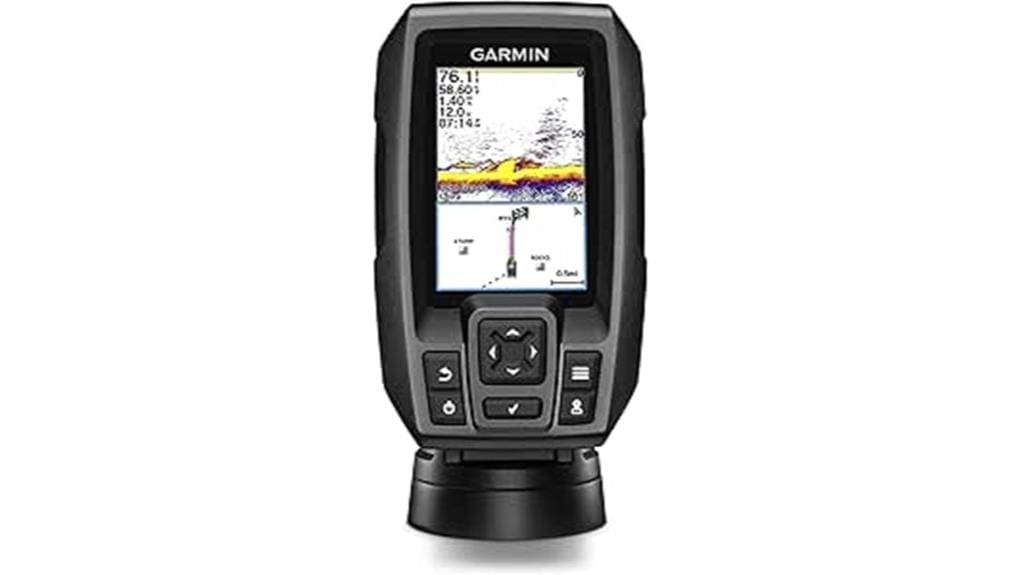

You’ll get a compact CHIRP + ClearVü unit that’s tuned for clear target separation and near-photographic structure at close range, with a 3.5" 480×320 screen, 300W transmit, and mounts for transom/trolling-motor or ice setups. It’s great for kayaks, jon boats, and ice fishing, and handles shallow to moderate depths well though clarity drops with thermoclines and very deep water. It’s competitively priced; continue for setup, performance tuning, and alternatives.
Some Key Takeaways
- 3.5" 480×320 display with CHIRP and ClearVü gives good target separation and near-photographic structure at close range.
- 300W transmit power and theoretical 1,750 ft depth rating, but practical depth and clarity drop with depth and thermoclines.
- Compact, low-power design suits ice fishing, kayaks, jon boats, and portable battery setups.
- Tactile keyed controls, dedicated gain/range/zoom buttons, and included mounts simplify installation and use.
- Competitive price for CHIRP/ClearVü, though small screen and depth performance lag higher-tier alternatives.
Garmin Striker 4cv At a Glance : Specs, Package Contents, and Who It’s For
Though compact, the Garmin Striker 4cv delivers a focused set of features for anglers who want reliable sonar without complexity. You get a 3.5" 480x320 LCD, 300W transmit, ClearVü and CHIRP support, max depth 1,750 ft, and a keyed interface that’s intuitive on the water. Package contents include the unit, transducer, power/data cable, tilt/swivel mount, transom and motor mounts, and documentation. Its compact portability and battery-powered operation favor mobile anglers; expect straightforward installation and efficient battery life management. It’s aimed at anglers who value autonomy, simple navigation, and dependable sonar basics. Essential GPS gear for kayakers includes units and accessories designed for marine gps use on small boats.
Real-World Sonar Performance : CHIRP, ClearVü, Depth Range and Target Separation
Put simply, the Striker 4cv gives dependable sonar performance for its class, combining CHIRP and ClearVü to deliver clearer target returns and structural detail than basic single-frequency units. You’ll notice CHIRP’s frequency sweep sharpens fish arches and improves target separation in mixed schools, while ClearVü renders near-photographic structure at close range. Depth range to 1,750 feet is theoretical; practical clarity drops with depth and thermoclines. You should perform routine sonar calibration to optimize sensitivity and reduce false echoes. Signal interference from nearby electronics or multiple fishfinders can smear returns, so keep mounts and cabling disciplined for best results.
Usability and Installation : Display, Controls, Mounting, and Setup Tips
When you power up the Striker 4cv you get a clear, 3.5-inch 480×320 LCD that presents CHIRP and ClearVü returns with good contrast for its size, and the keyed interface with dedicated buttons makes common adjustments—gain, range, zoom, and waypoint marking—quick without digging through menus. You’ll appreciate button ergonomics: keys are tactile, spaced for gloved use, and reduce input errors. Mounting is straightforward with the tilt/swivel bracket; transom and trolling-motor options fit standard setups. Route the power/data cable under gunnels for neat cable management. For setup, calibrate range and sensitivity, save waypoints, and test mounts before departure. Perfect Kayak Fish Finder Mounts offers purpose-built mounts that simplify installation and improve stability for kayak anglers kayak fish finder mounts.
Pros, Cons, and Best Use Cases : Ice Fishing, Boats, and Shallow vs Deep Water
Typically, the Striker 4cv serves as an excellent fishfinder for small boats, delivering reliable fishfinding capabilities on the ice as well. You’ll appreciate ClearVü for structure, CHIRP for target separation, and the flasher for vertical presentation. Pros: compact, straightforward interface, low power draw aiding battery life, and versatile mounting for portable setups. Cons: small screen limits situational awareness; CHIRP depth and clarity trail higher-tier units in very deep water. Best use cases: ice fishing and shallow to moderate depths from kayaks, jon boats, and small outboards. Plan seasonal maintenance to protect connectors and assure consistent performance. For kayakers and beginners, pairing the unit with affordable fish finder accessories helps create a practical, portable setup.
Value Check and Alternatives : Price, Warranty, and Comparable Models to Consider
Having covered performance and ideal uses, let’s look at value, warranty, and alternatives so you can decide if the Striker 4cv matches your needs and budget. You’ll find the Garmin Striker 4cv priced competitively for its ClearVü and CHIRP combo; run pricing comparisons against entry-level Humminbird PiranhaMAX and Lowrance Hook series to weigh features versus cost. Check warranty terms with Garmin—standard coverage varies by region and may affect total ownership value. If you want mapping or networking, consider stepping up to Striker Plus or comparable models. Choose based on feature trade-offs and long-term flexibility. Also consider how a portable fish finder fits kayak setups and beginner needs with portable fish finder options.
Some Questions Answered
Can the Transducer Be Used With a Kayak Scupper Mount?
Yes — you can, but you'll need the right hardware. You’ll install the transducer via a kayak scupper mounting location using a scupper transducer adapter designed to fit the Striker’s transducer footprint. That adapter isolates vibration, keeps the transducer aligned, and minimizes turbulence for clearer CHIRP and ClearVü returns. You’ll evaluate scupper depth, kayak hull curvature, and secure cable routing; choose a durable adapter and test positioning for best performance.
Does It Support External GPS Antenna Connection?
No — it doesn't support an external antenna. You won't find an external antenna connection on the unit; connection options are limited to the built-in GPS and power/data cable. In technical terms, gps compatibility is provided by the internal receiver only, so antenna support for improved reception or external GPS modules isn't available. If you need external antenna capability, consider higher-tier models with explicit external antenna connections.
Is the Unit Compatible With NMEA Networking?
No — it doesn’t support NMEA integration or broader network compatibility. You’ll get GPS waypointing from the internal receiver, but the Striker 4cv lacks NMEA 0183/2000 ports or Ethernet for sharing sonar and GPS connectivity across a boat network. If you need NMEA integration, choose a unit with explicit NMEA/NMEA 2000 support or add a compatible chartplotter/interface. That keeps your freedom to expand systems without frustrating limitations.
How Does It Perform in Saltwater Vs Freshwater?
You’ll get reliable performance in both environments, but expect differences: saltwater corrosion risk requires rinsing and stainless mounting to prevent damage, while freshwater clarity often yields crisper returns and better target separation. The CHIRP and ClearVü handle salt and fresh targets well, though you may need sensitivity tweaks in turbid freshwater. Regular maintenance in saltwater extends life; in freshwater you’ll enjoy clearer images with less upkeep.
Can I Update Firmware via microSD Card?
Yes — you can update the firmware via microSD card. Follow Garmin firmware procedures: download correct OS file to an exFAT/FAT32-formatted microSD, insert into the device with power off, then power on to trigger the update sequence. Be mindful of microSD limitations: use recommended capacity and quality, avoid corrupted files, and don’t remove power during flashing. Verify firmware version afterward and keep a backup of settings for recovery.


