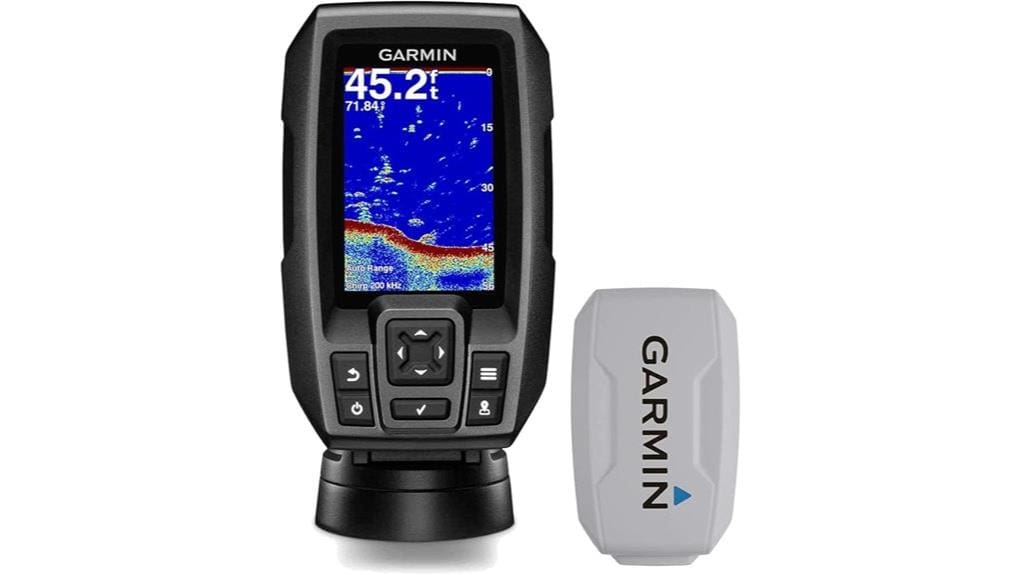

You’ll get a compact 3.5" CHIRP fishfinder with a 77/200 kHz transducer, built‑in GPS for fast waypointing, and dash or trolling‑mount hardware with wiring prepped for quick hookup. CHIRP gives good short‑range resolution and clear returns for a small unit, and the GPS is dependable for simple navigation. It’s ideal for kayaks, jon boats, and budget rigs though the screen is small and features are limited—keep going to see setup tips, pros/cons, and buying checks.
Some Key Takeaways
- Compact 3.5" Striker 4 offers reliable 77/200 kHz CHIRP sonar with clear target separation for nearshore and freshwater fishing.
- Built-in GPS locks quickly for waypoint drops and basic navigation, improving trolling and spot-return accuracy.
- Included CHIRP transducer, wiring, mounting hardware, and protective cover simplify installation on kayaks, jon boats, and small rigs.
- Small screen and limited advanced features mean tradeoffs versus larger, feature-rich units; battery life can be modest on portable setups.
- Renewed units deliver value but verify warranty, return window, firmware update access, and transducer/wiring compatibility before buying.
What the Garmin Striker 4 3.5 CHIRP Fishfinder GPS Actually Includes
The Garmin Striker 4 3.5" CHIRP Fishfinder GPS comes renewed and ready to install, and it includes the core components you need: the 3.5-inch color display unit, a CHIRP transducer (77/200 kHz), mounting hardware, wiring, and a protective cover (model 010-12441-00). You get compact box contents optimized for small-boat deployment: display, transducer, cover, dash or trolling mount parts, and cabling prepped for quick hookup. Documentation notes basic warranty details for renewed units—check serial and seller terms. You’ll appreciate the straightforward inventory, minimal setup, and transferable freedom to relocate the unit as required. This package is especially suitable for kayakers and beginners looking for essential, easy-to-install fish finder gear.
How the CHIRP Sonar, Transducer, and GPS Perform on Small Boats
Although small boats can be challenging platforms, the Striker 4’s CHIRP sonar, transducer, and built‑in GPS deliver dependable, practical performance for most nearshore and freshwater applications. You’ll notice beam narrowing on higher frequencies concentrates energy, improving target separation and bottom detail near structure. The included transducer pairs with the 77/200 kHz CHIRP sweep to balance depth coverage and short-range resolution. Signal clarity is strong for a 3.5" unit; returns are stable despite hull movement. GPS locks quickly for waypoint drops and simple navigation. For compact craft you get accurate sonar imaging and reliable position fixes without unnecessary complexity. This unit is especially well suited for kayakers and beginners looking for an affordable, portable fish finder option that balances functionality and simplicity.
Ease of Use: Setup, Interface, and Mounting on a Kayak or Jon Boat
You’ll get the Striker 4 set up quickly on a kayak or jon boat thanks to its compact footprint and straightforward wiring; route the power to a fused source, mount the transducer where hull turbulence is minimal, and bolt the included bracket to a stable surface using the supplied hardware. You’ll appreciate short setup time—standard wiring harness and clear instructions mean you’ll be on the water fast. Kayak mounting is simple: clamp or deck-mount options work. Power options include 12V battery connection with inline fuse. The interface responsiveness is solid; menu flow is logical, buttons tactile, and calibration straightforward for independent anglers. For added convenience, consider pairing it with a secure kayak rod rack to keep your gear organized and accessible while you fish.
Pros, Cons, and Who Should Buy the Renewed Striker 4
Because it balances compact design with reliable CHIRP sonar and GPS, the renewed Striker 4 is a pragmatic choice for anglers who need essential capabilities without unnecessary complexity. You’ll get accurate waypointing, clear 77/200 kHz returns, and a small footprint that suits kayaks and jon boats. Pros: dependable CHIRP performance, simple interface, included transducer and protective cover, and lower cost than new units. Cons: limited screen size, modest battery life on portable setups, and fewer advanced features. Buy it if you prioritize portability, straightforward navigation, and value — check warranty terms for renewed-item coverage before purchasing. Our shop also stocks minimalist kayak seats designed for beginner kayaking comfort and stability.
Quick Buying Checklist and Alternatives to Consider
If the renewed Striker 4 fits your needs, next confirm a few hardware and use-case specifics before buying. Check battery life expectations for your rig or portable pack, verify included wiring and transducer compatibility, and make certain the protective cover and mount match your installation. Inspect warranty options on renewed units and confirm return window. Ask about software updates and firmware access—updates keep CHIRP performance and GPS accurate. Do quick price comparisons with new and equivalent used units (other Garmin or Humminbird compact models). If you need mapping, larger display, or networking, consider alternatives before committing. Also consider the importance of carrying an appropriate backup battery when using portable electronics on the water.
Some Questions Answered
Does the Warranty Transfer for Renewed Units?
No — warranty transferability usually doesn't extend to renewed ownership; manufacturers often limit warranties to the original purchaser. You should check Garmin’s renewed-item policy and the seller’s listing for any seller-backed warranty or return window. If you want coverage, register the unit immediately and request written confirmation from the seller about any transferable protections. Keep purchase records and the protective cover/serial info handy to support any future claims.
Can I Use a Portable Battery Pack Instead of a Boat Battery?
Yes — you can use a portable battery pack instead of a boat battery, but make sure it supplies 12V DC, sufficient current, and stable output. A high-capacity portable powerbank or a lithium jumpstarter with a 12V output and at least a few amps continuous will run the Striker 4. Verify connector polarity, voltage regulation, and run-time for your transducer’s 200W RMS demands. Use fused wiring and secure mounting for safety and freedom on the water.
Is the Protective Cover Waterproof or Splash-Resistant?
No — the protective cover isn’t fully waterproof; it’s splash-resistant. You’ll get basic protection from spray and rain, but it lacks a sealed waterproof rating for submersion. The cover material is a flexible, durable rubberized vinyl that sheds water and resists UV and abrasion. You can confidently protect the unit during normal open-boat use, but don’t rely on it for immersion or prolonged exposure in heavy weather.
How Often Does the Unit Require Software Updates?
You should check for firmware updates every few months; there’s no fixed cadence. Garmin issues firmware cadence based on feature rollouts and bug fixes, so you’ll get update reminders via Garmin Express or the device when critical updates appear. Install software updates promptly to maintain GPS accuracy and sonar performance. If you use the unit frequently or travel, check monthly; casual users can verify seasonally to stay current and free to fish confidently.
Are Replacement Transducers Compatible Across Garmin Striker Models?
Yes — but only partly. You can often swap Garmin transducers between Striker models, yet transducer compatibility depends on model differences like frequency support, mounting style and connector type. You’ll want to match CHIRP frequency (77/200 kHz), power handling and connector pinout. Check Garmin’s part numbers and specs before buying. If you value freedom on the water, confirm fit and performance to avoid degraded sonar or navigation functionality.


