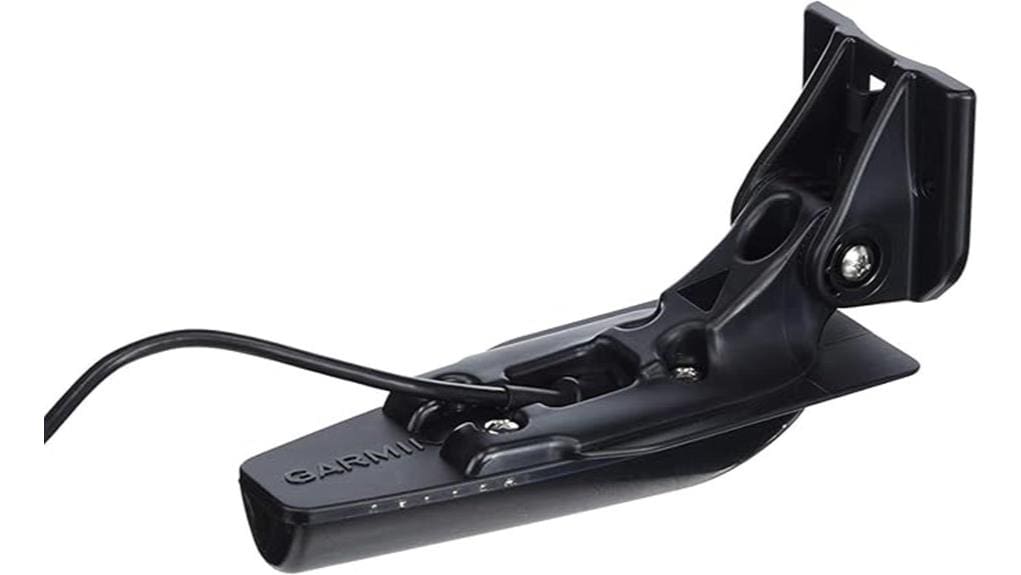
You’ll get a compact 500 W CHIRP transducer that delivers both 77/200 kHz traditional and 455 kHz ClearVü imaging, ideal if you want tighter target separation and photo‑like side scans on lakes, rivers, and flats. It mounts on transoms or trolling motors, includes a 20 ft cable and temp sensor, and suits kayaks and small boats. Setup’s straightforward but alignment and cable routing matter, and the next section covers performance, mounts, and troubleshooting.
Some Key Takeaways
- 500 W CHIRP yields tighter target separation and deeper returns than single-frequency units, improving fish detection at mid-depths.
- 77/200 kHz traditional gives reliable fish arches and broad coverage; 77 kHz for depth, 200 kHz for near-structure detail.
- 455 kHz ClearVü produces photo-like side scans with narrow beamwidth, excellent for structure and fish resolution near the hull.
- Transom or trolling-motor mounts provide flexible installation; trolling-motor position reduces turbulence and improves forward-looking ClearVü.
- Best for kayak and small-boat anglers seeking portable, mid-range performance with about 750 ft ClearVü and 1,900 ft traditional depth capability.
What the Garmin GT20-TM Is and Who Should Consider It
Targeting anglers who need reliable sonar returns, the Garmin GT20-TM is a compact 500 W transducer that delivers both traditional (77/200 kHz) fish arches and high-resolution 455 kHz ClearVü imaging to about 1,900 ft and 750 ft respectively. You’ll appreciate its machined housing, 20 ft cable with fast-response temperature sensor, and included transom and trolling motor mounts. It suits beginner anglers and freshwater enthusiasts seeking dependable, uncomplicated sonar for lakes and rivers. You can install it quickly, monitor structure and targets, and rely on clear imaging without excess features. It’s practical, portable, and built for freedom on the water. It's a great choice for kayak anglers looking for durable, compact electronics with portable performance.
Real-World Performance: 500W CHIRP, 77/200kHz Traditional, and 455kHz ClearVü Results
Now let's look at how that spec sheet behaves on the water. You’ll see the 500W CHIRP deliver tighter target separation and deeper returns versus single-frequency modes thanks to advanced signal processing. In 77/200kHz traditional you’ll get reliable fish arches and broad area coverage for offshore work; 77kHz extends range, 200kHz sharpens near structure. The 455kHz ClearVü yields photo-like side scans with narrower beamwidth, resolving structure and fish under the hull. Beamwidth comparison favors ClearVü for detail and CHIRP for noise rejection at depth. You’ll adjust gain and pulse settings to balance range, resolution, and clutter. For paddlers and small-boat anglers, pairing this transducer with kayak-friendly GPS trackers improves navigation and situational awareness.
Mounting, Compatibility, and Depth Limits by Use Case (Transom, Trolling Motor, Boat Size)
When choosing between the transom and trolling-motor mounts, consider boat size, shaft clearance, and desired depth performance: the GT20-TM's transom mount is straightforward for small to medium boats and keeps the transducer near the prop wash (good for shallow to mid-depth readings), while the trolling-motor mount places the element forward and lower in the water column to reduce turbulence and improve low-speed/forward-facing ClearVü imaging. You’ll match mounting to vessel length: transom suits shorter hulls; trolling-motor benefits longer, higher-transom craft. Make certain precise transducer alignment to avoid hull interference. Depth limits vary: 750 ft ClearVü, 1,900 ft traditional. Waterproof marine charts are a helpful resource for paddlers and kayakers.
Installation Tips, Temperature Sensor Notes, and Common Troubleshooting Fixes
In preparing the GT20-TM for service, start by choosing the mount that gives the transducer element clear, turbulence-free water and route the 20 ft cable so it won’t chafe or kink. Use secure cable routing clips, avoid sharp bends, and keep the lead clear of bilge pumps and engine mounts to prevent signal interference. Verify the built-in temperature sensor with sensor calibration against a known thermometer; allow thermal equilibrium. If you lose returns, perform power cycling before further checks. Inspect connectors, ground connections, and element cleanly. Replace damaged sections; consult Garmin support if faults persist. For paddlers consider keeping a compact backup battery designed for marine electronics on board for emergency power.
Is It Worth Buying? Price, Warranty, and Final Recommendations Based on Fishing Style
Although the GT20-TM isn't the cheapest transducer on the market, it delivers solid 500 W performance with dual-frequency traditional (77/200 kHz) and 455 kHz ClearVü imaging. You’ll weigh price comparison against capability: its depth, imaging fidelity, and included mounts justify mid-range cost if you value accurate structure and fish returns. Check warranty clarity with your vendor before purchase; Garmin provides standard coverage but seller return policies vary. If you fish lakes, coastal flats, or need reliable transom/trolling mounts, buy it. Skip it only if you require higher power, longer cable, or lower-cost basics. Many kayak anglers also prioritize portability and ease when choosing electronics.
Some Questions Answered
Does the Transducer Work Through Hulls or Only Transom/Trolling Mounts?
No — it’s designed for transom and trolling motor mounts, not through hull compatibility. You’ll install it externally on the transom or trolling motor; internal hull mounting or through-hull installations aren’t supported by this model. That preserves its acoustic alignment and cooling. If you want through hull compatibility or internal hull mounting, choose a transducer specifically rated for those methods to guarantee reliable sonar performance, depth accuracy, and void-free acoustic coupling.
Can the GT20-TM Integrate With Non-Garmin Displays?
No, it won’t natively integrate with non‑Garmin displays. You can use protocol adapters and third‑party interface modules to translate Garmin’s connector/protocol to standard NMEA/analog signals, but display compatibility depends on the adapter and target unit. You’ll need to verify supported frequencies (77/200/455 kHz), power handling, and connector pinout. Expect configuration work, potential signal loss, and limited warranty support when using non‑Garmin displays.
Is the Cable Length Extendable Without Signal Loss?
You can extend the cable, but you'll likely see signal degradation if you exceed short extension lengths. Use low-loss marine-grade cable, waterproof connectors and keep splices minimal and sealed to preserve signal integrity. Test any extension at operating frequencies (77/200/455 kHz) and verify depth performance. Prefer factory-length or professionally installed extensions to maintain ClearVü resolution; avoid long improvised runs that reduce effective range and image clarity.
Are There Recommended Cleaning Products to Maintain the Machined Exterior?
Yes — you should use non-abrasive cleaners and a light stainless polish to protect the machined exterior. Wipe with fresh water, mild detergent, and a soft cloth; rinse and dry thoroughly. Apply a thin protective coating or marine-grade corrosion inhibitor sparingly, then buff to spec. Avoid solvents, wire brushes, and harsh acids that damage seals or sensors. Perform maintenance routinely after saltwater exposure to preserve finish and long-term performance.
Does the Unit Support Ice Fishing or Cold-Weather Operation?
Yes — you can use it in cold weather, but test before relying on it. You’ll get reasonable cold start reliability thanks to the built-in temperature sensor and robust 500 W design, though extreme cold may slow power-up. Ice penetration depth depends on ice thickness and water clarity; ClearVü reaches practical imaging to 750 ft (ClearVü spec) but actual ice penetration depth for through-ice imaging will be far less and variable.