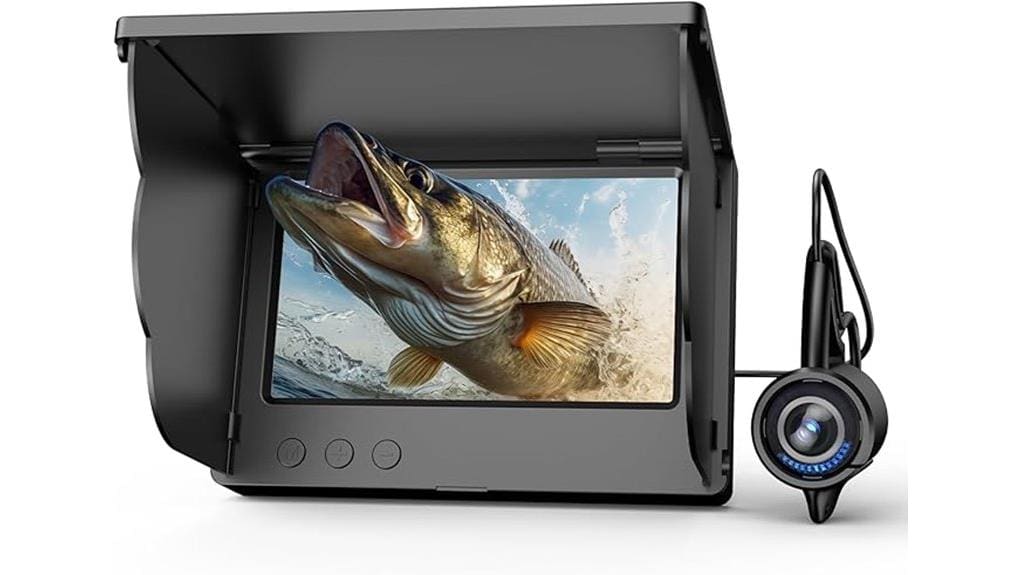

You’ll get a portable, plug-and-play underwater camera with a bright 4.3" HD display, 195° wide lens, IR night vision and a reinforced 65 ft cable that suits kayak, shore and ice use. Image quality is clear with mild edge distortion from the ultra-wide lens; IR works well at low light. Battery life runs about eight hours and the build is rugged, though cable length and occasional menu quirks limit some uses—keep going for mounting tips and alternatives.
Some Key Takeaways
- 4.3-inch HD display with 195° wide lens gives clear, real-time underwater views for species ID and structure spotting.
- 65 ft reinforced cable and IP68 build suit kayak, shore, and ice deployments but limit very deep drops.
- 12 IR LEDs provide effective dawn/dusk/night vision, though IR flattens contrast compared with daylight color.
- 5000mAh battery yields roughly eight hours of continuous use, supporting long trips without frequent charging.
- Plug-and-play setup is portable and user-friendly, but expect occasional menu quirks and routine maintenance.
Quick Verdict: Should You Buy the Eyoyo Underwater Fishing Camera?
If you want clear, real-time underwater views without complicated setup, the Eyoyo delivers: its 4.3-inch HD display, 195° wide lens, IR night vision, long 65 ft reinforced cable, and roughly 8-hour battery life make it a reliable, portable tool for kayak, shore, or ice fishing. You’ll get accurate, immediate feedback on structure and fish behavior; setup’s plug-and-play so you can go where you want, fast. Monitor battery health to avoid mid-trip loss, and check warranty coverage for peace of mind. It’s a practical choice if you value autonomy, durability, and straightforward performance on the water. Consider pairing it with other portable fish finders to expand your kayak fishing toolkit.
What’s in the Box and Key Specs That Matter (Display, Battery, Cable, IR, Waterproof)
When you open the box you'll find everything needed to start fishing right away: the 4.3-inch HD LCD monitor with sunshade, the 65 ft reinforced camera cable with 195° ultra-wide lens, the underwater camera head with 12 IR LEDs, a USB charging cable (for the 5000mAh battery), a mounting clamp and tether, plus basic user manual and spare O-rings. You get a compact, plug-and-play kit built for mobility and rugged use. The display is bright with minimal glare; cable feels overbuilt. Battery durability looks solid for long trips. Watch for slight lens distortion at the extreme edges in wide shots. This setup pairs well with kayak lighting and safety gear for night trips, especially when combined with kayak fishing lights to improve visibility and safety.
Real-World Performance: Image Quality, Low-Light/IR Tests, Cable Handling, Battery Life
Although compact, the Eyoyo system delivers surprisingly clear, usable footage that makes it easy to identify structure and fish behavior, with only mild edge distortion from the ultra‑wide lens. You’ll notice good color fidelity in daylight; hues aren’t saturated but stay realistic, aiding species ID. Frame rate is steady for smooth motion at typical depths, though rapid pan reveals minor blur. IR mode performs well for low-light dawn, dusk, and night observation without spooking fish, but contrast flattens. The reinforced 65 ft cable tracks smoothly, resists snags, and the 5000mAh battery reliably lasts about eight hours per charge. It’s a solid choice for kayakers getting started with underwater cameras, offering useful features without a steep learning curve.
Use-Case Breakdown: Kayak, Shoreline, Ice Fishing, Deep-Lake Setups and Mounting Tips
Because the Eyoyo camera's compact build and rugged cable adapt well to diverse fishing scenarios, you can deploy it confidently from kayaks, shorelines, ice holes, or deep‑water rigs with only minor setup changes. For kayak mounting, secure the camera to a paddle shaft or rail clamp; its light weight and reinforced cable minimize drift. Shoreline rigs benefit from a stake or tripod and short tether to prevent snagging. For ice deployment, use a small spool and keep the cable clear of slush during ice deployment. Deep lake anchors require a weight and steady line to hold the 65 ft cable stable near structure. Choose an inflatable PFD rated for kayaking with proper buoyancy to stay safe while handling gear on the water.
Final Pros, Cons, and Buying Checklist (Who It’s Best For and Alternatives)
You’ve seen how the Eyoyo camera handles kayak, shoreline, ice, and deep‑lake setups; now assess whether its strengths match your fishing style. Pros: durable IP68 build, long battery life, wide lens, night IR, portable plug‑and‑play freedom. Cons: cable length limits some deep drops, occasional menu quirks, you’ll need routine camera maintenance. Buying checklist: confirm battery needs, mounting options, and accessory fit; complete warranty registration and track software updates. Who it’s best for: independent anglers, kayak explorers, ice fishers wanting real‑time view. Alternatives: higher‑end tethered rigs or simpler budget cams. Join community forums for user tips. Consider also how your choice complements waterproof binoculars for kayak observation and fish‑finding.
Some Questions Answered
Does It Record Video or Only Show Live Feed?
It records video and also offers live streaming capabilities so you can watch in real time. You’ll get recorded footage saved to the device or an attached storage option while you stream the action to the 4.3-inch display or an external recorder. This dual function gives you freedom to review highlights later or share live with others. It’s practical, reliable, and built for anglers who want both immediate viewing and documented evidence.
Can I Connect It to a Smartphone or Tablet?
Yes — you can connect it to a smartphone or tablet, but functionality depends on model and app support. You’ll use wireless pairing for convenience; some units stream directly while others require the manufacturer’s app. Expect live view with real time overlay for depth, temperature, or timestamp if the app supports it. You’ll appreciate the freedom to monitor and reposition remotely, though recording and advanced overlays may vary by firmware and device compatibility.
Is There a Warranty and How Long Is It?
Yes — you get a limited warranty; the warranty duration is typically 12 months from purchase, and the warranty coverage usually includes manufacturing defects and faulty components under normal use. You should keep your receipt, register the product if required, and avoid unauthorized repairs that can void coverage. Inspect promptly and contact seller or manufacturer for claims. Review the specific terms to confirm exclusions, repair timelines, and return procedures.
How Heavy and Bulky Is the Camera Head?
The camera head is compact and won’t slow you down — it has a small footprint and a lightweight housing that’s easy to maneuver. You’ll find it feels minimal on your line, fitting into tight spots and handling rough use without bulk. Its reinforced cable carries strength, but the head itself stays nimble for kayak, shore, or ice setups. You’ll appreciate the freedom to explore without extra drag or weight.
Can Replacement Cables or Parts Be Purchased Separately?
Yes — you can often buy spare cables and replacement lenses separately, letting you keep fishing without long downtime. You’ll want to check the manufacturer or reputable retailers for compatible parts and confirm cable length, tensile rating, and lens fit. Choose genuine components when possible for durability and waterproof integrity. If you prefer independence, source OEM or high-quality third-party parts and keep spares on hand for remote outings.