
Winter’s great for kayak planning because you’ll save money on flights and campsites, scout calm put‑ins by satellite, and try layers and safety gear in controlled outings before spring; pick a trip type (day, multi‑day, expedition), test a drysuit or pogies on flat water, set flight alerts and flexible dates, map launch/takeout waypoints and permits, and run a short field trial with assigned roles and a float plan — keep going and you’ll find step‑by‑step checklists and booking windows.
Some Key Points
- Winter travel deals and quieter lodging mean cheaper, less crowded planning time for kayak trips and gear research.
- Off-season rentals, sales, and club swaps make it easier and cheaper to try different kayaks and safety kits.
- Satellite maps and low-traffic ramps reveal launch, campsite, and tide-line details without summer crowd interference.
- Cooler conditions let you test winter kit, drysuits, and layered systems before committing to long-season purchases.
- Setting fare alerts and flexible midweek dates in winter locks in cheaper flights and campsite reservations for spring trips.
Why Winter Research Saves Time and Money
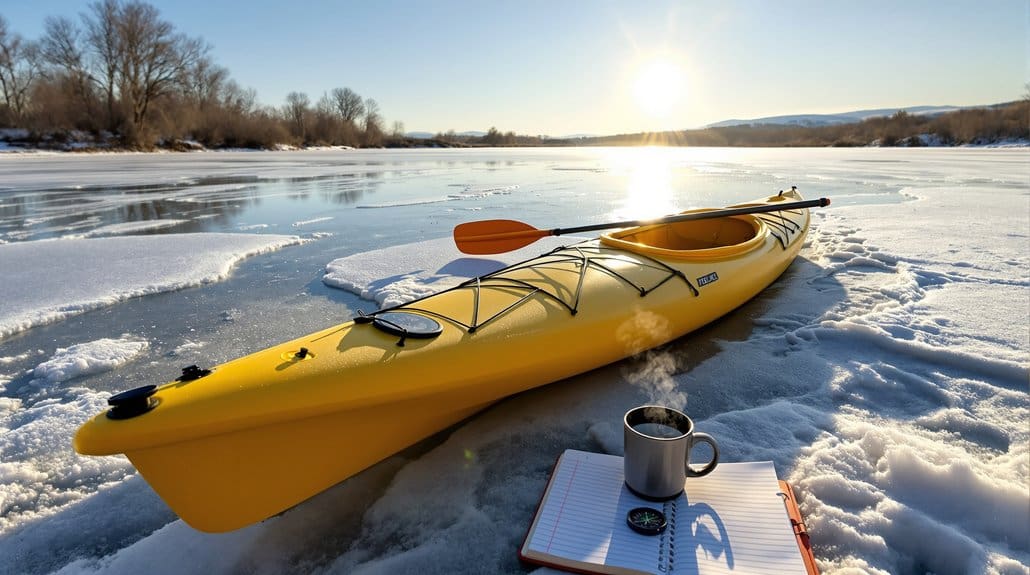
If you start your trip planning in winter, you’ll save both time and money because airfares and lodging quiet down after the holidays, so look for January tickets that are often 10–30% cheaper and snag campsite and waterfront cabin spots before spring fills them up. You’ll want to use that slower season to set alerts on Google Flights, Hopper, or Kayak, watch midweek departures, and lock domestic trips 1–3 months out or international 2–6 months ahead, which usually hits the best prices. While you research, compare rentals, local club gear swaps, and off-season sales for paddle and safety kit, and book the campsite or launch spot so you’re free to go when weather and tide look right. Also consider searching for waterproof phone cases and other gear tailored to paddling to protect your devices on wet adventures.
Choose Your Trip Type: Day Paddles, Multi-Day, or Expedition
Start by picking the trip length that fits your skills and schedule: for quick local day trips plan 2–4 hours on sheltered water, bring a spare paddle, PFD, and a dry bag with your phone and warm layers, and stick to easy exits. If you want multi-day work, map daily routes of 8–20 miles with campsite or hut reservations, pack water treatment, sealed food storage, and a tent or bivy, and think through resupply points and how weather could change your plan. For expedition-style outings expect long offshore days, check permits and tide windows, use a sea kayak with big hatch space and pro safety gear like an EPIRB and VHF, and make sure you’ve practiced navigation and self-rescue before you go. Also consider choosing a high-quality drytop to stay warm and dry during colder paddles, especially on longer trips with variable weather and water exposure, since the right gear can extend your season and comfort on the water; see our guide to drytops.
Day Trips: Quick Local Explorations
Planning a day paddle means picking a launch within about a 30–60 minute drive so you can actually spend 2–4 hours on the water, return the same day, and keep logistics simple; check tide and wind forecasts—Windy or NOAA are good—aim for winds under 10–12 mph and either slack tide or a favorable current so your 5–15 mile outing stays comfortable, scout your access and egress points ahead of time so you know where to park, how big the ramp is, and where you could bail out in the first 2–3 miles if something goes wrong, and pack light but smart: your PFD, a spare paddle, 2–3 liters of water, 1,500–2,500 calories of snacks, a whistle, phone in a dry case, and a small first-aid kit in a dry bag; and if you’re using day trips to train for multi-day or expedition work, strap on a 15–25 lb daypack and practice re-entry, navigation, and quick shelter setups during the outing so you build confidence without committing to overnight logistics. When you’re ready, leave early to snag calm time, check weather again, and use this short window to beat winter blues, sharpen Paddling skills, and reclaim time for exploration, testing gear and routes so you’ll feel freer when longer trips call. Choosing the right beginner kayak can make those outings safer and more enjoyable, especially if you prioritize stability and storage capacity for training gear beginner kayaks.
Multi-Day: Route & Resupply
You’ll want to think in days, not miles, when you’re plotting a multi-day route, so pick realistic daily goals—about 10–20 miles if you’re in a loaded touring kayak or 6–12 miles if you’re in a lighter tripping boat paddling surf or rocky coast—then factor in wind, current, and the extra time a headwind can add. Plan resupply points ahead, mark towns, marinas, and stores, and aim for at least one confirmed stop every 2–4 days, noting hours and seasonal closures, because winter schedules change. Scout access points and legal campsites, reserve when you can, and pick alternates every 8–12 miles. Carry three days of spare food, a reliable stove, repair kit, realistic pack weights, and a shuttle or cache plan for remote stretches. Winter is also a great time to compare kayaks and gear, since manufacturers and retailers often have detailed product guides to help you choose the right boat and equipment.
Expedition: Logistics And Permits
If you’re eyeing an expedition rather than a day trip or a quick overnight, think like an organizer first—what permissions, communications, resupply, and escape routes do you need before you ever shove off—because getting those pieces right keeps everyone safe and keeps the trip legal. For expedition-style trips you’ll draft navigation plans, arrange VHF or SAT comms, and file a float plan with a trusted contact, and you’ll check whether federal, state, tribal, or private permits are required, because landing rights vary. Plan resupply points and fuel or food caches spaced within your paddling range, map alternate exits every 15–25 miles, and budget for campsite permits, equipment inspections, fishing or CITES paperwork, and insurance or guide approvals so nothing surprises you mid-trip. Also consider equipment choices like kayaks and trolleys to match your route and payload needs.
Map Seasonal Windows: Northern vs. Southern Hemisphere Timing
Because seasons flip when you cross the equator, you can chase summer conditions by timing trips to the opposite hemisphere, so start by matching your calendar to the paddling window you want — Northern summer runs roughly June–September, Southern summer is about December–February — and then check local details like water temps, wind trends, and hazard seasons before you book. You want freedom, so plan inversely: search Southern spots in Northern winter, Northern ones in Southern winter, but don’t ignore local quirks like Florida’s warm April–October or Tasmania’s December–March prime. For Winter Paddling and Cold weather prep, start looking at sea temps, wind forecasts, and cyclone or snowmelt seasons, pick calm months, pack drysuit, spare kit, and a solid float plan. Also consider gear and outfitting advice from a trusted Gear Guide to match kayak choice and accessories to open-water touring conditions.
Build a Prioritised Hit List: Near, Long-Drive, and Far-Off Destinations
When you’re putting together a hit list for winter paddling, start close to home and work outward so you always have realistic options — jot down 6–10 spots within an hour that you can run to after work, including put-in GPS, where to park, and the season when conditions are calm. Then add 6–10 long-drive choices, note road time, fees, and whether they suit day trips or overnight runs, and finish with 4–6 bucket-list far-off spots, ideal months and trip length. Make sure you score each by drive time, seasonality, skill and cost so you can sort high/medium/low, capture trip reports and operator contacts, and turn top picks into bookings fast. New paddling plans feel warm and dry when you prep this way. Consider choosing a stable touring kayak for these trips to match your planned conditions and skill level, especially when prioritising stability and load capacity.
Use Online Tools to Find Deals and Best Travel Dates
You’ve already picked your near, long-drive, and bucket-list spots, so now start squeezing money and time savings out of the planning by using the right online tools, and do it in this order: check flexible-date maps, set fare alerts, and test alternate routings. Use Google Flights’ Explore map and its price graph to spot great time windows—domestic fares often drop 1–3 months out, January can be ~16% cheaper—then set Hopper or Kayak alerts for your exact route, enable predictions, and watch that inbox. Try midweek travel or a Saturday leave with Wednesday return, compare nonstop versus long-layover fares, and if you’re bold, test hidden‑city (carry‑on only), but know the risks. Flexible-destination filters reveal flash deals, so act fast when algorithms signal a clear drop. For paddlers planning gear and routes, also research handheld GPS options and kayak models to match your trip needs, including water trails and device compatibility.
Scout Access Points, Campsites, and Permit Requirements
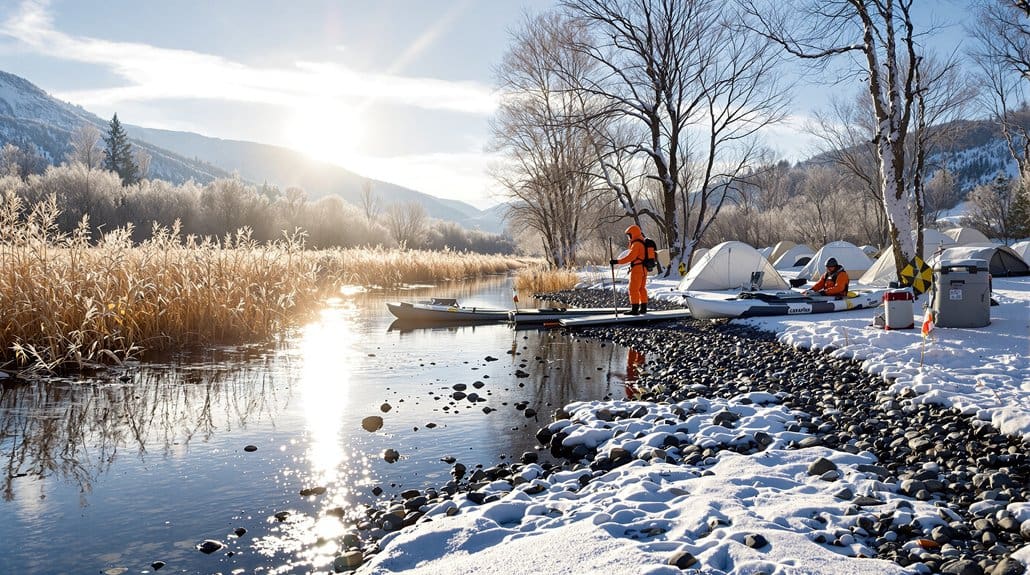
Start by scanning winter satellite maps to find put‑ins and takeouts—look for boat ramps, parking lots, visible trails within 100–500 meters of the water, and note tide lines so you know if a carry will be short or long. Then map likely campsites and management zones, check campsite inventories and reservation windows on official sites, and plan for alternative exits by measuring distances to service roads or cell coverage in case weather or tides change. Finally, research permit rules and fees well ahead—some areas need day‑use or kayak permits, quota spots, or one‑way shuttle permits, and fines for ignoring them can be steep, so book or apply as soon as reservations open.
Locate Launch And Takeout
Pick through satellite maps and local GIS layers to find likely put-ins and takeouts—scan for boat ramps, parking areas, docks, gentle shore slopes, or road ends within about 50–200 meters of a road, and mark those coordinates as your primary options. Check for private ramps, confirm shoreline access, and note tidal timing if you’re on tidal waters, because a calm-looking spot at high tide can become a scramble at low. Review parcel maps and contact land managers when access seems iffy, then record GPS waypoints, parking capacity, trailer or vehicle limits, and emergency egress routes. Look up permits and fees early, save offline charts and a printable map, and carry printed permissions or reservation confirmations on trip day.
Map Campsites And Zones
When you’re mapping campsites and access zones, think like a scout: scan satellite layers in Google Earth or Gaia to mark put-ins, takeouts, and likely campsites, then export those waypoints as GPX or KML so you can load them offline on your phone or GPS; while you’re doing that, check official land-management sites for reservation rules and permits, cross-reference tide tables or river gauges to avoid mudflats and low flows, and note parking limits and portage distances so you don’t arrive with too many vehicles or too much gear for a long walk to shore. Now walk the map in your head, flagging campsite microclimates—wind exposure, shade, level spots—save photo tagged waypoints during recon, log portage logistics like road-to-shore distance and parking capacity, note potable water or cell-signal gaps, and mark latrines or fire-ring locations so your team arrives informed, light, and ready.
Check Permits And Restrictions
Before you paddle out, make checking permits and local rules your first real reconnaissance step, because a missed reservation or closed launch can turn a good plan into a long, cold scramble. You’ll check federal, state, and local portals — NPS and USFS sites, park pages — for permit timelines and lead times, since some backcountry permits need booking months ahead, and day-use passes might be walk-up. Scout access points on satellite maps to spot seasonal closures, parking limits, and ramp sizes, and confirm campsite rules where group limits, fire permissions, and tent spacing matter. Don’t forget drone restrictions and special-use permits for guiding or fishing, note fees and nonrefundable windows, and carry screenshots or printouts of approvals before you go.
Plan Logistics: Transport, Storage, and Vehicle Rigging
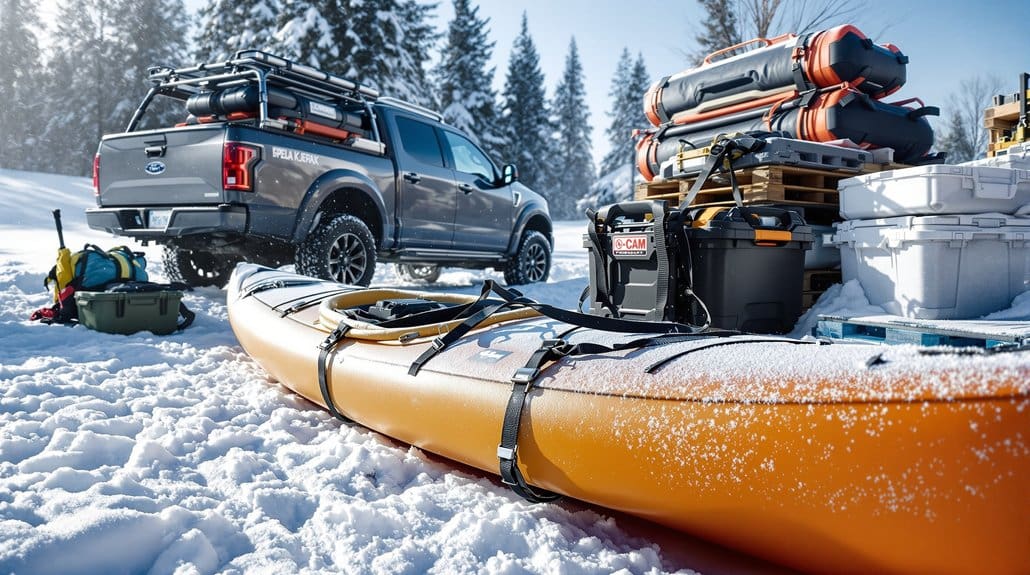
Start by measuring your vehicle and kayak carefully, since a few inches make all the difference: note your roofline height and the kayak’s length, beam, and height, then add at least 12–18 inches of overhang clearance at both bow and stern so you can position crossbars and tie‑downs without surprises. You’ll want accurate roofline measurements, a rated rack or trailer for the kayak’s weight, cam straps plus bow and stern safety lines rated ≥500 lb, and pulley systems rigged for shuttles or anchor retrievals, which save time and strain. Store boats upright on padded A‑frames in a heated garage if you can, keep hulls off the ground, check straps and bolts seasonally, grease bearings, and pack spare lines, quick‑links, and a 25–30 m throw bag.
Decide on the Right Kayak and Accessories for Your Goals
Because your choice of boat and kit will shape every trip you take, pick a kayak that matches the kind of paddling you plan to do—shorter, wider recreational boats (10–12 ft) are forgiving on calm lakes, longer, narrower touring or sea kayaks (12–18 ft) track and cruise better for distance and open water, and surf or surf‑ski designs (14–17 ft) deliver speed and downwind performance if you want coastal runs. Think freedom: decide if you want stability for relaxed days, or speed for long lines, then focus on cockpit fitment and seat comfort, check hatch space and bulkheads, and weigh material tradeoffs between tough polyethylene and lighter composites. Pay attention to hull tuning — keel, rocker, and beam — choose a paddle that cuts fatigue, carry a spare, PFD, pump, dry bags, and a tow.
Create a Winter Gear Checklist and Try-Before-You-Buy Protocol
Start by making a winter kit checklist that names layers and essentials—moisture‑wicking base (merino or Capilene), insulating midlayer, waterproof outer or drysuit, neoprene booties, pogies or gloves, hood, plus PFD, whistle, spare paddle, dry bags, and a first‑aid kit with hand warmers and a space blanket—and compare it to each trip so you don't forget a critical item. Note exact fit and compatibility for key pieces (PFD model and chest size, drysuit boot size, glove thickness, whether the hood plays nice with a helmet or pogies sit on the cockpit rim) and mark anything you need to test. Before buying expensive gear, borrow or rent it and use it in controlled water time—pool or calm water for at least an hour—then run simple pass/fail checks like wet exits, a controlled roll, fingertip dexterity after 20 minutes, and no seal leaks, log the results, and only commit after a professional fitting if needed.
Essential Winter Kit
You’ll want to treat winter gear like a safety system, not a fashion choice, so begin by thinking about what protects you from cold water and wind first, then add comfort and convenience items that make trips practical; that means a properly fitted PFD rated for kayaking, and preferably a drysuit (or a wetsuit if you’re limited) because a single sealed garment cuts failure points and buys you more survival time, layered clothing that wicks moisture next to the skin and insulates with fleece or synthetic mid-layers while avoiding cotton, and a waterproof breathable outer shell for spray and wind. Choose layered gloves that let you paddle and ditch them in a rescue, thermal socks inside neoprene booties, check helmet fit for comfort and retention, carry a spare paddle, VHF or waterproof phone, whistle, hand warmers and an emergency bivy, and test pieces where you can before buying.
Try Gear In-Real-World
Think of this first field trial as a squint-test for your winter kit: bring your checklist—drysuit or dry top plus insulating base layers like merino or Capilene, neoprene booties, pogies or gloves, a neoprene hood, a PFD, a spare paddle, and a dry bag with hand warmers and an emergency blanket—and then put each item through the simple, practical motions you’ll rely on in an actual outing, paddling in calm water for short stints while doing strokes, bracing, wet exits and a few rolls to watch for fit, freedom of movement, and where water sneaks in; note how long until your fingers or toes go numb, whether the drysuit gapes at the cuffs or neck when you twist, if pogies let you grip and release quickly, and how a borrowed or rented piece plays with your skirt and rescue techniques so you can compare gear by real numbers and real feels before you spend cash. Do layered Layering experiments during Mobility assessments and run Rescue simulations, record times to roll and self-rescue, and measure water intrusion, then tweak layers or swap items until your kit matches the freedom you want on the water.
Borrow Before Buying
Before you plunk down cash, try on the kit in real cold water so you know how it behaves when it matters—borrow or rent a drysuit or dry top, pogies, and neoprene boots for at least one outing, ideally two to four hours on flat water, and treat that time like a test drive: check neck and wrist seals by twisting and reaching, paddle a full stroke cycle to see if your PFD and layers limit rotation, fumble with grip and release while wearing pogies or gloves to see if you can brace or grab a paddle quickly, time how long until fingers or toes go numb, and watch for leaks or chafe when you get in and out; ask shops or clubs about demo periods and damage policies up front so you don’t get surprised, score each item on a 1–5 checklist with notes on temperature, duration, activity level and donning/doffing time, and use that logged data to tweak layers or swap pieces until the kit feels like something you’d trust on a real winter paddle.
Train Indoors: Paddling Technique, Strength, and Balance Routines
Get inside the rhythm and keep your technique sharp all winter by training on land, where you can focus on stroke cadence, strength, and balance without cold-water interruptions; hop on a paddling erg or kayak-specific machine for 20–30 minutes a few times a week to match the 40–60 strokes per minute you use on the water, watch your torso rotation and hand height, and make small adjustments until the motion feels smooth. You’ll work cadence drills and resistance intervals to build endurance and power, add 2–3 sets of rows, single-arm pulldowns, and seated cable rotations for lats and obliques, and do core sets—planks, side-planks, Pallof presses—for torque transfer. Practice balance on one leg or an unstable surface, simulate rolls weekly in your layers, and keep gear fit tight.
Organise Your First Group Trip: Roles, Meals, and Safety Plans
When you’re putting together your first group kayak trip, start by naming who’s going to do what—pick a trip leader to hold permits and make route calls, a navigator to read charts and watch tides, a safety/rescue lead for on-water issues, someone to manage food and logistics, and a gear person to check communal kit—because handing out roles early cuts down on confusion the day you shove off and makes one person accountable if plans change. You’ll keep freedom by trusting role clarity, by writing a simple safety plan with check-in times, VHF and phone emergency communication points, bailout routes and buddy pairs, and by organizing meal rotation with calorie-dense, easy meals and high-fat snacks, plus shared kit checks and spare paddles.
Test Plans With Mini-Trips and Finalise Bookings 2–6 Months Out
Now that people know their roles and you've sketched out meals and safety checks, it’s time to test those plans with a couple of mini-trips so you can fix problems without blowing your main-trip budget. Run one or two overnight rehearsals, car-camping plus day paddles, six to eight weeks out, timing drills for launches and drive-plus-load minutes so you learn real start-to-launch numbers and set honest daily paddle distances, watch for needed gear swaps if something doesn’t fit or weigh too much, and practice leader duties and rescue drills until everyone’s fluid. Use January–March to lock international campsites, ferries, and rentals two to six months ahead, check flight alerts for dips, and build contingency budgeting into bookings. Finalise once the mini-trips validate plans.
Some Questions Answered
Is Kayaking Good in Winter?
Yes — you can kayak in winter, but you’ve got to respect cold safety and plan smartly, wearing a drysuit or thick wetsuit with insulating layers, carrying a whistle, tow system, spare paddle and a waterproof phone. Check weather, river gauges and exits, paddle with others, and practice wet exits and rolls, because rescue matters fast. Enjoy quieter waters and winter wildlife, bring hot drinks and spare warm gear, and stay deliberate, not daring.
How Cold Is Too Cold to Go Kayaking?
If water temp drops below about 15°C (59°F), you’re entering cold-water paddling where hypothermia risk rises fast, so treat it seriously, wear a drysuit or wetsuit and prioritize gear insulation. Check water temp, carry spare dry layers in a sealed bag, a PFD and helmet, plan short shore-hugging routes, and practice self-rescue. If temps fall toward 0–5°C, don’t paddle without full cold-water protection and a solid rescue plan.


