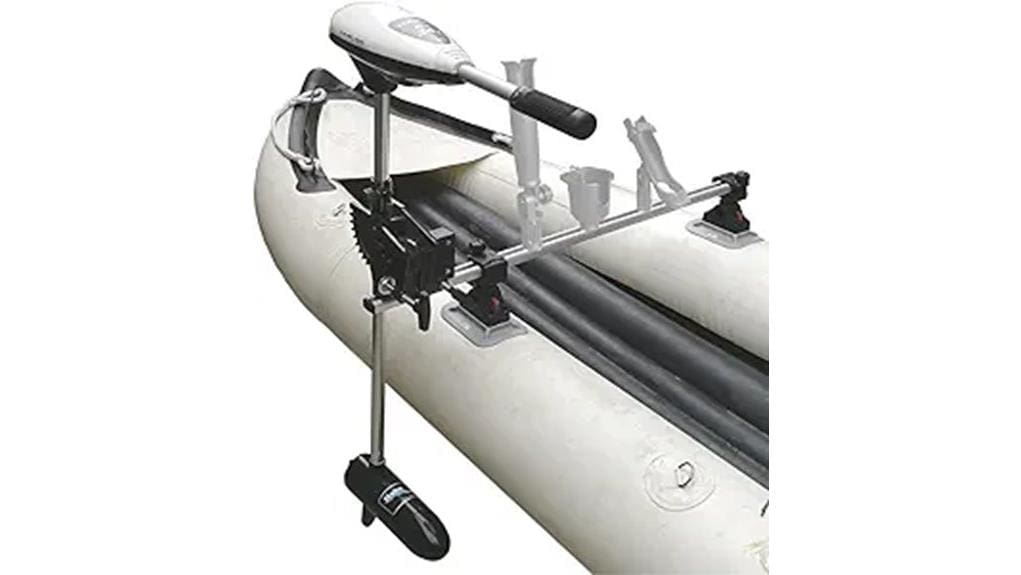
You’ll get a rigid, adjustable aluminum track that bolts to glue‑on PVC pads and will hold most small trolling motors on inflatable kayaks and SUPs. It’s lightweight, minimalist, and gives predictable alignment under trolling loads, though you’ll need PVC‑compatible adhesive and a confined‑water test after fitting. Clamps reduce vibration but won’t eliminate high‑RPM resonance and salt use needs careful rinsing. Installation takes some prep and torque checks; keep going for full fitment, install, and maintenance details.
Some Key Takeaways
- Sturdy aluminum track gives a rigid, low‑flex platform that maintains motor alignment under typical trolling loads.
- Requires glue-on PVC pads and PVC‑compatible adhesive; adhesive not supplied and proper bonding is critical.
- Adjustable mount fits most PVC inflatables when pads are placed on flat transoms or reinforced rails.
- Nylon protective clamps reduce vibration but may not eliminate high‑RPM resonance; periodic torque checks advised.
- One‑year warranty; rinse after salt use and inspect bonds regularly to avoid clamp slippage or corrosion.
Quick Verdict: Is the Brocraft Motor Mount Worth Buying?
While it won’t include a motor, the Brocraft Inflatable Kayak Trolling Motor Mount delivers a solid, no-nonsense solution for adding propulsion to PVC inflatables and SUPs: its marine‑grade aluminum track and adjustable aluminum mount provide robust, corrosion‑resistant support, the dual nylon protective clamps secure the motor, and the two glue‑on pads let you fit varying hull widths—just remember glue isn’t supplied and installation requires adhesive suited to PVC. You’ll get a super‑strong, minimalist mounting system that frees you to choose battery options and mounting accessories. It’s practical, lightweight, and backed by a one‑year warranty; suitability depends on motor weight and installation care. Designed with drop-stitch kayakers and beginners in mind, it pairs well with basic gear and simple setups.
What Boats and Motors It Fits : Compatibility and Sizing Tips
Because the mount adjusts to different hull widths and uses two glue-on PVC pads, you can fit it to most PVC inflatable kayaks and SUP paddle boards provided you apply appropriate adhesive and position the pads on a structurally sound section of hull. Check hull compatibility: flat transoms and reinforced rail areas work best. Verify shaft length for clearance and steering control; short shafts suit sit-on-top kayaks, longer shafts suit higher freeboard. Check the mount adapter options if your motor uses an uncommon clamp or bracket. Match motor power to the mount’s aluminum construction and clamps; avoid overspecifying thrust that exceeds clamp ratings. Also consider basic essential gear—like a pump, repair kit, and proper PFDs—when fitting a mount to an inflatable kayak.
How to Install It on Inflatable Kayaks and SUPs (Step‑by‑Step)
Now that you’ve checked hull compatibility and motor shaft length, prepare for mounting by gathering tools, adhesive, and a clean workspace on a flat surface. Position the aluminum track bar where it clears valves and seams; mark pad locations. Degrease PVC, test-fit glue-on pads without adhesive, then choose adhesive selection compatible with PVC (PVC-specific marine adhesive recommended). Apply adhesive, set pads, clamp until cured per adhesive instructions. Attach motor mount and motor clamp hardware to the track bar. Route safety and load straps, verify strap routing avoids chafing. Torque fasteners to spec, inspect bonds, and perform a confined-water test before open-water use. For best long-term performance on an inflatable kayak, consider materials and mounting practices recommended for hard-shell inflatables to reduce wear and improve durability.
On‑Water Performance: Durability, Handling, and Common Issues
When you take the Brocraft mount onto the water, expect a rigid, low‑flex platform that holds motor alignment well under typical trolling loads. You’ll notice solid handling; the marine‑grade aluminum track resists deformation and minimizes hull flexing on inflatable kayaks and SUPs. Corrosion testing appears adequate for occasional salt use, though regular rinsing is prudent. Vibration damping relies on nylon protective clamps; they reduce chatter but won’t eliminate resonance from high‑RPM motors. Watch for clamp slippage if pads aren’t bonded perfectly to PVC—secure glue application and periodic torque checks prevent movement. Overall durability is strong, with predictable maintenance needs. Beginners should also consider proper anchor selection to ensure stable positioning and safety on varied water conditions.
Pros, Cons, Warranty, and Best Alternatives to Consider
Having seen how the mount performs on the water, you can now assess its practical advantages and drawbacks alongside warranty coverage and alternative options. You get a super-strong, adjustable aluminum track that fits inflatable kayaks, SUPs and small boats, boosting propulsion without permanent mods. Cons include glue-on pads required (adhesive not supplied), potential corrosion if neglected, and one-year warranty with warranty limitations on misuse and glue failures. Follow maintenance tips: rinse, inspect clamps, lubricate fasteners. Consider alternative mounting: transom brackets or universal clamp mounts for easier removal. Resale value holds if you keep hardware corrosion-free and documented. For kayakers using power poles, consider adding a mounting track to your setup as essential gear for secure motor mounting.
Some Questions Answered
Can It Be Used in Saltwater Without Corrosion Issues?
Yes — you can use it in saltwater, but expect routine corrosion management. The marine-grade aluminum track and mount resist corrosion, yet saltwater accelerates electrochemical wear; add sacrificial anodes and rinse fresh after use. The nylon clamps help isolate metal, but you’ll need regular inspections and fastener care. You’ll preserve function by replacing anodes periodically, lubricating moving parts, and storing dry; this keeps saltwater compatibility practical and reliable.
Does the Mount Interfere With Kayak Storage or Transport?
No, it usually won’t interfere with storage or transport if you plan accordingly. You’ll remove the motor and clamps, then stow the lightweight aluminum track and mount; the parts compress for car roof rack placement or fit on garage shelving. You’ll still account for glued pads on PVC hulls and make sure fasteners are tight. The design’s low profile and modularity preserve freedom to transport and store without major modification.
Are Replacement Glue-On Pads Sold Separately?
No — replacement pads aren’t listed as sold separately. You’ll need to source compatible replacement pads and adhesive options yourself if needed. Choose marine-grade PVC glue or neoprene-safe adhesives for reliable bonding; test a small area first. Make certain pad dimensions match the mount’s two-side glue-on design and follow cure times for full strength. Keep a backup set and routine inspections to maintain secure attachment and preserve freedom on the water.
Can Two Mounts Be Installed on One Kayak for Twin Motors?
Yes — you can install two mounts for twin motors, provided your hull width and glue-on pad spacing allow secure placement. You’ll need to plan twin throttle control routing and safe battery placement to balance weight and avoid wiring conflicts. Utilize marine-grade mounting points and effective mounting techniques to align motor thrust vectors, ensuring that clamps don’t interfere. Follow load limits, secure batteries in waterproof boxes, and test maneuvering at low speed before full operation.
Is Professional Installation Recommended for Beginners?
You don't strictly need professional installation, but it's recommended if you're a beginner. You'll want correct motor alignment and proper weight distribution to avoid handling issues. A pro guarantees the marine-grade aluminum track, clamps, and glue-on pads are fitted and centered, reducing stress on the hull. If you’re comfortable with tools and careful measuring, you can install it yourself; otherwise hire a technician to guarantee safety and performance.