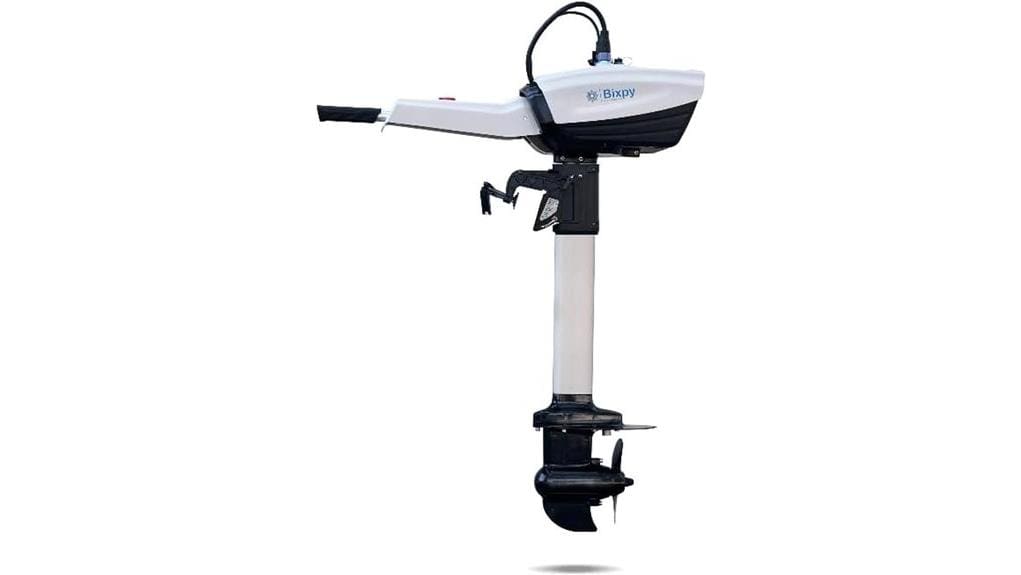

You’ll find the Bixpy N-3 outboard delivers smooth, stepless throttle control, predictable cruising and sharp steering for inflatables, dinghies and tenders. Its long 27.3" shaft keeps the prop submerged in chop, while marine‑grade alloys, anodized fittings and an IP67 sealed housing resist corrosion and temporary immersion. It’s lightweight and easy to mount, with hours of trolling on a proper lithium pack but limited top speed and range. Keep going and you’ll get setup, runtime and maintenance details next.
Some Key Takeaways
- Smooth stepless throttle offers precise speed control ideal for casting, trolling, and short hops.
- Long 27.3" (693 mm) shaft improves prop immersion, handling, and reduces cavitation on higher transoms.
- IP67-sealed electronics and marine-grade alloys resist corrosion, but use sacrificial anodes for prolonged saltwater use.
- Lightweight, compact design with carry handles makes installation, transport, and solo launching straightforward.
- Best for inflatables, dinghies, and day trips; not suited for long-range cruising, heavy towing, or high top speeds.
Performance and Handling: Real-World Speed, Throttle Feel, Range, and Maneuverability for Small Boats
Expect predictable, steady performance from the N-3 on small, lightweight boats: its stepless throttle gives you smooth, precise speed control ideal for casting, trolling, or short hops, and the long 27.3" shaft helps maintain efficient prop immersion and handling in varying load and chop conditions. You’ll notice excellent speed consistency at cruising settings, letting you focus on navigation or fishing without constant throttle corrections. Steering responsiveness is sharp for its class, so tight turns and tracking feel controlled. Range suits short trips and day outings; the low weight and compact profile free you to launch and explore with confidence. The N-3 pairs well with common kayak power pole setups and essential mounting gear for a secure, low-profile installation kayak power pole.
Build, Waterproofing, and Corrosion Resistance: Materials, IP67 Housing, and Saltwater Suitability
Alongside its predictable on-water behavior, the N-3’s construction is built to stand up to regular marine use: manufacturers use marine-grade, corrosion-resistant alloys and coatings on exposed metalwork and fasteners to limit electrochemical wear in both freshwater and saltwater. You’ll find anodized fittings and epoxy coatings on critical joints, plus marine grade plastics on housings and control surfaces to resist UV and impact. The IP67 sealed housing keeps dust and temporary immersion from reaching electronics, and designers recommend sacrificial anodes for prolonged saltwater exposure. Overall, the kit balances weight and durability so you can cruise without constant maintenance. For paddlers concerned about emergency signaling, pairing the motor with a personal locator improves safety on longer trips.
Installation and Portability: Transom Mounting, Long-Shaft Fit, Weight, and Step-by-Step Setup
Getting the N-3 mounted and ready to go is straightforward thanks to its compact housing, clear mounting points, and long-shaft (27.3"/693 mm) design that suits higher transoms on inflatables, dinghies, and small boats. You align the clamp, set recommended mounting torque on the bolts, and tighten evenly to avoid stress on the transom. The lightweight kit and integrated carry handles make transport and solo handling simple. With the long shaft you’ll clear most motor wells and avoid cavitation. Step-by-step: position, clamp, torque, secure safety tether, attach control linkages, verify alignment, and perform a short dock trial. This makes it easy to transfer and transport alongside accessories like kayak cart wheels for beach launches.
Battery, Power, and Maintenance: Expected Run Times, Charging, Low-Maintenance Care, and Usable Accessories
Plan your outings around the N-3’s power profile: with its efficient brushless motor and stepless throttle you’ll typically see several hours of run time on a suitably sized lithium battery pack at trolling speeds, and shorter durations as you increase throttle or fight currents. You’ll monitor battery health by tracking voltage under load and respecting recommended charging cycles to preserve capacity. Follow a simple maintenance schedule: rinse after salt use, inspect seals, and torque mounts. Use only tested battery packs and approved chargers to guarantee accessory compatibility. Pack a spare battery and a compact charger to maximize range and freedom. For extended trips consider carrying an emergency power bank designed for paddlers with waterproof features and long battery life.
Who Should Buy the Bixpy N-3 and Alternatives to Consider: Ideal Users, Limitations, and Comparable Motors to Compare Before Buying
Who is the N-3 best for, and where might you want to look elsewhere? You’ll appreciate the N-3 if you own inflatable boats, dinghies, kayaks or tenders and value portability, easy transom-mount installation, stepless throttle control and reliable dock compatibility. It’s ideal for short trips, fishing and low-maintenance weekend freedom. Don’t pick it if you need long-range power, heavy-load towing or high top speeds; larger outboards or higher-capacity electric motors suit those needs better. Consider comparable compact electric motors from Torqeedo and Minn Kota, weigh costs, warranty and resale value, then match real-world load and run-time expectations. Many inflatable kayak owners also find having dedicated essential gear for inflatables improves safety and convenience on the water.
Some Questions Answered
Is a License or Registration Required to Use This Motor on Public Waters?
It depends on where you boat: many places require registration requirements for any motorized vessel and boating licensing for operators. You’ll need to check state or local laws—some jurisdictions exempt very small electric motors, others don’t. Carry proof of registration and any required license, follow safety gear and operating rules, and contact the local boating agency or coast guard to confirm specific thresholds, fees, and decal or numbering obligations before you launch.
Can the Motor Be Used as an Auxiliary for a Sailboat Under Sail?
Yes — you can use it as an auxiliary while under sail. You’ll use it for underway steering and sail assist trimming in light winds or when maneuvering, giving you precise, low-speed control. It’s compact and portable, so you’ll mount and stow it quickly, and the stepless throttle helps you fine-tune thrust without jerks. You’ll still respect sailing priorities and regulations, using the motor to extend your freedom on the water.
What Warranty and Customer Support Options Are Available?
You get a limited warranty; typical warranty duration is one year against defects, with options to register for extended coverage when available. You can contact customer service by email or phone for troubleshooting, parts, or warranty claims, and they'll guide you through diagnostics, repair authorization, or replacement procedures. You’ll appreciate responsive, detail-focused customer service that supports installation, operation tips, and freedom to enjoy your watercraft confidently.
Are Replacement Parts and Propellers Sold Separately?
Yes — spare propellers and many replacement batteries are sold separately, so you can keep moving without being tied down. You’ll find OEM spare propellers and battery options through official channels and authorized dealers; they’re designed to match motor specs and maintain performance. You’ll want to confirm model compatibility and warranty implications before buying aftermarket parts, and you can usually order parts online for fast delivery to maximize your time on the water.
Does the Motor Comply With Local Noise or Emissions Regulations?
You’ll generally comply: the electric motor produces no combustion emissions, but you’ll still want to confirm local emissions testing rules that may apply to battery-powered craft. Noise usually falls well under typical sound limits for small vessels, yet some jurisdictions have specific decibel or operational restrictions. You should check regional regulations before use, retain proof of specs, and carry documentation showing IP67 and marine-grade materials to demonstrate compliance if questioned.