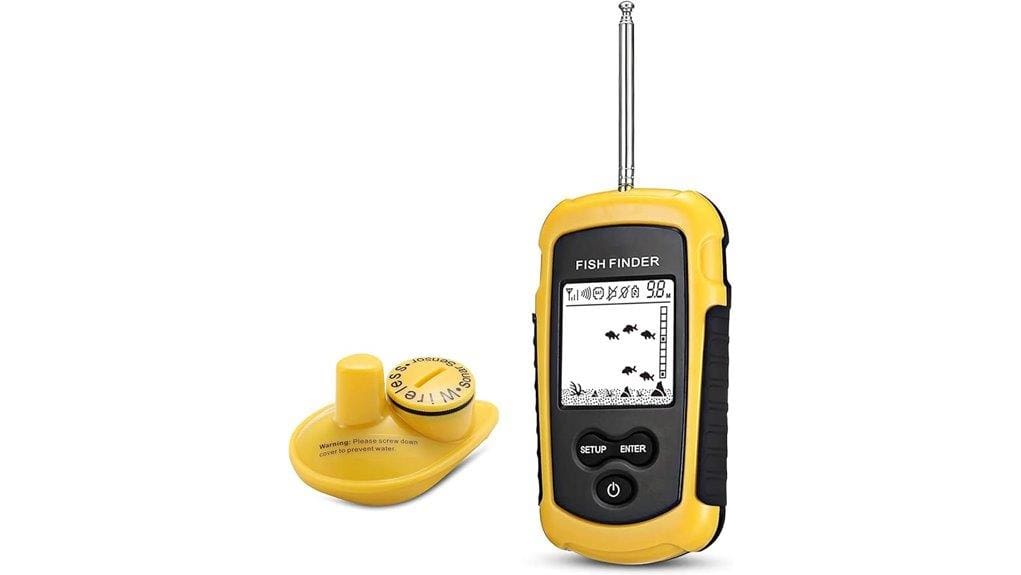
You’ll find the Atibin castable shore fish finder a solid, portable choice if you want quick depth and fish returns from shore, kayak, or RC boat. It’s easy to set up, casts or tows well, and gives usable depth from about 0.7–40 m with clear fish marks at moderate ranges. Battery-save and sensitivity controls help manage multi-hour trips and noisy water. It’s best for mobility and simple site checks — keep going and you’ll get deployment tips and alternatives.
Some Key Takeaways
- Portable, castable sonar ideal for shore, kayak, or RC-boat use with fast, simple setup.
- Reliable wireless range up to ~393 ft (120 m) and usable depth returns down to about 130 ft (40 m).
- Immediate depth and fish-mark readings, with clear fish arches at moderate ranges.
- Five sensitivity levels, 90° beam angle, power-save and auto shutoff for long trips.
- Best for mobile anglers seeking simplicity; consider tethered or GPS-charting units for deeper or mapping needs.
Quick Verdict: Is the Atibin Castable Shore Fish Finder Worth Buying?
If you want a portable, easy-to-use sonar that works from shore, kayak, or an RC boat, the Atibin castable fish finder is worth strong consideration. You’ll get a straightforward tool that frees you to fish where you want without bulky gear. Setup’s fast: choose mounting options or tie the transducer to line or craft, deploy, and read depth and fish marks immediately. Battery maintenance is simple — automatic cutouts and power-save stretch run time — so you won’t be stranded. For anglers craving flexibility, it’s a practical, reliable choice that prioritizes mobility, simplicity, and clear information. Ideal for kayak anglers, it complements other portable fishing gear and accessories.
Real-World Performance: Casting Range, Depth Accuracy, and Fish Detection
Putting the Atibin castable sonar into action quickly shows what it can do: you can reliably operate it up to the stated 393 ft (120 m) wireless range in open conditions, and it gives usable depth returns from about 2.3 ft (0.7 m) down to the 130 ft (40 m) limit. In practice you’ll get consistent cast accuracy when you tie the sensor to line or an RC boat and aim for spots beyond shore reach. Depth readings are immediate and repeatable; fish arches are clear at moderate ranges. Watch for signal interference near structures or crowded beaches—move a few yards for cleaner returns. This makes it a solid choice for kayakers and beginners looking for simple, portable fish-finding gear.
Features That Matter: Battery Life, Sensitivity Levels, Beam Angle, and Alarms
Because battery life and configurable sensitivity largely determine how useful the Atibin is on a long outing, you’ll want to understand their real-world impact before you cast. You get reliable battery performance with power-save and automatic shutoff when the sensor leaves water, so multi-hour trips won’t strand you. Five sensitivity levels let you tailor sonar for clear or turbid water, minimizing false marks. The 90° beam covers structure and schools without constant repositioning. Built-in fish detect alarm and backlight aid low-light sessions, and simple alarm customization keeps alerts meaningful so you stay free to move and fish. This makes the Atibin a practical choice for kayakers who value compact, purpose-built gear and accurate measurements like those used for fish measuring boards.
How to Use It Effectively From Shore, Kayak, or RC Boat
When you’re fishing from shore, a kayak, or an RC boat, position and deployment matter most to get reliable readings quickly. Cast the transducer beyond breaklines when line fishing from shore, or tie it to a lightweight leader for kayak drift coverage. Use the mounting bracket on your RC boat for stable towing; avoid air exposure to prevent false readings. Keep the display in a waterproof case when paddling or windy days. Carry spare batteries for quick battery replacement and monitor power-save mode. Sweep slowly, adjust sensitivity for clarity, and retrieve the sensor gently to prolong life and accuracy. Also consider having a dog life jacket on board when paddling with pets to keep them safe around water.
Who Should Buy It and Alternatives to Consider
If you fish from shore, a kayak, or an RC boat and want a simple, portable sonar that’s quick to deploy, the Atibin castable shore fish finder is a strong choice—its 120 m wireless range, 0.7–40 m depth window, and 90° beam give you versatile coverage without running wires. You should buy it if you value mobility, quick site checks, and an easy setup—ideal for weekend freedom, beginners guide seekers, or as compact gift suggestions for anglers. Alternatives: tethered transducers for deeper offshore work, GPS-charting combo units for mapping, and higher-frequency models for fine structure detail. Perfect Kayak fish finder mounts add stability and convenience for anglers using portable sonar.
Some Questions Answered
Does It Work in Saltwater and Freshwater Equally Well?
Yes — it works well in both saltwater and freshwater. You’ll get reliable depth, fish location, and bottom contour readings across environments; just rinse the transducer after saltwater use to protect waterproof rating and extend battery life. You can adjust sensitivity for turbid or clear conditions and use the power-save mode for longer trips. Tie it to a line or RC boat, cast it, and you’ll quickly scout productive spots.
Can Multiple Devices Connect to One Phone or Tablet?
No, you can’t pair multiple devices simultaneously to one phone or tablet; the unit supports single multi device pairing sessions only. You’ll pair one castable transducer at a time, so you won’t get simultaneous streams from multiple sensors on one screen. If you want broader coverage, you’ll need multiple host devices or swap pairings manually. This keeps setup simple and preserves battery life and connection stability while you roam.
Is the Sensor Replaceable if It Gets Damaged?
No — the sensor itself isn’t designed for owner replacement; you’ll need to contact the manufacturer for repair or replacement if it’s damaged. You can change the battery in the handheld unit per instructions, but the castable transducer is sealed. Check warranty transfer options before buying used so coverage can move to you, and document damage when claiming service. Take care deploying the sensor to avoid voiding warranty.
How Long Is the Warranty and Customer Support Availability?
The warranty duration is typically one year, and you’ll get basic coverage for defects; check your seller for exact terms. Customer support is usually reachable during weekday support hours, often 9am–6pm local time, with email options outside those hours. You can expect replacement or repair guidance and troubleshooting help; if you want extended protection or faster response, consider purchasing seller or third-party coverage for added freedom and peace of mind.
Can the Device Transmit Through Heavy Vegetation or Surface Clutter?
No — the signal penetration through heavy vegetation and surface clutter is limited, and vegetation interference can reduce accuracy. You’ll still get depth and general fish indications, but dense weeds, lily pads or heavy surface chop will scatter the sonar and create false echoes. Cast or position the transducer into clearer water or use higher sensitivity to compensate, and you’ll regain more reliable readings for freedom to explore different spots.