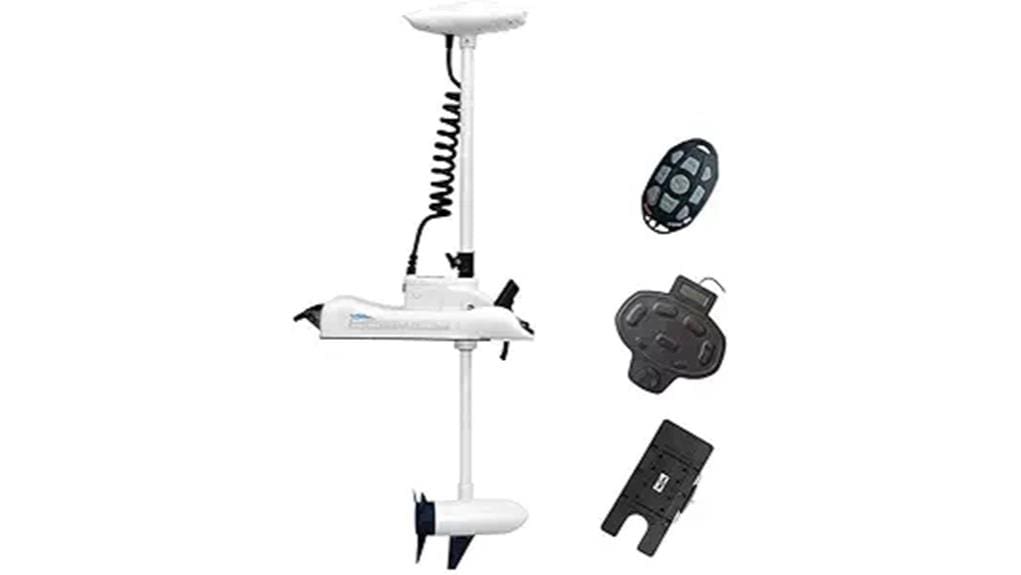

You’ll find the AQUOS Haswing CaymanB is a compact, quiet 55 lb-thrust bow-mount trolling motor that’s ideal if you run a small to mid-size boat and want precise, efficient low-speed control. It offers steady thrust, smooth speed modulation, a 48-inch shaft option, USB-rechargeable wireless remote plus a wired foot pedal, and a secure quick-release bracket. Battery management and corrosion checks are still necessary, and the longer review covers fit, trade-offs, and alternatives.
Some Key Takeaways
- Compact 12V bow-mount with 55 lb thrust suits boats up to ~18 ft for precise slow-speed maneuvering.
- Variable-speed control via USB-rechargeable wireless remote and wired foot pedal offers flexible hands-on or wireless operation.
- 48 in shaft (also 38.4 in option) and quick-release bracket enable correct immersion, repeatable trim, and easy removal.
- Aluminum alloy shaft, stainless fittings, and sacrificial anode resist corrosion but require regular inspection and maintenance.
- Efficient battery use with smooth throttle modulation; consider external battery monitoring and higher-thrust alternatives for heavier boats.
Should You Buy the AQUOS Haswing CaymanB? Quick Verdict and Ideal User
If you need a compact, quiet 12V bow-mount motor that balances power and efficiency, the AQUOS Haswing Cayman B is a strong option. You’ll appreciate its 55 lb thrust, 48 in shaft, and reversible operation for controlled maneuvering on boats up to 18 ft. You get variable speed for efficient battery use; still, implement external battery monitoring to optimize runtime. Controls include wireless remote and foot pedal for flexible command. Construction resists corrosion for broader range use. Buy if you prioritize portability, low noise, and autonomy. Check warranty details and vendor return policy before purchase. Many kayakers and new paddlers pair such motors with marine GPS and other essential gear to improve navigation and safety.
How the CaymanB Performs on Water: Thrust, Speed Control, Noise, and Efficiency
Although compact, the CaymanB delivers reliable 55 lb thrust that handles small to mid‑size boats (up to about 18 ft) for precise slow‑speed maneuvering and station‑keeping. You’ll notice consistent thrust consistency across low to mid RPMs, letting you maintain position without aggressive corrections. Speed modulation is smooth; incremental adjustments reduce prop slip and sudden torque spikes. Noise levels remain low compared with engines, supporting stealthy approaches and comfort. Battery draw tracks predictably with throttle setting, so you can plan range and spare capacity. Overall efficiency balances power and runtime, giving you freedom to fish longer with confidence. This makes the motor a great match for inflatable kayaks and beginner paddlers looking for an easy, reliable upgrade.
Controls and Handling: Wireless Remote, Foot Pedal, Cruise Control, and Depth Stow
Assess how you control the CaymanB and you'll find a choice of responsive interfaces: a palm-sized wireless remote, a wired foot pedal, and simple mechanical depth and stow controls that together prioritize precision and low effort. You’ll use the remote for untethered direction and cruise control; wireless ergonomics reduce hand fatigue and the USB-rechargeable unit extends runtime. The foot pedal offers direct, low-latency input with a 14.7 ft cable and quick-release deploy/stow. The depth collar locks securely for consistent trim. Cruise holds speed but requires manual heading tweaks. Overall controls balance remote reliability with tactile, low-complexity hardware for independent operation. For kayak anglers and beginner paddlers, consider pairing the motor with compatible kayak sail kits to expand your on-water options.
Mounting, Installation, and Fit: Shaft Length, Boat Size Limits, Materials, and Corrosion Protection
When you mount the AQUOS Haswing Cayman B, confirm shaft length and boat compatibility first: the 48-inch shaft (also offered in 38.4 inches) suits bow installations on boats up to about 18 ft or 2,750 lb, and guarantees proper immersion and steering leverage without excessive drag. You’ll use the quick-release bracket and depth collar for repeatable positioning; verify mounting compatibility with your bow thickness and transom clearances. The aluminum alloy shaft and stainless fittings balance weight and strength, but inspect sacrificial anode and coatings regularly to prevent shaft corrosion. Install electrical routing to minimize chafe and permit easy removal. Consider pairing the motor with appropriate kayak anchor trolley accessories for better anchoring control anchor trolley.
Real-World Pros, Cons, and Alternatives to Consider Before Buying
Before you commit, weigh how the Cayman B's 55 lb thrust, 12V efficiency, and 48 in shaft fit your boat and typical conditions: it delivers quiet, variable-speed control with a long-range wireless remote and quick-release mounting that make deployment and station-keeping straightforward, but its power and shaft length limit it to boats roughly ≤18 ft or 2,750 lb and to lighter-duty use compared with higher-thrust or GPS-equipped units. Pros: simple install, efficient battery draw, intuitive steering ergonomics, USB remote. Cons: limited thrust, no GPS, propeller options fewer, less effective in heavy wind. Consider higher-thrust or GPS alternatives and enforce a strict maintenance schedule and battery management plan. Transducer arms are a useful accessory for kayakers and beginners who want improved fishfinder performance with bow-mounted setups, especially when using quick-release mounts and compact motors like the Cayman B; see transducer arms for more details.
Some Questions Answered
Is the Remote Waterproof or Water-Resistant?
The remote isn’t fully waterproof; it’s water-resistant for typical splashes and rain but not submersion. You’ll want to protect it to preserve battery life and avoid corrosion. The remote range reaches about 164 ft; the button layout is simple and palm-sized for quick access. Treat it as splashproof gear: stow it during heavy spray or submerge events, and charge regularly to maintain reliable battery life and signal performance.
What Battery Capacity Is Recommended for Optimal Run Time?
Use a 12V deep cycle battery rated 100–200 Amp hours for ideal runtime; you’ll get extended run times with 150 Ah as a practical balance. Monitor charge and implement battery management to avoid deep discharges and preserve capacity. For marathon outings, parallel two 100 Ah batteries or move to 200 Ah single units. Regularly check voltage under load to fine-tune runtime optimization and maintain freedom on the water.
Can the Motor Be Used With a Second Battery in Parallel?
Yes — you can parallel a second battery to increase capacity, but you must manage battery paralleling and voltage balancing to avoid damage. You’ll connect identical 12V batteries in parallel, use heavy-gauge wiring, fuses, and a common charging system or an automatic voltage balancer. Monitor state-of-charge and match ages/chemistries. Proper installation preserves freedom on the water while ensuring safe, efficient operation and extending run time without overloading the motor.
Is the Propeller Replaceable or Upgradeable?
Yes — you can replace the propeller. You’ll find propeller options from OEM and aftermarket suppliers that fit the Haswing Cayman B hub; swapping allows performance upgrades like improved thrust, efficiency, or quieter operation. You should match hub spline, diameter, and pitch, and verify corrosion-resistant materials for saltwater. Carry spare props and tools, follow torque specs, and test in controlled conditions to confirm desired performance and safe operation.
Does the Warranty Cover Saltwater Corrosion Damage?
No — the warranty typically excludes saltwater corrosion damage. You’ll find warranty exclusions listed in the vendor docs; electrochemical and environmental corrosion from salt exposure is commonly not covered. To protect your unit, follow corrosion prevention steps: rinse with fresh water after use, install the sacrificial anode, use corrosion inhibitors, and store dry. Document maintenance and photos to support any warranty claim if other defects appear unrelated to corrosion.