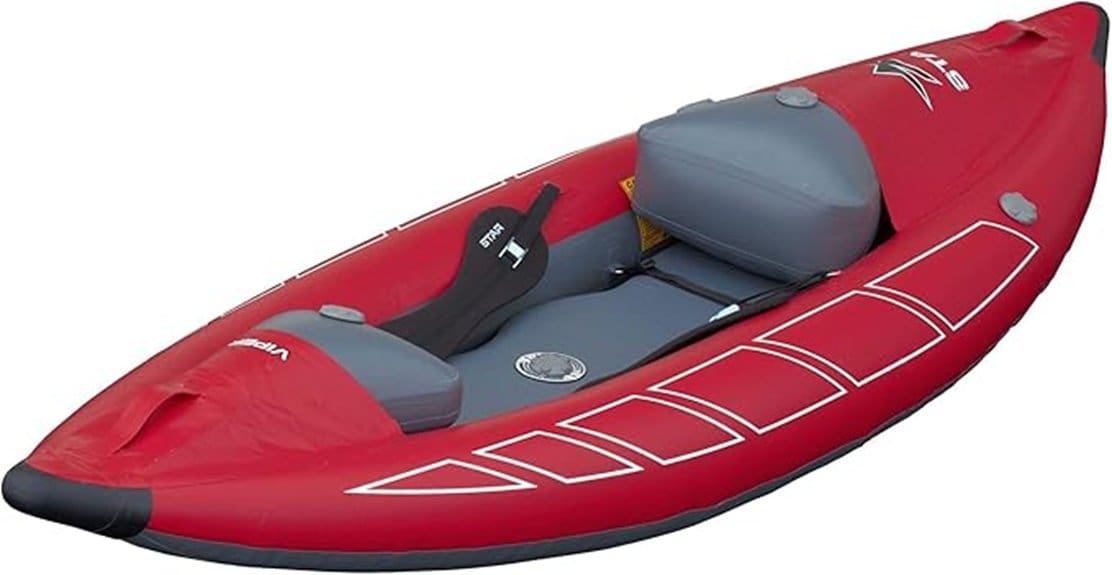
You’ll find the Star Viper accelerates briskly like a hard‑shell single and holds short bursts and momentum well, yet its inflatable bow and stern give forgiving buoyancy and fast recovery after hits. Stability’s committed but responsive, with centered seating and a firm floor that aids rolling practice and edging. Cockpit’s snug for taller paddlers but ergonomic for long runs; rigging and handles suit weekend rivers. Keep going to see detailed handling, fit, and rescue behavior.
Some Key Takeaways
- Brisk initial acceleration and responsive handling rival hard-shell singles for quick bursts and current navigation.
- Decent top-end speed for a whitewater inflatable, maintaining momentum through short rapids and waves.
- Committed, centered stability with high seating enables confident edging, controlled rolls, and predictable re-entry.
- Inflatable bow and stern chambers provide strong flotation, rapid resurfacing, and easier self- or assisted rescues.
- Ergonomic cockpit with firm floor and adjustable thigh braces balances comfort and efficient stroke transfer for solo paddling.
Real-World Performance Summary: Speed, Stability, and Rolling Capability
Although it’s inflatable, the Star Viper moves and maneuvers like a hard-shell—so you’ll notice brisk initial acceleration and decent top-end speed for a whitewater single. You’ll find a favorable speed comparison to many inflatable peers, matching short bursts and maintaining momentum through current. Stability feels committed without being sluggish; you sit high but centered, letting you edge and commit confidently. The top-deck profile supports controlled roll drills, and you’ll practice re-entry with predictable feedback. Gear rigging stays secure, and carrying is simple. Overall, you get a responsive, freedom-oriented craft that balances pace, control, and recoverability. This makes it a strong option for beginner kayaking enthusiasts looking for a hard-shell inflatable experience.
How the Inflatable Bow and Stern Chambers Affect Flotation and Recovery
Having a top-deck profile and roll capability is useful, but the inflatable bow and stern displacement chambers are what keep the Star Viper afloat and recoverable when conditions get rough. You’ll notice bow flotation lifts the nose in holes, resisting submersion and preserving trim. Stern chambers add reserve buoyancy so the kayak won’t pig-tail or bury the stern under load. Together they reduce water ingress risk and shorten recovery time after a capsize; you get rapid resurfacing and stable reorientation for an assisted or self-rescue. For you seeking freedom on moving water, that predictable buoyancy is essential. Beginners benefit from choosing the right drop-stitch kayak gear, especially inflatable chambers, to ensure reliable flotation and easier rescues.
Comfort, Cockpit Fit, and Paddling Position for Solo Use
When you sit in the Star Viper, the cockpit puts you slightly above the waterline in a secure, centered position that helps maintain control and visibility on solo runs. You get ergonomic seating that supports long outings without bulk, and the firm inflatable floor transmits strokes efficiently. Thigh braces adjustments are straightforward and let you lock hips for edging or relax for casual paddling, so you steer with body lean rather than arm strength. Knee clearance is modest; taller paddlers may feel snug but stable. Overall the fit favors freedom of movement while keeping you connected to the boat’s responsive feel. This model pairs well with essential accessories like a PFD (life jacket) to ensure safety during solo inflatables paddling.
Rigging, Carrying, and On-Water Handling: What to Expect
You’ll find the Star Viper’s rigging straightforward and functional: multiple D‑rings on the bow and stern decks give you several points to lash down dry bags or safety gear, while molded bow and stern handles make short carries simple and stable. You’ll use carry straps for longer hauls; they loop cleanly around reinforced handles without chafing the PVC. Deck lacing lets you secure a paddle or small pack on the foredeck for quick access. On the water the kayak tracks confidently, responds predictably to edging, and resurfaces quickly after wave impacts, so you can explore lines with control and freedom. For storage and to keep the kayak out of the way between outings, consider wall-mount racks designed for kayaks.
Who Should Buy the Star Viper? Use Cases, Limits, and Final Verdict
Who benefits most from the Star Viper? You will if you want hard-shell-like performance without heavy gear. Budget buyers get strong value: PVC durability, inflatable displacement chambers, and top-deck rolling capability at a lower cost. Choose it for recreational paddling, short rivers, and weekend adventures where portability and quick resurface matter. It’s not ideal if you chase advanced whitewater or exceed the 200-pound limit—its single-seat design and material limit extreme drops. In sum, pick the Star Viper for freedom-loving paddlers who prioritize portability, playful handling, and reliable flotation on moderate runs rather than pushing technical, high-risk rapids. Consider pairing it with essential folding kayak gear like compact paddles and carrying systems to maximize portability and on-trail convenience.
Some Questions Answered
What Maintenance Does the PVC Hull Require to Maximize Lifespan?
You should rinse, dry, and inspect the PVC hull after every use, patching abrasions promptly and using UV protection like a UV-resistant spray or cover when stored. Avoid prolonged sun exposure, sharp surfaces, and ozone sources. For Storage tips, deflate partially to relieve stress, roll loosely without creases, keep cool and ventilated, and store off the ground. Check valves and seams periodically and reapply seam sealant as needed to maximize lifespan.
Can I Use a Small Electric Trolling Motor With This Kayak?
Yes — you can use a small electric trolling motor, but you’ll need to mind battery weight and a secure transom mount. You’ll attach a lightweight, transom‑mount bracket to the stern handles or deck D‑rings, keep battery weight low for balance and flotation, and fasten gear to prevent shifting. Choose a compact, low‑thrust motor, waterproof connections, and test trim and handling in calm water before longer trips to preserve safety and performance.
Are Replacement Parts Available for Valves and Handles?
Yes — you can get replacement valves and you’ll find aftermarket handles. You should check NRS first for OEM replacement valves and stock handles that match fit and material. If NRS parts aren’t available, reputable paddling shops and online marketplaces offer compatible replacement valves and aftermarket handles; verify dimensions, mounting style and load rating before buying. Carry spares for remote trips so you won’t be stranded if a valve or handle fails.
How Long Does Full Inflation and Deflation Typically Take?
Full inflation takes about 8–12 minutes with a good high-volume pump; deflation and pack-down usually take 5–8 minutes. You’ll spend most pump time reaching recommended pressures for hull rigidity, then fine-tuning chambers. Rapid deflation valves speed collapse; fold and roll carefully to minimize pack size for transport. With practice you’ll shave minutes, making setup and breakdown efficient so you can get on the water and move freely.
Is This Kayak Compatible With Standard Life Jacket Attachment Points?
Yes — you’ll find the kayak compatible with standard life jacket attachment points. The multiple D-rings on bow and stern decks provide D ring compatibility for secure tethering, and you can attach a paddle leash to those points or dedicated fittings. You’ll remain free to rig gear, clip in a PFD tether, or secure a leash without fuss. Setup stays simple, dependable, and suited for moving water and exploration.