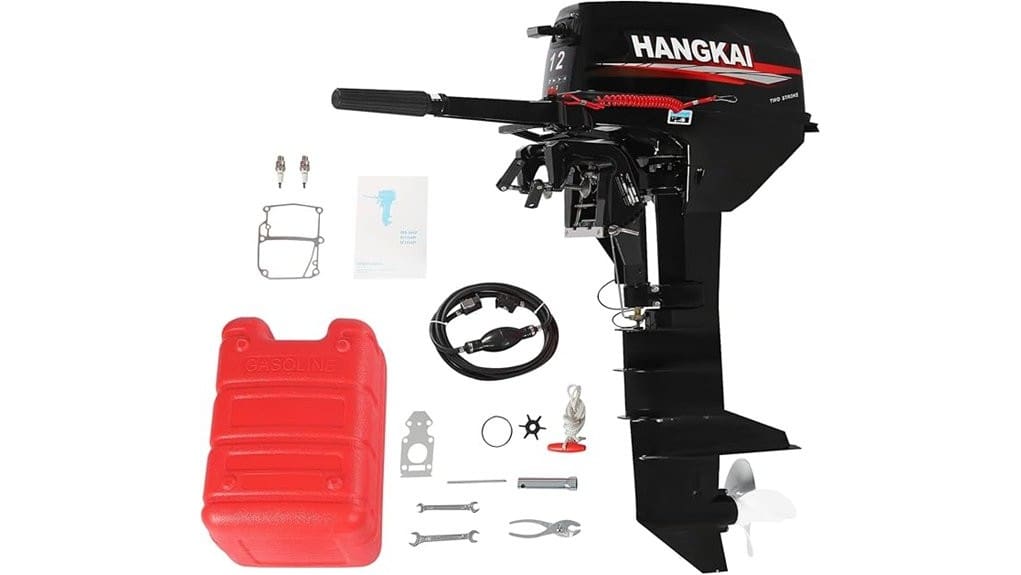

You’ll get a simple, lightweight 12 HP two-stroke that planes small inflatables quickly and gives predictable thrust for anglers and urban commuters. It’s a 169 cc, 2-cylinder, CDI-ignition engine with water cooling, a 2.08 gear ratio and manual tiller steering, weighing about 32 kg. Run it on 92 unleaded with a strict 50:1 mix for 5–6 hour range; expect basic handling, easy serviceability, and modest top-end under heavy loads — keep going to see fitment, mounting, and maintenance specifics.
Some Key Takeaways
- 12 HP two-stroke (169 cc) delivers predictable thrust and quick planing for small inflatables and light fiberglass boats.
- Lightweight 32 kg tiller model offers 360° steering, manual start, and simple serviceability for budget buyers.
- Operates best at 4,500–5,500 RPM with 50:1 fuel/oil mix and demands 92 unleaded fuel.
- Long-shaft fits 45–55 cm transoms; anti-cavitation plate should align with hull chine for optimal performance.
- Expect 5–6 hour range from 24 L tank; maintain spark, impeller, and seals for reliability.
Quick Verdict and Who This 12HP Hangkai Is Best For
While it’s a basic two-stroke unit, the Hangkai 12HP delivers solid, predictable thrust for small boats and gets you on plane quickly thanks to its 8.8 kW output and 2.08 gear ratio. You’ll appreciate steady acceleration, 360-degree steering, and a 24 L tank that yields 5–6 hours range—practical metrics for freedom-seeking trips. It suits budget conscious anglers and urban commuters who need reliable, lightweight propulsion for inflatable or small fiberglass boats. You’ll trade refinement for simplicity: manual start, tiller control, and corrosion-resistant aluminum construction. Use it where affordability, predictable performance, and portability matter most. It’s an option frequently paired with kayak accessories like fish finder mounts for anglers outfitting small craft.
What’s Under the Hood : Key Specs That Matter (Engine, Fuel, Weight)
Because you’ll rely on this motor for real-world performance, focus first on its 2-stroke, 2-cylinder 169 cc engine that produces 8.8 kW (12 HP) at 4,500–5,500 RPM and uses a CDI ignition and water-cooling with multiple intake ports for thermal stability. You get a compact engine displacement that balances torque and weight (32 kg net), making trailering and mounting straightforward. Fuel system needs 92 unleaded and strict fuel mixing at 50:1 with two-stroke oil; carry the 24 L tank for 5–6 hour endurance. Design choices favor simplicity, serviceability, and the freedom to roam. Consider pairing this outboard with a basic bilge pump to keep small craft dry and safe.
Real-World Performance: Speed, Endurance, Steering, and Load Limits
Although compact, the Hangkai 12HP delivers predictable on-water performance. You’ll reach planing speeds on light inflatables and push heavier loads at modest cruise; expect top RPMs 4500–5500 and reduced speed near the 1000 kg limit. Endurance runs about 5–6 hours per 24 L tank when you respect the 50:1 mix, balancing throttle and fuel economy. Steering is direct with 360-degree tiller control; you’ll appreciate nimble turns and steady tracking at cruise. Prop selection matters: match pitch to load for acceleration or top speed. Maintain recommended fuel and keep the engine trimmed for consistent results. Consider adding an anchor system like a bow anchor to improve holding and stability when you stop.
Fit and Installation: Transom Height, Boat Types, and Mounting Tips
When you mount the Hangkai 12HP, match the engine’s transom clamp to a stern height of 45–55 cm (17.7–21.7 in) to guarantee the cavitation plate sits at or just below the hull chine for peak thrust and cooling; misalignment will reduce efficiency and may aerate the intake. You’ll fit this long-shaft tiller to small inflatables, aluminum or fiberglass boats under 19.7 ft. Prioritize transom reinforcement on thin or worn sterns, use marine-grade mounting hardware, and verify shaft alignment to prevent vibration. Adjust trim so the anti cavitation plate is level with the hull for consistent performance. Consider using an all-terrain kayak cart to help move your boat to and from the water when launching from varied shorelines and uneven terrain, especially for heavier setups with motors all-terrain kayak cart.
Ownership Checklist: Maintenance, Common Issues, and Buying Advice
If you want reliable service from your Hangkai 12HP, commit to a regular maintenance routine that targets the engine’s two-stroke needs, cooling passages, and mounting integrity. Perform routine checks: fuel/oil mix at 50:1, spark plug condition, CDI timing, and water flow through multiple cooling holes. Inspect propeller for dings and correct pitch; check gear housing oil and seals. Log hours and register warranty registration immediately; keep seller paperwork. For seasonal storage, fog the cylinder, drain fuel, protect with corrosion inhibitor, and remove battery. Buy with spare impeller, extra prop, and realistic load expectations. Also consider matching your setup with the proper kayak anchor and tie-down points to ensure safe, steady anchoring when fishing or holding position.
Some Questions Answered
Can I Tow Another Small Boat With This Outboard?
Yes — you can tow a small boat, but you’ll respect towing capacity and practical limits. With a 12 HP engine and 1000 kg maximum load, expect reduced speed and maneuverability when towing; heavier tows slow you markedly. Use firm docking techniques, secure towlines, and keep rpm within 4500–5500 for sustained thrust. Monitor engine temperature and fuel endurance, maintain steady throttle, and avoid sharp turns to preserve control and range.
Is This Model Legal for Lake or River Registrations Locally?
You’ll need to verify local registration requirements and emission standards before using it on lakes or rivers. Two-stroke engines often face stricter emission standards; some jurisdictions limit or ban non-compliant models. Check your state or provincial boating authority for horsepower thresholds, required emission certifications, and registration paperwork. If it lacks accepted certification, you’ll need retrofit controls, use approved fuel/oil mix, or choose a compliant engine to guarantee legal, unrestricted operation.
Does It Come With Spare Propellers or Accessory Kits?
No, it doesn’t include spare props or comprehensive accessory kits by default; the package lists only one propeller and basic parts (fuel tank, kill rope, start rope, oil pipe, spark plug, impeller, etc.). You should plan to buy spare props and accessory kits separately for redundancy and mission flexibility. That improves uptime, lets you match prop pitch to load, and guarantees you maintain range and performance during extended outings or remote operations.
Can the Engine Run on Ethanol-Blended Fuels Safely?
Yes — you can run ethanol-blended fuels, but you’ll need caution. Ethanol compatibility is limited: use low-ethanol (E10) 92 octane only, mix two-stroke oil at 50:1, and drain fuel for long storage. Monitor seals and fuel lines regularly to prevent fuel system corrosion; replace any ethanol-affected components with ethanol-resistant parts. If you want maximum reliability and freedom on remote trips, stick to ethanol-free fuel when possible.
Are Replacement Parts and Service Centers Widely Available?
Replacement parts and service centers aren’t universally abundant; you’ll find Aftermarket availability varies by region and Dealer network density. Check local dealers for spare propellers, impellers, CDI units and carb parts; high-demand items are common, specialized components less so. If you value freedom, plan spares for long trips and confirm dealer warranty/service support beforehand. Empirically, regions with active marine markets show faster parts turnaround and better service coverage.