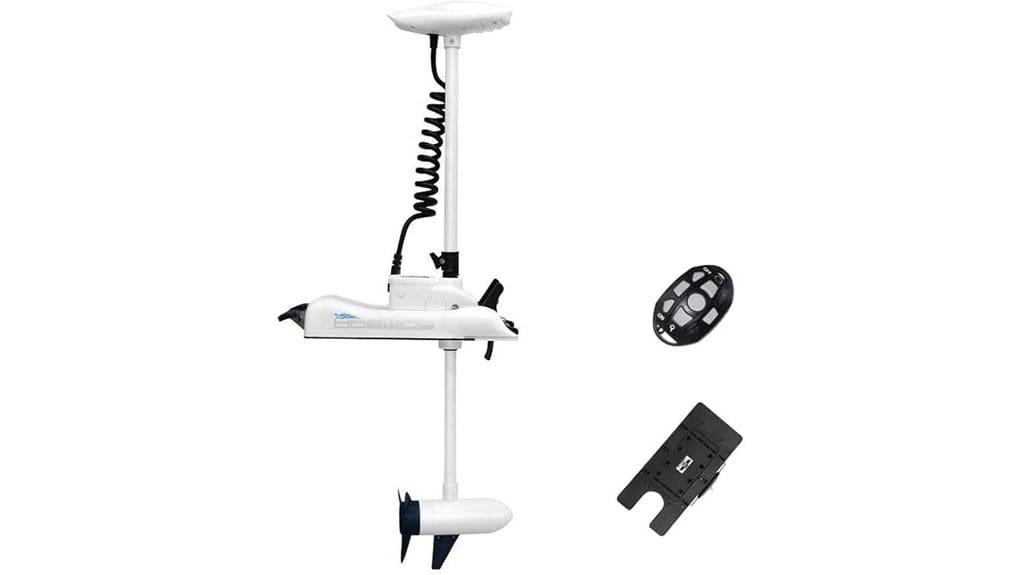

You’ll find the AQUOS Haswing Caymanb is a 55‑lb thrust, 12V bow‑mount trolling motor that’s suited to light inflatables and small aluminum boats up to about 2,750 lb/18 ft. It gives precise low‑speed control, variable speed and cruise, a 2.4G wireless USB remote, reversible motor and quick‑release bracket. The 48‑in aluminum shaft and sacrificial anode support saltwater use with maintenance. Performance favors efficiency over top speed; continue for detailed specs, mounting and runtime guidance.
Some Key Takeaways
- 55-lb thrust suits light inflatables and small aluminum boats, delivering roughly 2–5 mph in calm water depending on hull and load.
- 2.4G wireless USB-rechargeable remote offers low-latency variable speed, reversible motor, and cruise-hold for precise control and battery economy.
- Quick-release bow-mount requires a flat 13.7×8 in backing, through-bolting, and proper surface prep for secure installation.
- 48 in aluminum-alloy shaft (34 lbs) balances stiffness and corrosion resistance; sacrificial anode included for saltwater use.
- Good for skiffs/pontoons up to ~2,750 lbs/18 ft, but limited top speed and 12V range constrain run time compared to higher-power alternatives.
Performance Breakdown: Speed, Thrust, Battery Life, and Noise for a 55‑lb 12V Motor
Estimate performance by matching the 55‑lb, 12V CaymanB to your boat and battery: in calm water that thrust typically moves light inflatables and small aluminum boats (up to the recommended 18 ft / 2750 lb capacity) at trolling speeds—expect roughly 2–5 mph depending on hull shape and load—with variable speed control allowing finer speed selection and improved battery economy. You’ll monitor thrust vs. battery voltage to predict run time; heavier loads reduce speed and increase current draw. Efficient propeller design and hull-prop interaction improve hydrodynamic efficiency, lowering amperage. Noise is low; cruise control steadies consumption for extended range and autonomy. Consider pairing the motor with an appropriate anchor system to maintain position and improve fishing or photography stability, especially when paddling from Anchor Systems.
Mounting & Installation: Bow‑Mount Fit, 13.7×8 In Surface Requirement, Shaft Lengths, and Quick‑Release Setup
When you mount the AQUOS Haswing CaymanB, confirm your bow has a flat 13.7 × 8 in surface and sufficient structural backing for a bow‑mount installation; the quick‑release bracket speeds installation and removal but still needs secure through‑bolting or reinforced backing to prevent flex under load. Choose 48 in or 38.4 in shaft length based on hull height and transom clearance; longer shafts increase submersion margin. Perform surface prep to guarantee a true plane and corrosion‑free fastener contact. Plan wiring routing alongside the mount to minimize chafe, secure connections, and allow quick removal without re‑routing cables. For kayakers using Power‑Pole style systems, integrate the motor mount plan with anchor mounting considerations to keep gear and lines organized.
Controls and Real‑World Operation: 2.4G Wireless Remote, Variable Speed, Cruise, Stow/Deploy Pedal, and Reversible Motor
After mounting and routing are set, controls determine how effectively you pilot the CaymanB across changing conditions. You’ll use a 2.4G wireless remote with low remote latency; it’s palm-sized, USB-rechargeable, and lanyard-ready for freedom of movement. Variable speed gives precise thrust control to trim speed and conserve battery. Engage cruise to hold speed while you correct heading manually. The reversible motor rotates 180° for immediate reverse thrust. Stow/deploy pedal operates by hand or foot; tactile feedback and compact layout prioritize user ergonomics. Depth collar and lifting handle simplify adjustments and transport without compromising control fidelity. For extended trips and off-grid outings consider pairing the motor with a solar charger to prolong run time.
Build, Corrosion Resistance, and Durability: Aluminum Shaft, Sacrificial Anode, Saltwater Use, Weight, and Warranty
Although built for light commercial use, the CaymanB keeps weight down at 34 lbs by using a 48-inch aluminum-alloy shaft that balances stiffness and corrosion resistance, making it suitable for both freshwater and saltwater environments when the sacrificial anode is maintained. You’ll appreciate the aluminum shaft’s rigidity during thrust loads and its predictable fatigue behavior under load testing. Corrosion resistance relies on routine anodic maintenance—inspect and replace the sacrificial anode after salt exposure. The quick-release bracket and ergonomic handle aid transport. Warranty covers two years for the motor; retain proof of purchase and document any load testing for claims. For kayak owners, pairing the motor with an electric bilge pump can enhance safety by managing water intrusion during use and storage, so consider adding a bilge pump to your checklist.
Who Should Buy It and Alternatives: Ideal Boat Types (Up to 2750 Lbs/18 Ft), Pros/Cons, and Comparable Motors to Consider
If you’re outfitting a small skiff, pontoon, inflatable, or jon boat up to about 2,750 lbs (roughly 18 ft), the AQUOS Haswing CaymanB delivers a practical balance of 55 lb thrust, 48 in shaft reach, and a 12V power profile that keeps weight and complexity low. You should buy it if you want quiet, efficient propulsion with kayak compatibility for light tenders and clear angler benefits like precise speed control and cruise hold. Pros: lightweight, USB remote, saltwater-ready anode, easy install. Cons: limited top speed, 12V range constraints. Alternatives: 55–80 lb Minn Kota or Lowrance models. Hard-shell inflatables are a popular small-boat choice for beginners due to their stability and portability.
Some Questions Answered
Is a Separate Battery Charger Included With the Motor?
No — a separate external charger isn’t included. You’ll need to supply your own external charger or charging adapters compatible with a 12V battery. The motor charges via the boat battery; the remote and accessories use USB charging but ship without dedicated chargers beyond basic cables. You should plan for a quality 12V charger and any necessary adapters to maintain battery health, guarantee safe charging, and preserve motor performance and range.
Can I Use This Motor With Dual-Battery Setups or Battery Isolators?
Yes — you can integrate this motor with dual battery integration and isolator compatibility setups. You’ll wire the motor to a dedicated trolling battery while using a battery isolator or VSR to protect the cranking battery. Make sure wiring, fuse sizing, and cable gauge match the motor’s 12V, 55 lb draw and expected run-time. Test charging paths and monitor voltages to prevent over-discharge; follow manufacturer warranty and safety limits.
Are Replacement Propellers or Spare Anodes Available Separately?
Yes — you can get replacement propellers and spare anodes separately. OEM and aftermarket replacement propellers fit the CaymanB’s shaft and are sold individually; choose the correct pitch and three-blade configuration. Spare anodes (sacrificial zinc/magnesium) are available to protect submerged metals; replace periodically. Verify part numbers or measurements before purchase, and install per torque and orientation specs to guarantee corrosion protection and peak propulsion performance.
Does the Motor Come With Pre-Drilled Mounting Holes or Templates?
Yes — the motor’s quick‑release bracket includes pre‑drilled mounting holes and drill patterns for common bow layouts, and the package provides mounting templates to speed installation. You’ll align the templates, mark hole locations, then drill pilot holes per the specified drill patterns. The templates and pre‑drilled bracket minimize guesswork, letting you choose best placement while maintaining structural integrity and freedom to adapt to your boat’s bow dimensions.
Is There an Audible Low‑Battery or Fault Alarm on the Remote?
No — the remote doesn’t emit an audible alert for low battery or faults. You’ll rely on visual indicators and remote diagnostics through the controller: check LEDs and status cues on the motor and remote, and use the motor’s diagnostic behavior (response loss, reduced thrust) to detect issues. You can still monitor battery voltage externally and set personal alerts on a separate device to preserve your freedom and avoid surprise failures while operating.


