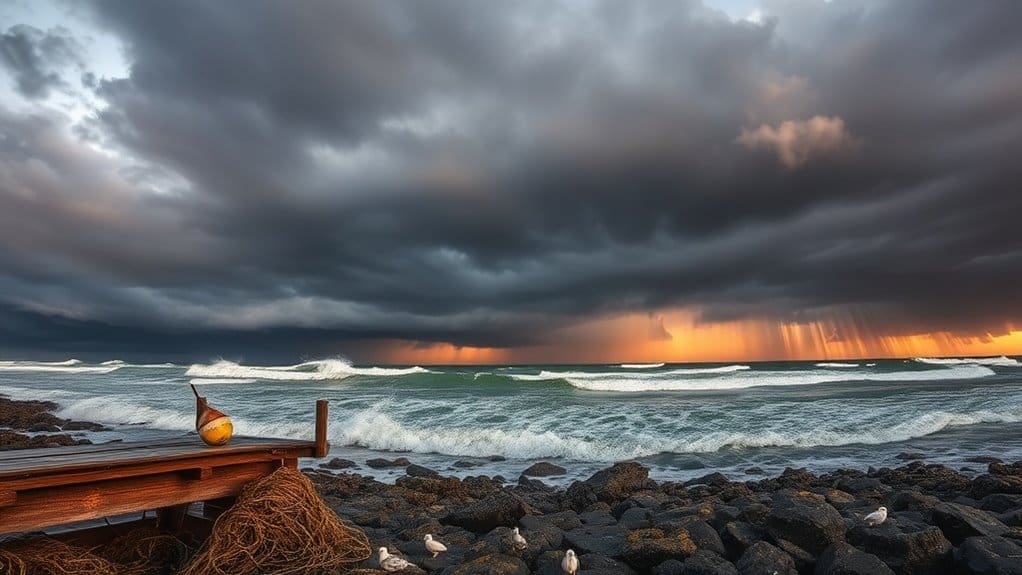

You’ll watch sky and sea for fast cues: dark anvil clouds, towering cumulonimbus, sudden temp drops, or a 3 hPa barometer fall, and if you hear thunder or see sharp wind shifts you don’t launch, you secure gear, put on PFDs and head for shelter, reef or slow if underway, and tune VHF/NOAA for warnings; carry a handheld anemometer, barometer, GPS and spare comms, plan short sheltered routes and turnaround times, and keep calm—more practical checks and steps follow.
Some Key Takeaways
- Monitor rapid barometer drops (>3 hPa/hour) as an urgent sign to secure gear and seek shelter.
- Watch for towering cumulonimbus, anvils, or dark shelf clouds indicating imminent squalls or microbursts.
- Audible thunder, sudden temperature drops, or sharp wind shifts signal approaching convective activity—delay departure.
- Visibility falling below 1 nautical mile in rain or fog requires delaying departure, reducing speed, and securing navigation instruments.
- Track steady wind direction shifts, peak gust spikes, and gap-wind warnings to adjust course, reef sails, or avoid exposed passages.
Recognize Immediate Sky and Sea Signals for Safe Departure
If you want to leave the dock safely, start by looking up and checking your instruments right now—scan the sky for dark, anvil-topped cumulonimbus clouds and listen for thunder, glance at the barometer for any rapid drops of about 3 hPa or more in an hour, and note whether the wind suddenly shifts while the air turns noticeably cooler and the sea builds short, steep waves; those are the quick, clear signals that a squall or frontal band is moving in, and they mean you should hold off until things calm or the cells move well away. You’ll watch for a rapidly falling barometer, darkening cumulonimbus overhead, or visibility below 1 nautical mile in rain or fog, and you’ll delay departure, secure gear, check VHF weather, and wait. Consider carrying a Personal Locator Beacon PLB and other essential safety gear whenever you head out on coastal waters.
Use Barometer Trends and Temperature Shifts to Forecast Minutes–Hours
Now that you’ve scanned the sky and immediate sea signs, start watching your barometer and the air temperature closely, because those small, steady changes tell you what’ll happen in the next few minutes to hours. You’ll read barometric pressure drops to know when to tighten up, a fall of about 3–6 mb per hour usually means a storm or frontal system is closing fast, so secure gear and consider altering course right away. If temperature plunges 5–10 °C in 30–60 minutes, that’s often a cold front with ramping winds and rough seas, so head for shelter, shorten your day, or reef sails. If pressure steadies after a sharp drop, expect peak conditions within two hours, then gradual easing. Keep your barometer trends logged, and trust steady, simple actions. For added safety on the water, pair those observations with a reliable weather radio to get timely alerts and confirmations.
Read Wind Signs: Direction Changes, Gusts, and Gap Winds
Start watching the wind closely, because changes in direction, sudden gusts, and narrow gap flows tell you a lot about what’s coming and what to do next: note any steady shift in wind direction, for example from southwest to northwest, since that often means a front or coastal low is moving through and you can expect pressure swings and squalls within one to six hours, so trim sails or slow down and begin securing loose gear now rather than later. You’ll watch wind speeds and gusts for clues, if peak gusts jump well above the steady wind, slow up, reef or hand-steer, and lash down gear; if winds back while the barometer falls, brace for intensifying storm; avoid exposed gaps when local gap winds spike. Remember basic paddling precautions and carry personal flotation and signaling gear, especially when coastal forecasts indicate changing conditions and water safety essentials.
Interpret Cloud Types and Movement to Spot Approaching Storms
Watch the sky for telltale cloud types and how fast they’re moving, because a towering cumulonimbus with an anvil means a convective storm that can kick up squalls and lightning, while a dark low cloud wall and a quick pressure drop (even 3–5 hPa in an hour) usually signals a squall line or front—if you see those, head for shelter and check your barometer or phone radar. Pay attention to spreading low stratocumulus or nimbostratus from the west, and to lenticular or rotor clouds near ridges that can mean sudden strong winds; if bases start lowering into mist or fog and temperatures fall with light winds, slow down, use lights, and keep VHF or weather apps tuned. Carry a simple kit—life jacket, waterproof layers, a handheld radio or charged phone—and act on the first signs, because recognizing cloud type, movement, and falling pressure gives you time to secure gear and choose safer routes. For coastal paddling, have an up-to-date waterproof river map and plan exit points before conditions change.
Cloud Types And Hazards
When you see a towering, cauliflower-topped cloud with a flat, spreading anvil, take it seriously—those cumulonimbus giants usually mean strong convection and you can expect thunderstorms, heavy rain, lightning, and sudden gusts to arrive within 30–60 minutes, so start securing loose gear, steer clear of exposed areas, and make a plan to get to shelter or safe harbor fast. Watch for dark scud or shelf clouds on the storm’s front, those hint at outflow and microbursts that can throw you into sudden strong winds and chop, tie off or weigh things down, and avoid being caught broadside. If altostratus or nimbostratus thickens, expect visibility to fall over hours, so ready lights, radar, and a solid route, and don’t gamble on narrow channels. For coastal paddlers, always consider tide and current when deciding how and where to seek shelter, since these factors can greatly affect your ability to reach safe harbor and return to shore coastal touring.
Cloud Movement And Speed
If you notice clouds suddenly picking up speed or changing shape, pay attention—those shifts often tell you a storm’s on the way, and you can act before it hits, so start by scanning the sky, feeling the air, and checking your barometer or phone for a pressure drop. Watch cloud motion for clues: towering cumulonimbus with an anvil top or fast-moving scud and shelf clouds mean rapid change, so check wind speed and temp, grab gear, and head for shelter if needed. Look for outflow boundary signs—a sharp temp drop, gust front, darkening sky—and note cloud shear, different layers moving different ways, which signals fronts or squalls. Carry a compact barometer, waterproof jacket, and radio, and move early when seas or winds start to worsen. Also keep a lake touring map handy to plan quick routes to nearby launch points and safe shelters.
Low Clouds And Pressure
You’ve already been scanning cloud speed and shape, so now sharpen your eye on low clouds and pressure changes, because those tell you how soon a storm might arrive and what kind of action to take first. Watch your gauge for a falling barometer, a 3–5 hPa drop in hours, which often precedes low stratocumulus thickening and tells you a front or storm is coming, so start securing gear and plotting shelter. If low ragged scud or towering cumulonimbus anvils pop up inside the deck, expect sudden squalls and strong gusts, head for protected water, and shorten sail or tie down loose items. If uniform gray stratus or fog hugs the sea with light wind, slow down, use instruments, and keep crew close. Also consider carrying waterproof charts to help navigate coastal hazards and find safe landing spots.
Detect Fog, Visibility Drops, and What They Mean for Navigation
When you see humidity climbing toward saturation, winds below about 5 knots, or a few degrees’ difference between air and sea temperature, start treating the horizon like it might vanish soon and slow down so you’ve got time to react. If visibility falls under about 1 nautical mile, or you wake to damp decks after a clear, calm night, put sound signals and navigation lights on, call up radar/AIS and NOAA VHF weather, and consider plotting a more sheltered route on your chart. Remember that different fogs form for different reasons—advection, radiation, or sea smoke—so carry a working horn, chart and compass, and a plan to reduce speed and keep a sharp lookout if conditions start to close in. For kayakers and newcomers, check local tide tables and coastal guides before setting out to better anticipate conditions and plan safer routes.
Recognizing Early Fog Signs
Because fog often comes on fast around dawn, you’ll want to watch a few simple signs so you’re not caught off guard: feel for a 2–5°C drop in air temp with humidity climbing toward 100%, check the barometer for a steady fall and note if winds are calm under about 5 knots after a clear night, and listen for subtle onboard cues like damp decks, condensation on instruments, a muffled soundscape, or sudden haloing around lights — all of which usually show up before visibility measures it. Keep an eye on warm southerly winds moving over colder coastal currents, note any rapid sea-surface contrasts, monitor VHF/weather radio, slow down at the first cues, use radar and AIS, and stay ready to reduce speed and post extra lookouts.
Navigational Visibility Limits
If visibility starts to fall, or you notice the air suddenly feels cooler and damp and the horizon blurs, slow down, post extra lookouts, and switch to continuous radar and GPS tracking right away, because visibility under about 1–2 nautical miles is where rules and real risk kick in. You’ll watch for quick temperature drops, wind shifts, or rising humidity that mean fog banks or rain are moving in, and you’ll listen for AIS, VHF, or NOAA updates while sounding fog signals when required, because sea fog can hang for hours. Keep radar on, reduce speed, station hands on the bow and stern, confirm position on GPS, check the barometer for falling pressure, and expect radiation fog to clear after sunrise.
Assess Wave Patterns, Swell Direction, and Dangerous Surf
Start by standing where you can see a wide stretch of beach and the incoming waves, and take a few slow scans: note whether sets come in regularly every 5–15 minutes or the sea looks choppy and random, watch how the crests line up to read the swell direction, and check the slope of the water as waves near the shore—you’ll spot long-period swell by the slower, powerful sets and steeper, faster-breaking waves by the sudden, tall curls. You’ll want to read swell, rip currents, and wave patterns together, mark which beaches face the swell azimuth, and favor gentler slopes if you’re swimming or launching, while keeping distance from plunging shorebreaks; carry a whistle, a float, and tell someone your plan before you go.
Identify Local Hazards: Currents, Tidal Rivers, Shoals, and Inlets
When you’re sizing up a shoreline for currents, tidal rivers, shoals, or inlets, take it slow and start by looking for the signs that tell you where the water’s really moving: watch for lines of foam or discolored water, converging or diverging seams, and eddies off headlands that can signal strong flow or submerged structure, and remember those telltale boiling, short-period waves at inlet mouths that mean turbulence and rips. You’ll want to check tide tables and current predictions before you go, since currents in tidal rivers and tidal inlets can top 5–7 knots and overwhelm small craft or swimmers, and consult current charts, Notices to Mariners, local pilots or harbormasters, recent soundings, and avoid shoaling areas except at slack water.
Combine Onboard Instruments and VHF/NOAA Briefings for Real‑Time Updates
You’ve just finished scanning the shoreline for currents and inlets, and now you’re going to put the tools on your boat to work—listen to VHF channel 16 and NOAA radio, watch your barometer for pressure drops, and cross‑check those readings with your GPS position and onboard wind instruments so you know whether a front or squall is really bearing down on you. Tune your VHF marine radio to channel 16, monitor NOAA Weather Radio frequencies, note falling barometric readings, and call the nearest station or buoy for spot observations, then compare those reports with your anemometer and wind vane for sudden shifts or gusts. If visibility or thunderstorm warnings come in, slow down, secure gear, and alter course or anchor based on coordinates and your own sensors.
Use Satellite and Radar Briefly: What Maps Tell You Before Launch
If you want a quick, clear picture before you shove off, pull up the latest satellite and radar maps and let them tell you what the sky’s been doing and what it might do next, because those images pick up everything from broad cloud blankets to fast‑moving squall lines and even sea‑surface roughness that hints at strong winds. You’ll check geostationary satellite data for growing cloud tops that mean storms hours away, scan polar and SAR snapshots for sharper coastal detail and validated sea-surface wind estimates, watch radar for echo tops and squall lines that can form in minutes, cross-check modeled winds against observed surface roughness, tune NOAA weather radio, and overlay AIS so you know where other boats are already changing course.
Plan Route and Timing: Weather‑Aware Decision Rules for Kayakers
Before you shove off, pick a route that keeps you near sheltered shorelines or inside bays, plans crossings under 30 minutes when you can, and flags safe landing spots every 1–3 nautical miles so you’ve got options if conditions change. Check the short‑term and 48‑hour forecasts for wind, waves, and tides, plan trips mid‑morning to early afternoon to avoid late day sea breezes or gap‑flow gusts, and tune a VHF or NOAA Weather Radio on the water so you can abort at the first Small Craft Advisory, thunderstorm warning, or sudden barometer drop. Bring a simple toolkit—a paddle float, bilge pump, spare paddle, life jacket, and a compact chart or GPS—and if skies darken, pressure falls, winds shift, or chop builds, head for the nearest landing without hesitating.
Weather-Linked Route Choices
When you’re planning a paddle, think like a scout: check short- and long-range forecasts for wind, wave height, and tides, and be ready to cancel if you see sustained winds above about 15–20 knots, waves over roughly 1.5–2 meters, or a Small Craft Advisory for your area, because those conditions can turn a calm outing into a survival challenge pretty fast. Pick routes that keep shelter within easy reach, hug shorelines or lee sides of islands when gusty winds or gap flows can spike, and avoid exposed coasts if onshore winds exceed about 10–12 knots, because you want options. Use real-time weather data—NOAA radio, buoy apps, barometer—watch pressure drops and wind shifts, and be ready to turn back or tuck into a harbor.
Timing Based On Forecast
You’ve already picked a route that keeps shelter close and checked for gusty gaps or exposed coastlines, so now you want to time your launch and return around the forecast so the weather works with you, not against you. Check National Weather Service short and extended coastal forecasts, avoid Small Craft Advisories, and don’t go open-coast if sustained winds top 15–20 kt, and plan to leave early to ride the diurnal wind cycles when mornings are calmer, then return before onshore breezes build. Watch your barometer drops, if it falls fast (>3 hPa/3 hours) or winds shift, head in. Bring a VHF or phone for updates, set conservative turnaround times, target 30–60 minutes visibility margin, and never reenter during frontal or thunderstorm windows.
Emergency Responses: What to Do When Weather Changes Fast
If the sky sharpens and the barometer tumbles, act like your boat and crew depend on it—because they do: check the VHF or NOAA Weather Radio right away for Small Craft Advisories or gale warnings on 162.550, 162.400, or 162.475 MHz, secure hatches and loose gear, and either shorten sail or reduce speed so you can steer into a safe harbor or a sheltered lee without panic. When you see a fast barometer drop, towering cumulonimbus, or a sudden temp swing, recognize rapidly changing conditions, put on lifejackets, stow loose items, and steer bow-on at about 45° if underway, but head for shelter or drop a bow anchor if you lose steerage; expect squalls/convective storms and keep VHF tuned for updates.
Prepare Gear and Group Protocols to Reduce Weather‑Related Risk
Start by gearing up and briefing your group before you shove off, because the right kit and clear roles cut risk fast: make sure everyone’s wearing a properly fitted USCG‑approved PFD and that spares are stowed where they can be grabbed in 30 seconds, check that your VHF is tuned to NOAA frequencies (162.550, 162.400, 162.475 MHz) with a satellite or cell backup ready, and secure critical items—charts, handheld VHF, GPS, flares, first‑aid—in labeled, waterproof containers while lashing loose gear belowdecks so it can’t shift and upset stability in a blow. Designate skipper, lookout, and emergency roles, train with drills, monitor barometer and horizon routinely, carry a handheld anemometer, and act on falling pressure or rising winds immediately.
Some Questions Answered
What Is the Pattern Recognition of Weather?
Pattern recognition of weather is spotting repeating atmospheric signs—like synoptic cycles, mesoscale dynamics, and atmospheric teleconnections—that signal storms, wind shifts, or calm, so you can act early. Watch falling pressure, cloud bands, wind swings, and rapid temp drops, carry a charged radio, waterproof gear, and a portable anemometer, and first secure craft or seek shelter, then check satellite or buoy updates and local forecasts, asking “Is this pattern intensifying?” before you move.
What Influences Coastal Weather Patterns the Most?
Large-scale pressure systems influence coastal weather most, but you’ll also watch ocean currents, coastal orography, and land sea breezes closely, since currents shift fog and temperature, terrain channels winds, and breezes flip directions each day. Check forecasts for pressure drops, scan sea-surface temps, note nearby mountain gaps, and expect afternoon onshore winds; carry waterproof layers, a windproof jacket, navigation lights, and a barometer app, and retreat early if winds climb or pressure falls fast.
How to Read the Weather for Sailing?
You read weather for sailing by watching clouds and cloud navigation cues, checking barometer and radar, and factoring tidal currents into route choices, so you know when to shorten sail or trim sail trim for stability, right? Carry VHF, spare power, and rain gear, note wind shifts and squalls, steer toward safe harbors if pressure falls fast, and practice heaving-to and reefing drills before you leave, stay calm, stay free.
Which AI Tool Can Help in Weather Forecasting?
You can use deep learning tools that fuse satellite imagery with ensemble forecasting to sharpen short-term coastal wind and wave forecasts, and you should start by picking a platform that offers satellite feeds, model ensembles, and bias-correction, so you’ll get corrected outputs not just raw maps. Check that it shows uncertainty, nowcasts under six hours, and gives simple route or safety advice you can act on, then trial it with nearby buoy data.