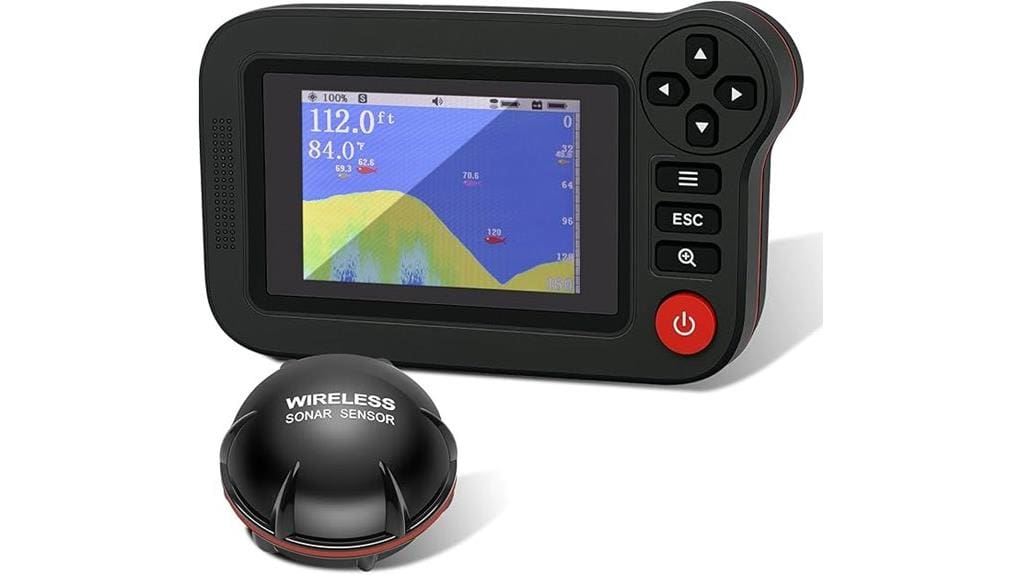

You’ll get a compact, rechargeable fish finder with a wireless transducer that sends a 105° sonar cone to about 164 ft, showing depth, water temp, bottom contour, and fish targets on a 3.5‑inch TFT. It’s castable or mountable for kayak, shore, ice, or small boat use, holds up to eight hours per charge, and keeps a reliable wireless link around 200 m in open water. Keep scanning sensitivity and noise filters adjusted to improve returns, and keep reading for setup tips and real‑world tests.
Some Key Takeaways
- Portable unit with wireless transducer offers up to 164 ft depth, 105° sonar cone, and clear fish/contour readouts.
- 3.5-inch TFT shows depth, water temperature, bottom hardness, and fish size/depth indicators.
- Battery lasts up to eight hours per charge, two-hour recharge, with probe/host battery indicators.
- Reliable wireless range about 200 m (656 ft) in open water; interference reduces range near metal or harbors.
- Best for kayak, shore, ice, and small-boat anglers; tune depth range, sensitivity, and noise filter for optimal results.
How This Portable Rechargeable Fish Finder Works in Real Fishing Situations
When you take this portable rechargeable fish finder onto the water, it gives you immediate, practical feedback: the wireless transducer sends a 105° sonar cone down to 164 ft (50 m) and the 3.5-inch TFT screen shows depth, water temperature, bottom contour, and fish size and depth so you can decide where to cast. You’ll mount or cast the wireless probe, monitor readings, and adjust sensitivity or depth range for cluttered or deep water. Keep battery maintenance routine—charge fully, watch indicators, and carry a spare power source. Account for weather effects: heavy rain or rough seas increase noise, so use filters and slower scanning. For longer trips, consider a high-quality kayak battery designed for fish finders that delivers reliable longer run-time.
What the Display, Sonar, and Transducer Actually Show on the Water
Although the screen is only 3.5 inches, you'll get a clear, actionable picture of what's below: the TFT display presents depth and water temperature numerically, plots bottom contour as a continuous line, and marks fish targets with size/depth indicators so you can decide where to drop your bait. The 105° sonar beam maps targets down to 164 ft, using color gradients to show return strength; strong arches mean larger targets or structure. Your transducer returns bottom hardness, thermoclines, and fish echoes; adjust sensitivity and noise filter for accurate signal interpretation. Readouts, alarms, and selectable ranges keep you mobile and autonomous. Designed for paddlers, it pairs well with kayak-friendly accessories and compact mounting options.
Battery Life, Charging, and Wireless Range Tested (Real-World Results)
Because battery life and wireless range determine whether the unit keeps you fishing or leaves you chasing charges, we tested real-world endurance and signal reliability across typical use scenarios. You’ll get up to eight hours per full charge with a two-hour recharge; charging indicator and probe battery indicator give straightforward battery diagnostics so you won’t guess remaining runtime. Wireless probe held a reliable link to 200 m (656 ft) in open water but dropped faster near metal or crowded harbors where signal interference increased. Use the correct 5V/12V adapter, monitor indicators, and position the transducer to minimize interference for freedom on the water. Portable units pair well with compact GPS trackers to help kayakers maintain location awareness and safety on long trips.
Mounting, Portability, and Use Cases: Kayak, Shore, Ice, and Boat
Whether you’re paddling a kayak, standing on shore, drilling through ice, or cruising from a boat, this fish finder’s compact host, wireless transducer, and simple mounting options make it easy to set up and move between platforms. You’ll clip the host to a rail or wear it with the clip on lanyard for quick access. The castable transducer lets you toss from shore or deploy through an ice hole; it also mounts under a kayak or over a boat transom. Wireless range and lightweight design give you freedom to roam while maintaining stable sonar performance and straightforward repositioning. For kayak anglers, having the right essential gear can make portability and mounting even easier.
Who Should Buy This Model and the Key Settings to Optimize Performance
If you fish from kayaks, shorelines, ice holes, or small boats and need a lightweight, easy-to-move unit, this portable rechargeable fish finder is a strong match—its wireless transducer and long 200 m link let you reposition gear quickly without tangled cables. You should buy it if you're a beginner anglers, weekend anglers, kayak anglers, or shore anglers who value mobility and clear data on depth, fish size/depth, temperature, and bottom contour. Optimize performance by setting appropriate depth range, tuning sonar sensitivity, engaging noise filter, and using sonar background switch; monitor probe battery and use correct adapter for charging. This model pairs well with common kayak mounting and portable fish finder accessories designed for small-boat anglers.
Some Questions Answered
Does the Unit Come With a Warranty and What Does It Cover?
Yes — you get a limited warranty; the typical warranty duration is one year from purchase. It covers defects in materials and workmanship for the host and wireless probe but not damage from misuse, water intrusion beyond design limits, or unauthorized repairs. If you need service, you contact the seller/manufacturer and follow the documented service process: provide proof of purchase, describe the fault, ship per instructions, and they'll repair or replace under warranty terms.
Can the Transducer Be Used in Saltwater Long-Term Without Corrosion?
Yes — you can use the transducer in saltwater long-term if you maintain it. Check for material coatings and any exposed metal; rinse the unit with fresh water after each saltwater use, dry it, and inspect seals. Fit sacrificial anodes on nearby metal fittings or on a mounting point if you plan prolonged deployments. Reapply protective coatings as needed and recharge regularly to keep electronics sealed and corrosion-free.
Are Replacement Batteries or Spare Transducers Available?
Yes — you can get replacement batteries for battery swaps and some transducer options. You’ll buy spare probe packs or host batteries from the manufacturer or authorized dealers; check compatibility and correct power ratings. For transducer options, choose castable or bracket-mounted types and confirm wireless pairing range. Keep a charged spare for freedom to fish longer, and always use the recommended adapter and charging procedure to avoid damage.
Is the Device Compatible With Smartphone Apps or Firmware Updates?
No — it doesn't offer native app integration or cloud sync, and you won't get update notifications. You can manually check the manufacturer's site for beta firmware and official firmware updates, then apply them via the host's USB/adapter connection. You can’t push settings or logs to a smartphone in real time, so you’ll rely on the device's onboard controls and occasional manual firmware flashes to keep features current and experiment with beta firmware releases.
Can the Screen Be Mounted Inside a Closed Console or Viewed With Polarized Sunglasses?
Yes — you can mount the screen inside a closed console and still get usable screen visibility, though direct sunlight readability is best when the cover’s removed. The 3.5-inch TFT LCD with three backlight modes helps, and you’ll want to position the host near the console’s viewing window or use the mounting bracket for angle. Polarized sunglasses may reduce contrast; try different backlight modes to maintain clarity and freedom on the water.