The U1 12–16V thruster set gives you compact, predictable thrust—about 7.5 lb per thruster at 16V—using brushless motors with 45A bi-directional ESCs. It’s optimized for small freshwater ROVs or kayaks, offers plug‑and‑play controls, and runs quietly enough for discreet use, though ESCs are only splash‑proof and not for long immersions. Use a 4S LiPo, monitor current and temps, and seal your electronics; keep going to see setup, limits, and integration tips.
Some Key Takeaways
- Compact brushless thrusters with 45A bi-directional ESCs perform best at 12–16V, delivering about 7.5 lbs thrust each.
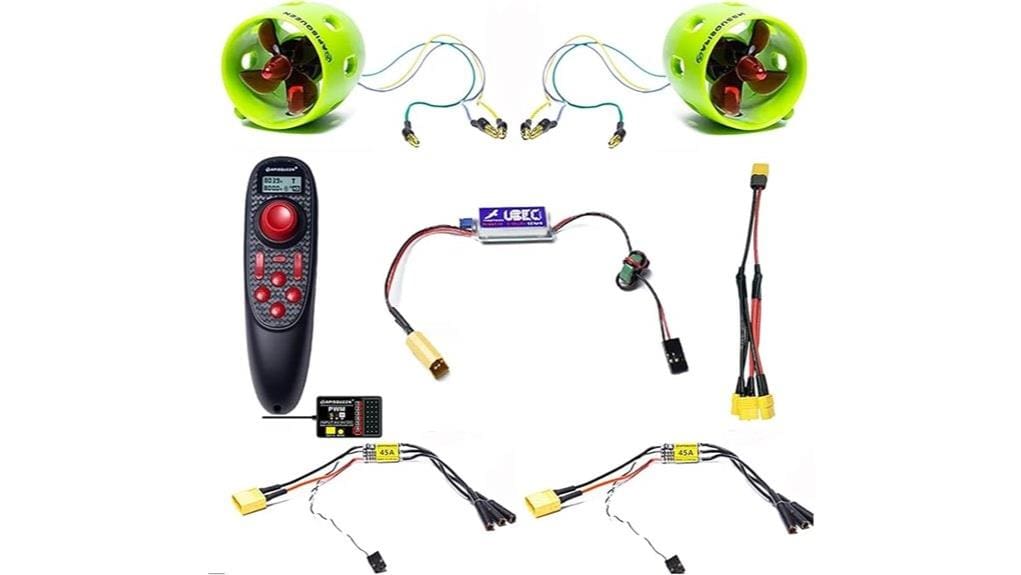
- Kit includes CW/CCW thrusters, two ESCs, pre-configured remote/receiver, BEC, XT60 plug, and screw pack; batteries not included.
- ESCs are splash-proof only; electronics require sealed enclosures for immersion and careful thermal monitoring.
- Recommended battery is 4S (16V) LiPo; size capacity to keep continuous draw safely below ESC limits with headroom for peaks.
- Best for lightweight freshwater ROV/AUV hobby projects; avoid for continuous heavy-duty or seawater applications without fully waterproof components.
Real-World Performance and Specs
Because the U1 set pairs compact brushless motors with 45A bi-directional ESCs, you'll see an efficient thrust-to-weight ratio: each thruster delivers about 7.5 lbs of thrust across a 12–16V input, with peak performance at 16V (4S LiPo). You’ll verify thrust measurement with a simple dynamometer; expect repeatable results near spec when testing in freshwater. Assess the noise profile — it’s moderate, suitable for discreet operation but not silent. Monitor thermal behavior during extended runs; ESCs are splash-proof only. Evaluate propeller options to trade top speed for torque. You’ll get predictable, tunable performance for DIY freedom. These thrusters pair well with lightweight craft and complement waterproof navigation aids for kayakers, especially when mounted on vessels used with waterproof marine charts.
What’s in the Box and Quick Setup Steps for First Run
Unpack the U1 set and confirm each component against the kit list: one CW and one CCW brushless thruster, two 45A ESCs, a pre-configured (non-waterproof) remote and receiver, a BEC, an XT60 plug, and a screw pack; batteries aren’t included. Inspect hardware, propellers, and connectors for damage. Mount thrusters to your frame, secure screws, and follow a strict wiring checklist: ESC to motor, BEC to receiver, XT60 to battery leads. Before first power-up, verify polarity and continuity. Use proper battery safety: charged, balanced, and with an inline fuse. Power on remote, then apply throttle gently to confirm correct spin directions. Also pack an essential repair kit including spare screws, propellers, and basic tools to handle common field fixes.
Power, Control, and Waterproofing Limits You Must Know
Now that your hardware is mounted and initial wiring checks are complete, you need to understand the U1’s electrical limits, control behavior, and what its splash-proof rating really means. You’ll run the brushless motors at 12–16V; stay within that window to protect the 45A ESCs and prioritize battery safety. Expect reliable thrust up to 7.5 lbs but monitor current draw to avoid ESC thermal cutouts. Control uses PWM: forward 1.5–2 ms, reverse 1.5–1 ms; calibrate deadband to reduce jitter. Splash-proof ESCs and non-waterproof remote mean no long immersions—seal enclosures and plan for minimal signal latency. For kayak outings, pair the thruster setup with a marine-grade emergency power bank designed for watercraft battery safety to keep electronics protected.
Best Battery, Mounting, and Integration Tips for ROV/AUV Projects
Choose a 4S (16V) LiPo for peak efficiency and predictable current delivery, and size its capacity to keep continuous draw below the 45A ESCs’ thermal limits while allowing a safety margin for peak thrust bursts. You’ll pick battery chemistry matching weight, discharge rate, and runtime targets — LiPo offers best power-to-weight for freedom-focused builds. Use rigid mounting brackets to lock thrusters and batteries to the hull, minimizing vibration and torque slip. Prioritize neat cable management with labeled, heat-shrinked runs and strain relief. Integration tips: separate power and signal wiring, fuse the XT60 feed, and test ESC thermal behavior under load.
Verdict: Who Should Buy This U1 Set and Alternatives to Consider
Because the U1 set balances compact brushless motors with a modest 7.5 lb thrust and 45A bi-directional ESCs, it's best for hobbyists building small freshwater ROVs/AUVs who prioritize light weight and simple plug-and-play control over heavy-duty continuous thrust. You’ll appreciate the pre-configured remote, compact footprint, and 12–16V compatibility if you’re a hobby pilot or budget builder focusing on short missions, splash-proof operation, and easy integration. If you need continuous high-thrust, seawater tolerance, or waterproof electronics, consider higher-power thrusters with fully potted ESCs or professional sealed thruster kits as alternatives. For safe retrieval and handling during tests, pair your build with appropriate static rescue ropes to aid in recovery and shore-side safety.
Some Questions Answered
Can I Use This Thruster in Saltwater With Corrosion Mitigation?
No — you shouldn’t. You can attempt saltwater use only with extensive modifications: apply corrosion resistant coatings to all metal and electronics, isolate non-waterproof components in sealed housings, and implement sacrificial anodes with careful anode placement strategies to control galvanic corrosion. Even then reliability’s limited because ESC and remote aren’t waterproof and motor internals may corrode. For freedom to operate, choose purpose-built saltwater thrusters or fully waterproof enclosures instead.
Are Replacement Propellers or Spares Available Separately?
Yes — spare props are available from some sellers and third-party vendors. You’ll want to verify prop pitch, diameter, and hub fit before buying. Aftermarket hubs can let you adapt alternate prop designs or replace stripped splines, but check shaft dimensions and mounting pattern. Keep stock ESC/shaft tolerances in mind; mismatched props increase load and risk. Buy matched sets when possible and carry spares for field repairs to preserve mission freedom.
How Loud Is the Thruster During Operation Underwater?
You’ll hear a low mechanical noise level underwater; it’s moderate rather than silent. The thruster’s acoustic signature shows broadband motor and propeller tones concentrated at low frequencies. Vibration transfer into a hull or frame increases perceived loudness, so isolate mounts to reduce it. Auditory masking from ambient water noise will help conceal the sound in active environments. Expect quieter operation at lower RPMs and with balanced, undamaged props.
Can the ESC Be Fully Waterproofed Safely for Long-Term Use?
Yes — you can safely waterproof the ESC for long-term use if you do it correctly. You'll need to disassemble, apply conformal coating to PCBs for moisture protection, then encapsulate with a suitable potting compound to seal connectors and components. Make certain thermal paths remain effective, use marine-grade sealants on joints, and test under expected pressure and temperature cycles. You'll want serviceable entry points and to validate insulation and heat dissipation before deployment.
Will the Receiver Interfere With Other Nearby RC Systems?
No, the receiver won’t normally interfere with nearby RC systems if you bind it correctly and maintain reasonable signal range separation. You’ll bind the channel to your unique transmitter ID, preventing cross-control. Still, you should test at full signal range and keep transmitters spaced apart to avoid receiver desensitization or overlapping frequencies. If you need freedom in crowded areas, use certified diversity or frequency-hopping equipment for added immunity.