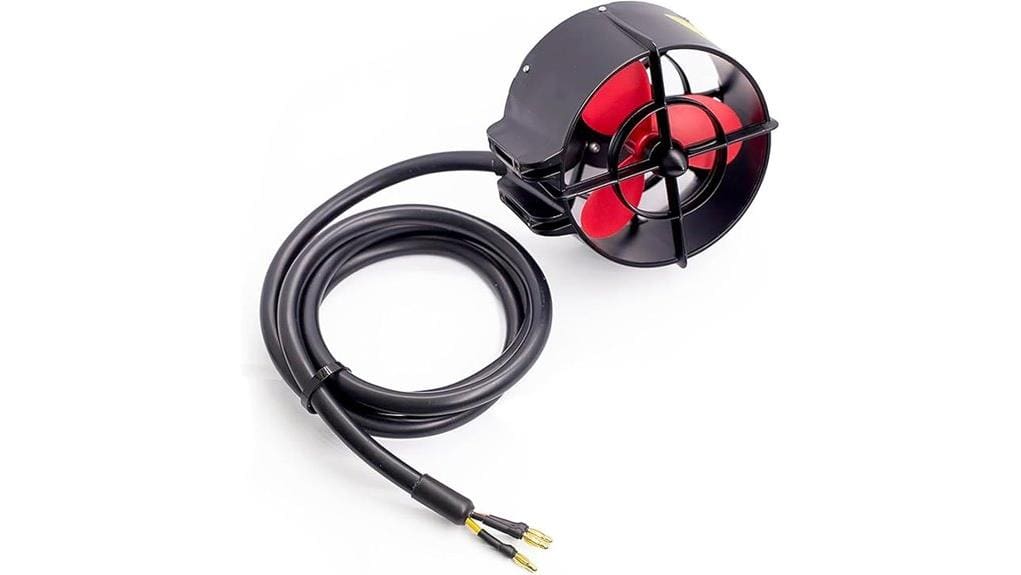
You’ll get a compact, waterproof 500W brushless thruster that runs on 12V or 24V and suits small craft, ROVs, and DIY marine projects. At 12V it draws less current and favors larger, lower‑RPM props; at 24V it delivers much higher thrust but adds thermal, ESC, and wiring demands. Mounting, seal care, and ESC/battery matching are critical for safe operation. Keep reading to see measured thrust, run‑time expectations, and installation tips.
Some Key Takeaways
- The U92 Pro is a compact 500W waterproof brushless thruster available in 12V or 24V configurations for small craft and marine robotics.
- 12V offers lower current draw, gentler torque, and simpler battery options with reduced thermal stress.
- 24V delivers substantially higher thrust (up to ~23.6 lbs) but increases current, heating, and cavitation risk at high RPMs.
- Proper ESC selection, gauge-appropriate wiring, and thermal management are essential for safe 24V operation.
- Installation requires precise mounting, waterproofed connectors, periodic seal inspection, and land calibration before deployment.
What the U92 Pro Is and Who It’s For
The U92 Pro is a compact, high‑torque underwater thruster designed for small watercraft and DIY marine projects; it runs on 12V or 24V and uses a 500W waterproof brushless motor with CCW rotation. You’ll find it tailored to marine robotics and hobbyist propulsion, balancing power, weight, and sealing for reliable operation. You’ll mount it for straightforward hull integration on inflatables, skiffs, or custom ROV frames. You must plan wiring, ESC control, and secure fastenings, and respect waterproofing and torque loads. Use safe battery practices and test thruster response with a controller before deploying in open water. This thruster is especially suitable for beginner kayakers looking to retrofit small craft safely.
Key Specs That Matter: 12V vs 24V Performance and Power
Having covered what the U92 Pro is and where you’d use it, let’s look at how its two supply options change performance and power demands. You’ll choose 12V for conservative draws and simpler battery chemistry like lead‑acid or single‑cell LiFePO4 packs; expect modest thrust and lower current. Move to 24V to unleash the motor’s torque envelope and much higher thrust, but manage higher charge voltages and wiring. Match prop design to voltage: larger pitch at lower RPMs for 12V, finer, faster props for 24V. Always respect ESC limits, cable gauges, and thermal margins for safe, free operation on the water. Waterproof marine charts are useful for planning routes and hazards when using thrusters on open water, especially for kayakers using small electric propulsion waterproof charts.
Real-World Performance: Thrust, Efficiency, and Runtime Expectations
Because power configuration drastically alters output, you’ll want clear expectations for thrust, efficiency, and run time before you head out on the water. At 12V expect about 4.63 lbs thrust; at 24V (29.4V fully charged) you’ll approach 23.6 lbs. That jump changes current draw and thermal load—manage throttle to avoid excessive heat and battery degradation. Monitor for prop cavitation at high RPMs; cavitation reduces thrust and can damage the prop long term. Real-world runtime depends on battery capacity, discharge rate, and duty cycle; plan conservative margins, watch voltage sag, and prioritize safe operation to preserve range. Consider carrying a compact emergency power solution tailored for kayakers to maintain communication and navigation if your thruster drains the main battery.
Installation, Control, and Sealing : Practical Setup Tips
After you’ve balanced expected thrust and runtime, plan the physical installation, control wiring, and sealing steps to keep performance reliable and avoid water intrusion. Mount alignment is critical—secure the U92 Pro to minimize vibration and guarantee prop clearance. Route power and signal with tidy cable routing, use heat-shrinked joints and strain reliefs. Perform controller calibration on-land: confirm PWM ranges and fail-safe behavior before deployment. Follow seal maintenance schedules: inspect rotor sleeve and external seals after each saltwater session, replace damaged O-rings, and apply approved grease. Test submerged at shallow depth to verify watertight integrity and control response. Consider keeping a small kit of static rescue ropes and basic sealing supplies on board for quick recovery and maintenance.
Is It the Right Thruster for You? Use Cases, Pros, Cons, and Buying Checklist
When you’re choosing a thruster, match the U92 Pro’s torque, voltage options (12V/24V), and CCW rotation to your boat’s power system and mounting layout to guarantee safe, efficient operation; its 500W waterproof brushless motor delivers modest thrust at 12V (4.63 lb) and substantial thrust at 24V (up to 23.6 lb at 29.4V), but you’ll need appropriate ESCs, wiring, and battery capacity to avoid overheating or voltage sag. You’ll want it if you need compact, durable propulsion for small craft, low propulsion noise, and saltwater resilience. Cons: single‑unit control limits maneuverability. Checklist: verify ESC compatibility, install battery management, confirm mounting, and plan cooling. Consider pairing the thruster with an all-terrain kayak cart when launching from varied shorelines to protect your gear and simplify transport.
Some Questions Answered
Does the U92 Pro Require a Specific ESC Model or Any Compatible PWM ESC?
No, you don’t need a specific ESC model; the U92 Pro accepts any compatible PWM ESC that matches its 12/24V and 500W motor ratings. You’ll want an ESC with proper PWM compatibility, current handling, and waterproofing or placement protection. Perform ESC tuning for safe motor limits, thermal protection, and correct CCW rotation. Check voltage, amperage, throttle response, and fail-safe settings so you retain control and operational freedom on the water.
Can the Motor Be Reversed for CW Operation Safely?
Yes — you can reverse the motor to CW, but don't reverse wiring without proper control. Use a bidirectional ESC or send reversed PWM; perform bidirectional testing with the thruster secured and power limited. That prevents damage from sudden torque or cavitation. Verify waterproof seals after tests. You’re free to reverse direction, just follow safe procedures, use appropriate ESC firmware/settings, and monitor temperature, current, and shaft behavior during initial trials.
What Maintenance Interval Is Recommended for Saltwater Use?
You should perform a quarterly inspection for saltwater use. You'll check seals, prop, mounting, and wiring, replace any corroded fasteners, and verify ESC function. Clean salt deposits and flush with fresh water after each outing; lubricate moving parts as specified. Fit and replace a sacrificial anode annually or sooner if eroded. If you spot damage or increased vibration, service immediately to maintain safety and freedom on the water.
Is a Thrust Vectoring Nozzle Compatible With This Thruster?
Yes — you can fit a thrust vectoring nozzle, but check nozzle compatibility with the U92 Pro’s 500W CCW external-rotor and mounting pattern. You’ll preserve hydrodynamic efficiency if the nozzle’s diameter, lip shape, and clearances match the propeller and flow. Make certain control integration with the ESC/PWM signal for reliable directional response. Follow sealing and torque limits, and test for cavitation and overheating to maintain safe, freedom-oriented operation on saltwater craft.
Does the Unit Include Anti-Corrosion Coatings on Internal Components?
Yes — you’ll find anti‑corrosion measures on internal components. Electroplating details include zinc/nickel layers on fasteners and contact surfaces to resist galvanic attack. Anodizing methods are applied to aluminum housings and motor sleeve for oxide barrier protection. You’ll want to inspect seals and replace sacrificial anodes periodically; follow torque and maintenance specs to preserve coatings and guarantee safe, long‑life operation in saltwater environments.