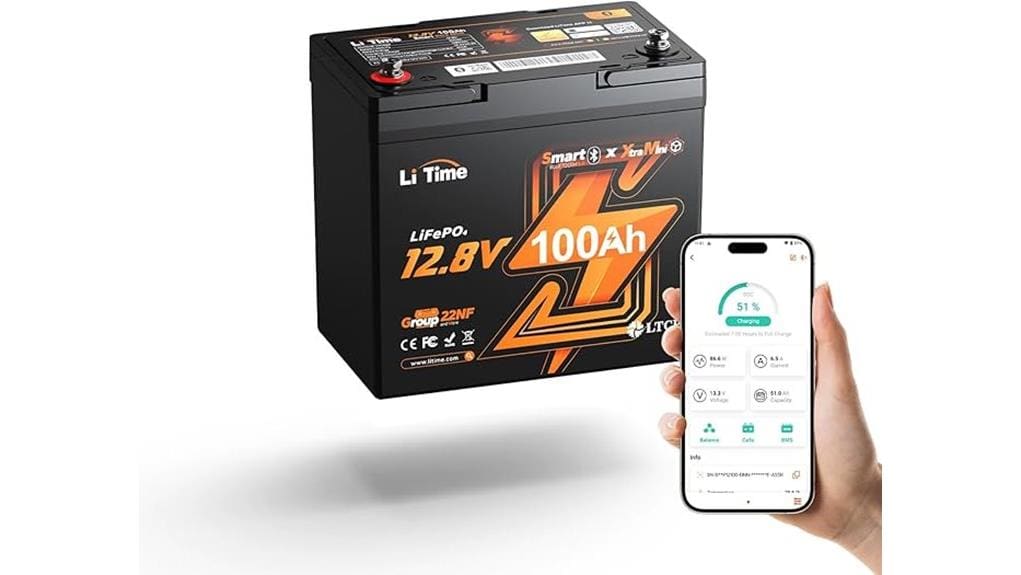
You’ll get an ultra‑compact 12 V LiFePO4 pack in a Group‑22NF case (9.02×5.43×8.19 in) with 1,280 Wh (100 Ah), 100 A continuous output and 500 A surge. EV‑grade cells, integrated cell monitoring and thermal management keep voltage stable under load and enable rapid ~1‑hour recharge. The BMS provides 20+ protections, low‑temp cut‑off and 4,000+ cycle life expectations. Keep Bluetooth antenna clear for telemetry; more performance, install and use details follow.
Some Key Takeaways
- Ultra‑compact 12 V LiFePO4 (Group 22NF) offering 100 Ah (1,280 Wh) in a 9.02 × 5.43 × 8.19 in case.
- EV‑grade cells with integrated BMS deliver 100 A continuous and 500 A short‑term surge capacity for high‑draw loads.
- Real‑world tests show minimal voltage droop, controlled temperature rise, and rapid 1‑hour fast recharge to usable capacity.
- Bluetooth 5.0 telemetry and LiTime app provide SOC, voltage, current, event logs, and troubleshooting diagnostics.
- Rated 4,000+ cycles with extensive protections, but verify warranty, mounting, and incompatibility with engine starter use.
What the LiTime 12V 100Ah Xtra‑Mini Actually Is (Size, Specs, and Standout Features)
Think of the LiTime 12V 100Ah Xtra‑Mini as an ultra‑compact, power‑dense 12 V LiFePO4 module engineered for tight installations: it packs 1,280 Wh (100 Ah) into a Group 22NF case (9.02 × 5.43 × 8.19 in) yielding 194.7 Wh/L. You get EV-grade cells, 12 V nominal, and a continuous 100 A BMS rating in a compact footprint that frees space for gear and mobility. Thermal management is integrated via cell-level monitoring and controlled charge/discharge to sustain 4000+ cycles. Traceable components, outdoor validation, and Bluetooth telemetry let you manage energy precisely and maintain autonomy.
How It Performs: Power, Recharge, and Real‑World Load Tests
When you load the LiTime 12V 100Ah Xtra‑Mini, it delivers up to 100 A continuously with 500 A surge capacity, so high‑draw devices like trolling motors or inverters run without immediate voltage sag. You’ll see steady 12 V under 100 A and short‑term peaks handled by the 500 A surge handling spec. In bench tests the pack sustains rated output with minimal voltage droop; thermal rise stays controlled. Rapid recharge (1‑hour fast recharge) restores usable capacity quickly, letting you get back on the water or trail. Data‑driven performance equals predictable power and operational freedom.
Durability and Lifecycle: LiFePO4 Cells, BMS Protections, and Expected Lifespan
Because LiFePO4 chemistry and EV‑grade cells underpin the Xtra‑Mini, you get a highly predictable degradation curve and long calendar life: the pack is rated for 4,000+ deep cycles and an expected service life exceeding 10 years under normal use. You’ll benefit from cell aging metrics that remain linear across typical depth‑of‑discharge profiles; capacity retention expectations are conservative and verifiable. The 100A BMS enforces 20+ protections (including low‑temp charge cut‑off, 1s discharge switching, 30s overload recovery) and supports active thermal management strategies. For mobile freedom, that means reliable, consistent output with minimal maintenance and documented longevity.
Connectivity and Usability: Bluetooth Monitoring, App Features, and Installation Tips
Tap into the Xtra‑Mini’s Bluetooth 5.0 link to get real‑time, data‑driven visibility of state‑of‑charge, voltage, current, and key BMS events via the LiTime app. You’ll use Bluetooth diagnostics to log charge/discharge cycles, view surge events (500 A peak), and monitor the 1‑second discharge switch and 20+ protection triggers. The app displays SOC percentage, instantaneous current, and historical profiles with timestamps for troubleshooting. For installation ergonomics, mount the Group 22NF case where airflow and cable access are optimal; torque terminals per spec and keep the BT antenna unobstructed. You’ll stay free to roam with confident monitoring. This battery is a strong option for paddlers looking for reliable backup power and compact sizing suitable for kayaks, especially when paired with GPS backup batteries.
Is It the Right Battery for You? Best Use Cases, Limitations, and Buying Decision Checklist
If you need a compact, high‑cycle 12 V pack that delivers 100 A continuous with 500 A surge and 1280 Wh in a Group 22NF footprint, the LiTime Xtra‑Mini is engineered to fit those requirements. You’ll get 4000+ cycles, 1-hour recharge, Bluetooth SOC, and robust BMS protections for adventure systems like RVs, trolling motors, and boats. Consider weight tradeoffs versus lead alternatives and confirm your application isn’t an engine starter or golf-cart motor. Check warranty considerations: coverage length, pro rata terms, and failure modes covered. Buy if you prioritize power density, longevity, and compact installation. Kayakers should also evaluate mounting, waterproofing, and mobility needs when integrating a battery into small craft and emergency gear, especially for marine safety.
Some Questions Answered
Does It Come With a Warranty and What Does It Cover?
Yes — you get a warranty; the warranty duration typically covers defects for a multi-year period tied to the product lifespan (check your seller for the exact term). Coverage exclusions usually include misuse, improper installation, engine-starting abuse, physical damage, and non-approved charging. You’ll have replacement or repair for manufacturing faults within terms; keep purchase proof and follow installation/usage specs to preserve coverage and claim rights.
Can Two Batteries Be Connected in Parallel or Series?
Yes — you can use two batteries in parallel or series, but you’ll follow strict rules. For parallel use, match voltages, state-of-charge, and use equal-length cabling; total capacity doubles to 200 Ah at 12 V, BMS remains 100 A. For series connection, match cells identically to create 24 V while keeping current at 100 A; guarantee BMS/support for series stacks and that charging systems accommodate 24 V. Test and monitor via Bluetooth.
What Are the Exact Charging Voltage and Cutoff Settings?
Charge to 14.6 V and float at 13.6 V; cutoff voltages: low-charge cutoff near 10.0–10.5 V and low-temperature charge cut-off active below ~0°C. Your BMS enforces charging thresholds and a 100 A BMS current limit, plus short 30-second overload recovery and 1-second discharge switching. Set chargers to 14.6 V bulk, 13.6 V float, and respect the low-voltage cutoff to protect lifespan and enable long-term, freedom-oriented use.
Are There Replaceable Cells or User-Serviceable Parts?
No — you don't have user-serviceable cell access; the pack isn't modular design for field cell swaps. The enclosure and BMS are sealed to preserve safety and validation test integrity. If a cell fails, you'll return or replace the whole battery assembly per warranty. That limits DIY repairs but maintains 20+ protection features, 80+ outdoor tests, and traceable EV-grade LiFePO4 cells for predictable 4,000+ cycle lifespan and safe long-term operation.
Is the Battery Air-Transport or Airline-Friendly?
No — you can't air-transport this battery on most passenger aircraft. Airline restrictions bar large lithium batteries above specified Wh limits; at 1280 Wh this pack exceeds typical carry-on and checked limits. You’ll need special cargo arrangements, compliant shipping labels, and operator approval for airfreight. Coordinate with the carrier, provide proper documentation, and expect additional handling fees and safety inspections to meet hazardous materials regulations and guarantee lawful transport.