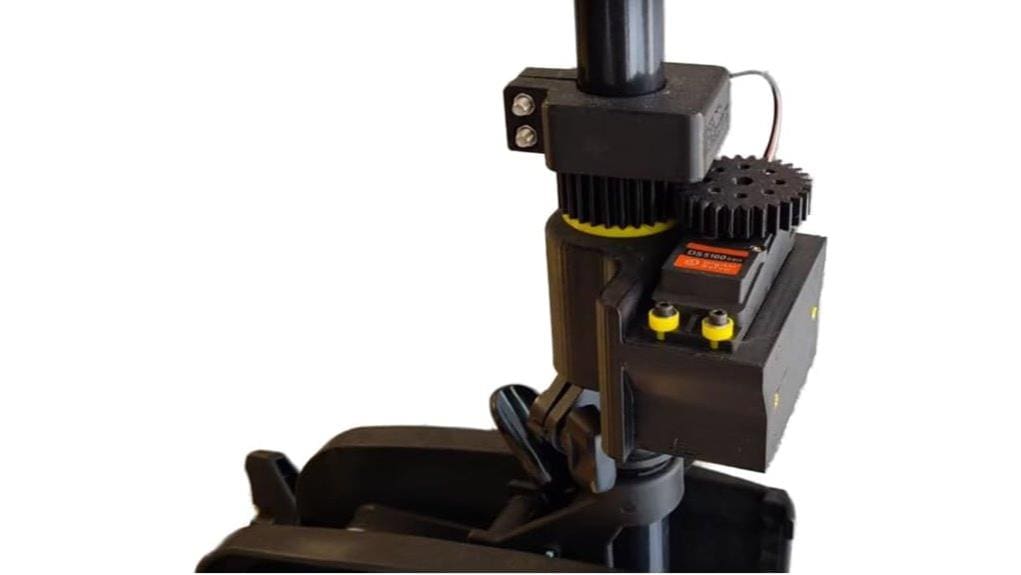

You’ll get a wireless, servo-driven retrofit that replaces manual tiller steering on Minn‑Kota C2 shafts and similar motors, letting you trim heading remotely for smoother course corrections and less hand strain. It’s practical for anglers and small-boat users who want precise control; mounting hardware fits C2 patterns but other motors need brackets and the high-torque servo isn’t included. Power, range, and torque need testing before use, and alignment/route checks are critical—keep going for full fit, install, and performance details.
Some Key Takeaways
- Confirms compatibility with Minn‑Kota C2 shafts and steer tubes; verify shaft diameter and clamp points before purchase.
- Servo is excluded; recommended high‑torque ANNIMOS 60KG (DS5160) for reliable 180° steering and 8.4V operation.
- Installation is straightforward with supplied C2‑pattern bracket, proper servo alignment, harness routing, and bench calibration.
- Performance hinges on torque stability, steering latency under one second, current draw, and wireless range testing in real conditions.
- Pros: improved ergonomics and waterproof casing; cons: extra servo cost and limited fit for non‑C2 motors without adapter brackets.
What the Trolling Motor Servo Steering Kit Actually Does and Who It’s For
While you’re paddling or cruising, the Trolling Motor Servo Steering Kit converts manual steering into wireless, servo-driven control so you can adjust a Minn-Kota C2 trolling motor remotely. You’ll gain navigation precision and smoother course corrections without leaving your seat. The kit lets you use a remote to trim heading, reducing hand strain and improving user ergonomics for long outings. It’s aimed at anglers and freedom-seeking boaters who want practical, technical upgrades: minimal installation, predictable response, and compatibility focused on Minn-Kota C2. Servo not included; choose a recommended high-torque unit for reliable, repeatable control. The kit is especially appealing to those outfitting kayaks with drift socks for better stability and control.
Fit and Compatibility: Minn‑Kota C2 Details Plus Alternatives (Traxxis, MotorGuide R3)
Now that you know what the kit does, let’s look at fit and compatibility specifics. You’ll find Minn‑Kota adaptations engineered to match the C2 shaft and steer tube; check shaft diameter and clamp points before ordering. Mounting hardware is supplied for the C2 pattern, but alternatives require different brackets. The Traxxis footprint version aligns with a narrower mount — confirm bolt spacing. MotorGuide R3 models need their dedicated bracket set. Wiring harness routes are similar across versions but verify connector types and length for your setup. If you want freedom on the water, confirm model fit before you buy. Also consider essential kayak power pole accessories like mounting plates and quick‑release brackets for a complete setup essential gear.
Installation and Recommended Servo (ANNIMOS 60KG / DS5160) : Step-by-Step Checklist
If you’re installing the Trolling Motor Servo Steering Kit on a Minn‑Kota C2, follow a precise sequence to guarantee the ANNIMOS 60KG (DS5160) servo mates correctly and reliably: verify the servo’s 8.4V power source and 180° rotation match your steering geometry, mount the servo to the supplied C2-pattern bracket with recommended torque settings, align the servo horn so center pulse corresponds to straight-ahead, secure the linkage to the steer tube clamp and confirm no binding through full travel, route the wiring harness away from moving parts and water ingress points, and perform a bench calibration and final water/road test to validate steering range, fail-safe behavior, and connector integrity. Also confirm your kayak’s tie-downs and lash points are secure before testing to prevent movement during setup and trials and to follow secure tie-down best practices.
Checklist:
1) Inspect servo, tools, wiring diagram.
2) Fit bracket and fasteners.
3) Set servo center pulse.
4) Attach horn and linkage.
5) Verify smooth travel mechanically.
6) Connect 8.4V supply per wiring diagram.
7) Run servo calibration and endpoint adjustment.
8) Test remote control, fail-safe, and waterproofing.
Real-World Performance: Steering Accuracy, Range, Power Requirements, and Battery Notes
After you finish mechanical setup and calibration, evaluate steering accuracy, range, and power draw under real conditions to confirm the system meets expectations. Check steering latency by timing response to joystick inputs; acceptable delay is under a second for practical control. Verify torque stability during full deflection and in chop so course holds without hunting. Test wireless range in open water and near obstructions to spot signal interference; log dropouts and adjust antenna placement. Monitor current draw during idle, cruise, and full-turns to estimate battery drain. Use those measurements to size a battery and confirm mission endurance. Also consider selecting and routing the correct rudder cable for smooth control and corrosion resistance, focusing on cable material and proper installation.
Buy-Or-Skip Verdict With Pros, Cons, Price Considerations, and Gift Suitability
While it won't be the cheapest add-on you buy, the Trolling Motor Servo Steering Kit delivers a straightforward, practical upgrade if you need wireless, remote steering for a Minn-Kota C2-equipped kayak or small boat. You should buy if you value freedom on the water, want reliable steering control, and will pair it with the recommended ANNIMOS 60KG servo (8.4V, 180°). Pros: simple install, improved handling, waterproof casing and good remote ergonomics. Cons: servo not included, limited to Minn-Kota C2 unless you request other models, upfront cost. It's a smart, practical gift for water-sports enthusiasts. Many kayakers pair such upgrades with a VHF radio for safety and communication on open water VHF marine radio.
Some Questions Answered
Does the Kit Include Waterproofing for Electronics and Antenna?
No — the kit doesn’t include full waterproofing for electronics or antenna sealing. You’ll get standard connectors and mounting hardware, but you’ll need to add waterproof connectors, gasketed enclosures, and antenna sealing yourself. Use the recommended 8.4V servo and protect its connections with heat-shrinked, sealed crimps or IP67-rated plugs. That keeps your wireless control reliable on open water and preserves the freedom to customize rugged protection.
Can It Be Used With Foot-Controlled Trolling Motors?
Yes — you can use it with foot control systems, but you’ll need to integrate the servo steering without interfering with existing foot control and throttle modulation. You’ll mount the servo to steer while retaining your foot throttle linkage or electronic throttle signal. Verify compatibility with your Minn‑Kota C2 (or contact seller for other models), use the recommended 8.4V, 180° servo, and test fail-safes so you keep control and freedom on the water.
Are Replacement Parts or Brackets Available Separately?
Yes — you can get spare brackets and some replacement parts separately. You’ll need to contact the seller for stock and compatibility; they’ll confirm which brackets fit Minn-Kota C2 or offer models for Traxxis/MotorGuide R3. If you need unusual fittings, ask about custom mounts or provide measurements; they’ll quote fabrication or recommendations. Keep servo specs handy (8.4V, 180°) so you can match parts and preserve your steering freedom.
Will Using the Servo Void My Trolling Motor Warranty?
Not automatically — you should check with the motor manufacturer first. Installing a third‑party servo can affect warranty transferability if the maker deems modifications causal to failure. You’ll want documented manufacturer responsiveness: get written confirmation that the servo won’t void coverage or limits, or request approved installation guidelines. If they refuse, consider using approved parts or retaining stock components to preserve warranty and your freedom to revert modifications.
Can I Integrate This With a Fish-Finder or GPS Autopilot?
Yes — you can integrate it, but with limits. You’ll need an autopilot or fish-finder that outputs standard NMEA or PWM steering signals; then map that to the servo input or use an intermediary controller. GPS integration and Sonar compatibility depend on your device’s output and the kit’s input options. You’ll likely add a signal converter or flight-controller-style board. Test thoroughly, secure wiring, and verify voltage/grounding to avoid damage.