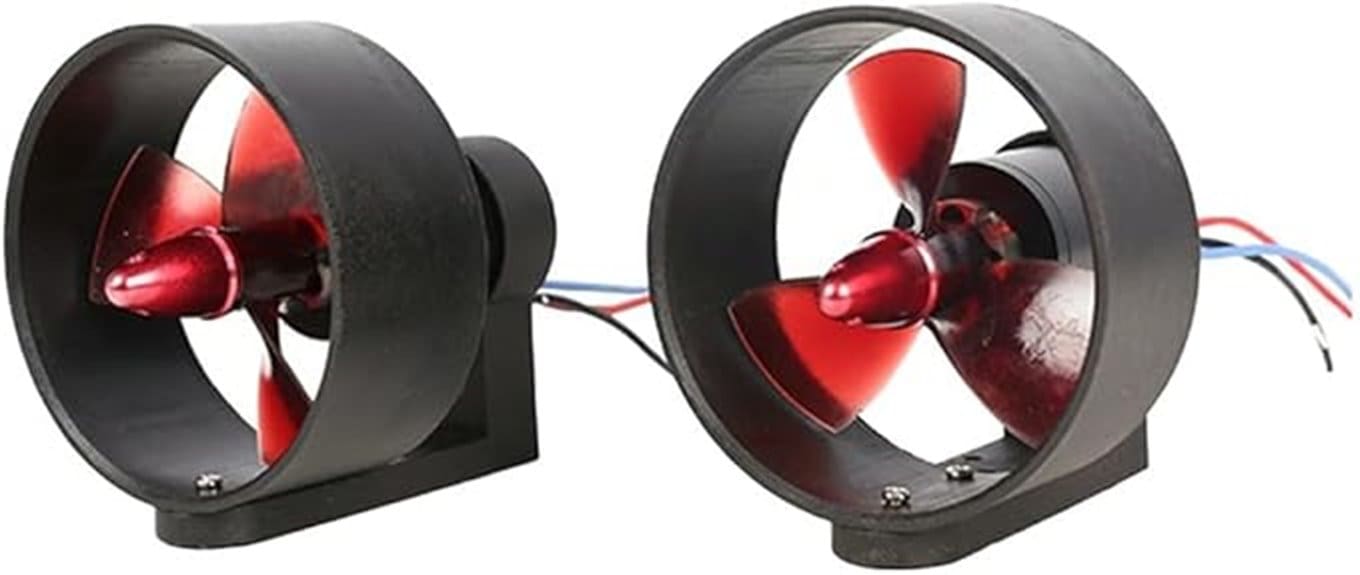

You’ll get a compact 3550 500KV brushless thruster that puts out about 600 W and runs on 12–24 V with a 40 A ESC, giving strong low-to-mid RPM thrust and efficient acceleration with modest battery draw. It weighs light, uses a 290 g single prop with a nylon shell and aluminum cover for cooling, and needs proper fusing, waterproof connectors, and ESC calibration. Keep torque/rotation, prop choice, and cooling in mind — more details follow.
Some Key Takeaways
- Confirm motor supports 12–24 V and pair with a 40 A ESC to avoid overcurrent and compatibility issues.
- Expect ~600 W continuous thrust ideal for small boats, kayaks, and bait tugs with responsive low-to-mid RPM performance.
- Use lightweight propellers and proper CW/CCW selection to balance thrust direction, torque reaction, and hull layout.
- Ensure waterproof connections, fused battery leads, short cabling, and ESC calibration before testing at low throttle.
- Monitor heat under sustained loads; aluminum cover helps cooling but avoid prolonged near-maximum power runs.
Performance and Power: What the 3550 500KV, 600W Thruster Actually Delivers
Because the 3550 500KV motor pairs a relatively high KV with a 600 W rating, you’ll get strong low-to-mid RPM thrust suitable for small-boat propulsion without oversized current draw. You’ll see predictable thrust curves that match lightweight propellers, giving efficient acceleration for bait tugs, kayaks, and nests. You can push responsive maneuvering while keeping battery drain modest across 12–24 V. Monitor heat management under sustained high load; the aluminum cover helps dissipate heat but you should avoid prolonged near-maximum power without breaks. Installation choices and prop selection tune the tradeoffs between top speed, torque, and runtime for freer exploration. This makes the thruster a practical option for kayakers seeking reliable bilge pump integration and lightweight propulsion.
How to Install and Wire the Thruster With a 12–24V System and 40A ESC
When you're ready to wire the 3550 500KV thruster into a 12–24 V system with a 40 A ESC, start by verifying voltage compatibility, ESC rating, and rotor direction so you avoid mismatches that could damage components. Mount the thruster with secure waterproof connectors on power and signal leads, route battery positive/negative through a fuse, and minimize cable length to reduce voltage sag. Configure ESC endpoints and enable thermal protection in its settings. Calibrate throttle range and test control algorithms in open water at low throttle. Inspect seals, recheck connections, and progress to full-power runs once stable. Also consider using epoxy-safe mounting practices and materials to ensure durable watertight seals when installing on kayaks.
Propeller Rotation, Weight, and Build: CW vs. CCW, Nylon Shell and Aluminum Cover
Although propeller rotation might seem like a simple left-or-right choice, selecting CW (forward) or CCW (reverse) affects thrust direction, torque reaction, and installation orientation, so match the prop rotation to your hull layout and control scheme. You’ll pick CW or CCW based on desired maneuvering and counter-torque handling. The 290 g single propeller and lightweight nylon shell reduce inertia for responsive control. Aluminum motor cover improves heat dissipation and corrosion resistance. Check mounting options for correct shaft alignment. Perform routine propeller maintenance to limit wear and manage noise levels; secure fasteners and inspect seals after use. For kayakers starting out, choose compatible attachment points and hardware designed for small craft to ensure safe, reliable installation, especially when using carabiners and gear.
Real-World Use Cases: Bait Tugs, Nests, Kayaks, and Fishing Boats Tested
If you’re fitting this 3550 500KV, 600W thruster to small craft, expect responsive thrust and straightforward installation across bait tugs, nests, kayaks, and light fishing boats. You’ll notice quick planing on bait tugs with predictable throttle mapping and modest battery range impact at cruising speeds. On nests the unit provides steady station-keeping with low maintenance and acceptable noise levels. Mounted on kayaks it’s lightweight, improves range and control, and lets you explore farther without fighting currents. On light fishing boats it offers reliable trolling and maneuvering. Follow wiring for 12–24 V and 40 A ESC to secure safe operation. For kayak setups consider essential mounting and gear for Power Pole installations like secure transom mounts to ensure stability and proper alignment.
Buy or Skip? Compatibility Checklist, Pros/Cons, and Final Recommendation
You've seen how the 3550 500KV, 600W thruster performs across bait tugs, nests, kayaks, and light fishing boats; now assess whether it fits your boat and mission. Check voltage (12–24V) and 40A ESC readiness, prop rotation (CW/CCW) match, mount space, and material compatibility with your hull, brackets, and saltwater exposure. Pros: compact 290g prop, nylon shell, aluminum cover, efficient 600W output, simple install. Cons: limited to small boats, potential noise levels at full throttle, cooling demands. Recommendation: buy if you value a lightweight thrust system and match specs; skip if you need quieter or higher-power systems. Consider also adding kayak floatation bags to maintain buoyancy when installing aftermarket thrusters for safety and stability floatation bags.
Some Questions Answered
What Maintenance Schedule Keeps the Motor and Propeller Corrosion-Free?
Inspect monthly while in use and weekly on saltwater trips; do regular inspections of the shell, prop, wiring, and seals. Rinse with fresh water after each outing, dry connectors, and apply corrosion inhibitor to metal parts. Replace seals or damaged propellers immediately. Install and check sacrificial anodes quarterly; replace when 50% depleted. Annually, open the motor cover for internal inspection, clean, and test ESC and bearings for reliable, free movement.
Is There an IP or Waterproof Rating for the Motor Assembly?
No official IP rating is provided for the motor assembly. You should assume no guaranteed IP protection and rely on proper sealing methods. Use marine-grade potting, silicone gaskets, and sealed cable glands; apply corrosion inhibitors and dielectric grease at connectors. Install within waterproof housings or enclosures rated for the environment you’ll operate in. Regularly inspect seals and replace degraded materials to maintain long-term waterproofing and reliable underwater use.
Can the Thruster Run Continuously at Full Power Without Overheating?
No — you shouldn’t run the thruster continuously at full power without risking overheating. The 3550 motor and 40 A ESC can hit thermal throttling under sustained max load; duty cycle matters. Operate in bursts or maintain a conservative duty cycle (intermittent full-thrust periods with cool-downs) to preserve motor life and avoid ESC cutbacks. Monitor temperature and follow installation guidance to maximize safe continuous use within limits.
Are Replacement Propellers and Parts Readily Available?
Yes — replacement propellers and parts are generally available. You’ll find spare availability from the manufacturer and third-party sellers; aftermarket compatibility is common for the 3550 motor/500 KV family and standard prop sizes. You can source nylon shells, aluminum covers, props (CW/CCW) and ESC-compatible components. Verify part fitment, rotation and 12–24 V/40 A specs before buying. Keep spares onboard to maintain freedom and minimize downtime.
Does the Unit Emit Electrical Noise Affecting Onboard Electronics?
You shouldn’t see major electrical noise if you install it properly; the 40 A ESC and brushless motor can generate some EMI. You’ll want EMI shielding on signal and power runs and keep data cables separated to prevent signal interference. Route wiring away from navigation and radios, use ferrite beads or twisted pairs, and ground the aluminum motor cover. Do that and you’ll preserve onboard electronics freedom and reliable signals.