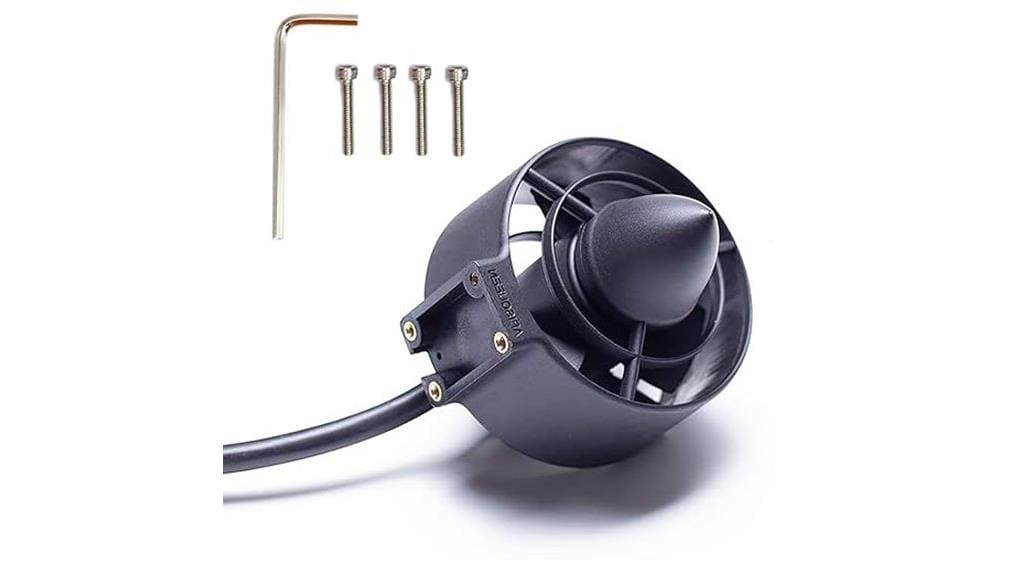

You’ll find the U2 Mini is a compact, efficient 500 KV brushless thruster designed for 12–16 V systems, giving about 2.87 lb static thrust in a seawater‑compatible composite housing with front/rear ribs and sealed connectors. It’s lightweight for kayaks and small ROVs, but you’ll need a properly rated ESC, correct PWM calibration, and robust mounting to avoid vibration and seal failure. It suits low‑power marine projects and, if you want specifics on performance, integration, and buying tradeoffs, keep going.
Some Key Takeaways
- Compact, seawater-safe 500 KV brushless thruster ideal for small watercraft and ROVs using 12–16V power.
- Delivers about 2.87 lbs static thrust with efficient low-current draw for extended runtime.
- Requires a 12–16V (3–4S LiPo) compatible ESC rated above expected current and PWM-calibration.
- Durable composite housing with front/rear ribs and sealed connectors reduces corrosion and debris ingress.
- Verify mounting clearance, prop pitch, spare props, and plan routine seal and propeller inspections.
Quick Verdict: Who the U2 Mini Thruster Is Best For
If you need a compact, efficient thruster for small watercraft or ROV projects, the U2 Mini is a strong choice: it’s a 500 KV brushless unit rated for 12–16V input, built in seawater-compatible composite with front and rear ribs for debris protection, and provides about 2.87 lbs of thrust. You’ll appreciate its low weight and efficient draw when prioritizing range and maneuverability. Use it if you want simple, modular propulsion with ESC/PWM control, minimal maintenance, and predictable behavior for battery balancing and noise profiling during system integration. It’s ideal when autonomy and portability matter most. For lightweight vessels, pairing the U2 Mini with appropriate foam paddle floats can improve stability and safety.
U2 Mini Specs That Matter: Power, Size, Materials, and Connectors
Because power delivery, size, materials, and connectors determine installation options and operational limits, you should assess each U2 Mini spec against your vehicle's electrical system and mounting constraints before integrating it. The U2 Mini accepts 12–16V (3–4S LiPo) so match it to your battery chemistry and voltage sag characteristics. Its 500 KV brushless motor yields high RPM with low current draw; check ESC rating and PWM compatibility. Weight and compact form factor suit kayaks and small ROVs, but confirm mounting clearance and propeller pitch for desired thrust profile. Composite seawater-safe materials and sealed connectors simplify corrosion management. For long-term durability on kayaks consider routine gelcoat and surface maintenance to prevent wear on exposed fittings and hardware, especially using gelcoat repair methods.
Real-World Performance: Thrust, Efficiency, and Watertight Reliability
When you evaluate the U2 Mini in real-world conditions, focus on measured static thrust, sustained efficiency at your chosen voltage (12–16 V), and the integrity of seals under pressure and prolonged immersion. You’ll record initial thrust, monitor thrust decay over runtime, and note propeller erosion after salt exposure. Track battery heat and input current to quantify efficiency per watt at 12–16 V. Inspect composite housings, front/rear ribs, and O-rings for seal longevity; perform pressure soak tests and vibration cycles. Use repeatable test rigs, calibrated load cells, and thermistors to produce defensible, comparable performance data. Also document compatibility with essential kayak safety gear like electric bilge pumps to ensure the U2 Mini integrates safely into typical kayaking setups.
How to Integrate and Control the U2 Mini (ESC, PWM, and Mounting Tips)
Although the U2 Mini is a self-contained thruster, you'll need an appropriate ESC and PWM source to make it spin and to control speed precisely. For ESC setup, choose a 12–16V compatible brushless ESC rated above expected current; wire battery, motor and signal per manufacturer diagrams and secure connectors. Perform PWM calibration with your controller or microcontroller: set neutral, full, and failsafe endpoints; verify direction and response before immersion. Use rigid Mounting brackets to align thrust vector, isolate vibration with rubber pads, and route cables away from prop. Finish with thorough Waterproof sealing at cable exits and mounting interfaces to maintain reliability. For installations on kayaks and small boats, consider marine-grade adhesives and sealants for mounting and sealing to ensure long-term corrosion and water resistance.
Should You Buy It? Alternatives, Accessories, and Final Buying Checklist
Now that your ESC, PWM setup, and mounting are sorted, you'll want to decide whether the U2 Mini fits your project requirements and budget. You should buy it if you need compact, efficient 12–16V propulsion with a favorable noise profile and proven composite resistance. Consider alternatives if you need higher thrust or reversible CW/CCW pairing. Add accessories: compatible ESC, secure mounts, inline fuse for battery safety, and sacrificial anodes for corrosion maintenance. Verify warranty support and parts availability before purchase. Final checklist: voltage match, ESC PWM compatibility, physical fit, spare propellers, and a plan for routine inspection, alongside other ESC setup considerations. Also consider pairing the U2 Mini with a reliable emergency power bank to keep your electronics and ESC powered during extended trips.
Some Questions Answered
Does the Propeller Direction (CW) Matter for Pairing Multiple Thrusters?
Yes — propeller direction matters when pairing multiple thrusters. You’ll match CW and CCW units to balance torque, yaw, and propeller balance effects; otherwise you’ll need opposing mounting orientation or counter-rotating props to cancel net rotation. Make certain identical mounting orientation, alignment, and matched thrust vectors to preserve stability. Use ESCs with correct rotation mapping and verify propeller balance during installation so paired thrusters deliver symmetric, predictable control and freedom of maneuver.
Can the U2 Mini Operate Continuously at Maximum Thrust?
No — you shouldn’t run the U2 Mini at maximum thrust continuously. You’ll trigger thermal throttling and risk overheating the brushless motor and ESC. Operate within recommended duty cycle limits, using intermittent high-thrust bursts and allowing cool-down periods. Monitor temperature and PWM input, and size your ESC and battery for margin. If you need sustained high thrust, use multiple thrusters or upgrade cooling and components to avoid motor or controller failure.
Is There Built-In Overheat or Current Protection?
No — it doesn’t include an internal thermal cutoff or current sensing. You’ll need to provide external protection. Use an ESC or separate controller with thermal cutoff, overcurrent and temperature monitoring, and set conservative duty cycles if you want continuous high thrust. Monitor motor temperature and battery current with sensors or a smart ESC, and program fail-safes to reduce power or shut down when thresholds are exceeded to prevent damage.
Can I Use This Thruster in Brackish Water Long-Term?
Yes — you can use it long-term in brackish water, but you’ll need proactive corrosion resistance and biofouling management. The composite housing tolerates mixed salinity, yet salt and ions accelerate wear at fasteners, connectors, and bearings. Flush electrical interfaces, use sacrificial anodes or coatings, and schedule regular cleaning to prevent biofouling. Monitor motor temperature and current; replace seals or hardware showing corrosion to maintain reliable, long-lasting operation.
Are Spare Propellers or Service Parts Available for Purchase?
Yes — you can buy spare propellers and replacement hubs. You’ll source them from the manufacturer or authorized dealers; check compatibility with the U2 Mini CW propeller spline and shaft dimensions. Keep spare propellers on hand if you operate in obstructions or brackish mixes. Use OEM replacement hubs to preserve balance and seal integrity. Install with proper torque and verify ESC-free spin before submersion to avoid motor or seal damage.