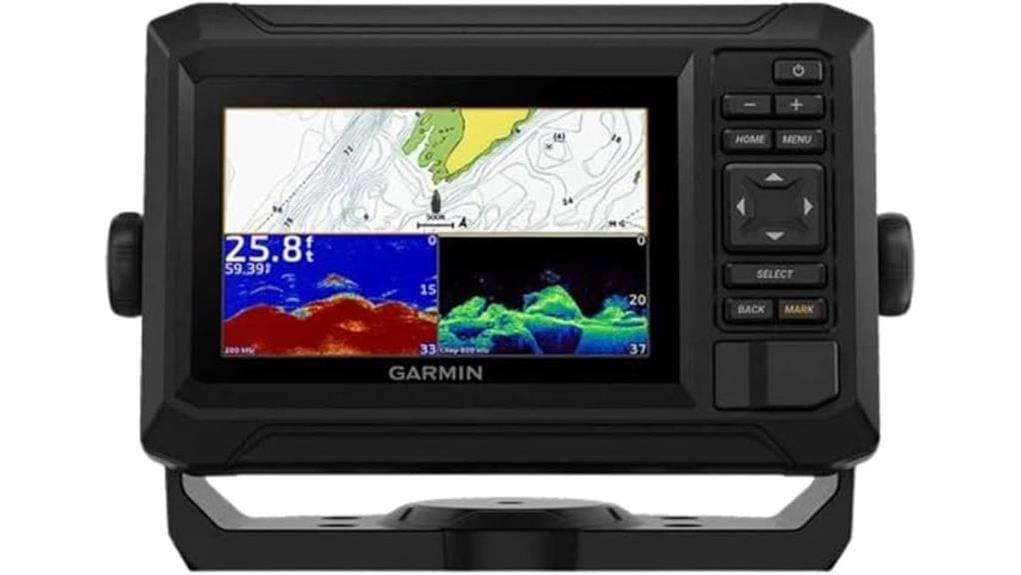
You’ll get a compact, sunlight‑readable 7" chartplotter with a GT20‑TM transducer that delivers crisp CHIRP arches and near‑photographic ClearVü structure imaging, plus preloaded Navionics+ charts, Wi‑Fi and ActiveCaptain support for waypoint sync and updates. Installation uses a tilt or flush mount; route the transducer for laminar flow and separate power lines from sonar cables to minimize noise. It’s ideal for bay anglers who want high‑detail structure ID without a larger MFD — more setup and performance details follow.
Some Key Takeaways
- 7-inch sunlight-readable ECHOMAP UHD2 74CV pairs with GT20 transducer, ideal for small boats and solo anglers.
- CHIRP sonar yields crisp fish arches and clear target separation for locating individual fish and schools.
- ClearVü scanning delivers near-photographic structure and bottom detail to validate arches over hard structure.
- Preloaded Navionics+, Wi‑Fi, and ActiveCaptain enable chart detail, updates, waypoint sync, and route sharing.
- Compact package with tilt mount and flush option; proper transducer placement and cable routing are crucial for best performance.
What the ECHOMAP UHD2 74cv + GT20-TM Includes and Key Specs
Although it's compact, the ECHOMAP UHD2 74cv Combo ships as a complete plug-and-play package: you'll get the 7-inch keyed chartplotter with a sunlight-readable display, the GT20-TM transducer, a power/data cable, tilt (bail) mount plus flush-mount hardware, and documentation. You’ll find included items listed clearly; unpacking takes minutes. Key specs emphasize practical performance: 7" display, DC power, dimensions 12.5 x 10.6 x 8.7 inches, package weight 2.11 kg, model 010-02595-51. Preloaded Navionics+ charts, Wi‑Fi and ActiveCaptain compatibility extend capability. Installation options suit rigs where autonomy and reliable sonar matter. It's a solid choice for paddlers seeking essential marine GPS gear and straightforward installation.
How Garmin’s Traditional Sonar and ClearVü Perform on the Water
With the hardware and transducer confirmed, you’ll notice how Garmin’s traditional CHIRP sonar and ClearVü scanning work together on the water. You get crisp fish arches from CHIRP that separate targets at varied depths while ClearVü paints a near-photographic cross-section of structure and bottom detail. Together they let you quickly validate targets—arches that mark fish above hard structure shown in high-contrast ClearVü. Readable palettes and adjustable sensitivity keep clutter low so you can make confident drift or anchor decisions. The combined return gives freedom to explore efficiently, locate schooling fish, and interpret bottom composition on each pass. This makes the unit a strong choice for kayakers and beginners looking for a compact, reliable portable fish finder.
Navigation, Mapping, and Connectivity: Navionics+, Wi‑Fi, and ActiveCaptain
A reliable chartplotter is only as useful as the maps and connectivity behind it, and the ECHOMAP UHD2 74cv delivers precise navigation through preloaded Navionics+ charts, built‑in Wi‑Fi, and ActiveCaptain integration. You get detailed U.S. coastal cartography, depth contours, and hazards for confident route planning. Wi‑Fi lets you push software updates and synchronize waypoints, enabling route sharing between compatible Garmins. The ActiveCaptain app provides OneChart access, route/waypoint management, and seamless app integration so you control charts and alerts from your phone. For independent boaters who value freedom, the system is responsive, reliable, and straightforward to operate. It’s also a great choice for kayakers looking to pair with GPS speed trackers and other essential gear for safer trips.
Installation, Mounting Options, and Real‑World Setup Tips
Now that your charts and connectivity are set, mounting and powering the ECHOMAP UHD2 74cv correctly will determine real-world performance. Mount using the supplied tilt or flush kit depending on console space; flush gives clean sightlines, tilt eases access. Position the GT20 transducer for asymmetric wake and keel clearance—aim for laminar flow, avoid turbulence from strakes. Secure cable routing along stringers, through chases, and use grommets at penetrations to prevent chafe. Tie and label power/data runs; keep power lines separate from active sonar cables to reduce noise. Finalize with a system test at idle and cruising speeds to verify readings. For paddlers installing on small boats, consider mounting options and gear from trusted transducer arms suppliers to simplify attachment and alignment.
Who Should Buy It and How It Compares to Similar Chartplotters
Although you don't need top-tier chartplotter power for casual weekend fishing, the Garmin ECHOMAP UHD2 74cv gives serious anglers a compact, reliable option that balances advanced sonar with approachable pricing and simple installation. You’ll want this if you’re a bay angler who values ClearVü detail, a solo fisherman needing a sunlight-readable 7" display, or budget cruisers upgrading basic electronics without complexity. Compared with larger MFDs it sacrifices screen real estate but keeps Navionics+ charts, Wi‑Fi, and ActiveCaptain compatibility. It’s pragmatic: powerful sonar, minimal footprint, and straightforward mounting—ideal when freedom to roam matters more than excessive features. For kayakers and small-boat users, pairing this unit with a proper VHF marine radio improves safety and communication on the water.
Some Questions Answered
Does the GT20-TM Work on Aluminum and Jon Boats Without Modification?
Yes — the GT20‑TM will work on aluminum and jon boats without major modification. You’ll transom mount it using the supplied tilt bracket, positioning the transducer to minimize hull cavitation and keep the element clear of prop wash. Fine‑tune height and angle for clean return and avoid turbulence from strakes or trim tabs. You’ll retain portability and freedom to remount between boats with basic hand tools and sealant.
Can I Use a Portable Battery Pack Instead of the Boat's DC Power?
Yes — you can use a portable battery pack, but you’ll need one with sufficient battery capacity and proper power regulation. Choose a DC output that matches the chartplotter’s voltage/current specs, or use a battery pack with a regulated 12V output and low ripple. Add inline fusing and quality cables to prevent voltage drop. Test runtime first; higher capacity gives longer use, but stable regulation is critical for reliable operation.
Is the Unit Compatible With Third-Party AIS Receivers?
Yes — you can integrate third-party AIS receivers via NMEA 0183 or NMEA 2000 depending on the receiver. You’ll make certain AIS compatibility by matching the interface protocol and wiring, enabling network integration with the ECHOMAP UHD2. Configure sentences and ports in the unit’s settings, verify baud rates for NMEA 0183, or connect to the vessel’s N2K backbone. You’ll get target overlays and safety alerts once the AIS feed is properly integrated.
How Long Is Garmin's Warranty and What Does It Cover?
Garmin provides a one-year limited warranty; it covers defects in materials and workmanship under normal use. You’ll get repair or replacement for covered failures; shipping and labor terms vary by region. Coverage details exclude damage from misuse, unauthorized modifications, wear, and consumables. You should register the product and keep proof of purchase to streamline claims. For full coverage details and regional exceptions, consult Garmin’s official limited warranty document.
Can I Transfer Routes Between This and Older Garmin Units via SD Card?
Yes — you can transfer routes via SD card, but make sure route transfer follows card compatibility and file formats used by both units. Export routes to GPX or Garmin proprietary files, copy them to the card, then import on the older unit. Match firmware versions where possible — firmware matching reduces incompatibilities. If formats differ, use Garmin’s ActiveCaptain/OneChart or PC software to convert and verify routes before loading for reliable playback and freedom on the water.