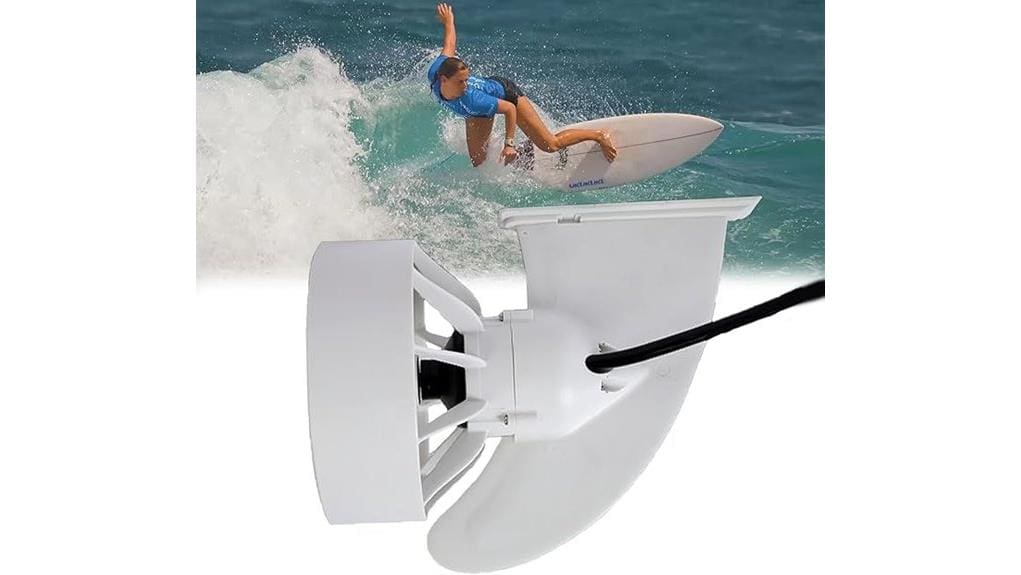
You’ll get steady, hands‑free propulsion around 5+ mph with a 380W brushless pump‑jet and roughly 50 minutes at top speed from the included 12,000 mAh pack. The three‑blade pump‑jet gives low vibration, reduced cavitation and linear throttle response, so steering stays responsive with small weight or paddle inputs. Installation fits inflatables, kayaks and canoes with supplied adapters; carry spares and shim if needed. Keep going to see detailed fit, battery care and alternative options.
Some Key Takeaways
- 380W brushless pump‑jet delivers smooth, low‑vibration thrust with predictable acceleration and minimal cavitation.
- Top speed around 5+ mph (≈8 km/h) and roughly 50 minutes runtime from the included 12,000 mAh battery.
- Three‑blade pump‑jet yields efficient, quiet cruising and responsive steering with no noticeable torque steer.
- Lightweight, portable system (~8 kg) fits inflatables, kayaks, canoes via adapters and simple bolt/spline mounting.
- Best for steady cruising, exploration, and range extension; choose higher‑power options for faster or multi‑hour needs.
Performance at a Glance: Speed, Runtime, and Real-World Range
Although the unit tops out at about 5+ mph (≈8 km/h), you'll notice the pump-jet and three-blade prop deliver stable, low-drag thrust that markedly reduces paddling effort. You get predictable speed and a clear runtime envelope: a 12,000 mAh battery yields up to ~50 minutes at top speed. Range estimation uses speed, current, and payload profiles; expect up to 5× the unaided travel distance under typical conditions. Endurance testing shows consistent output over 1,000 charge cycles and reliable thermal behavior. You’ll appreciate repeatable performance, straightforward battery management, and the extended exploration capability this package provides. Designed with kayakers in mind, this setup pairs well with lightweight gear and solar chargers for extended trips.
What the 380W Brushless Pump‑Jet Feels Like on SUPs, Kayaks, and Canoes
When clipped to a SUP, kayak, or canoe, the 380W brushless pump‑jet delivers steady, low‑vibration thrust that you can feel as immediate forward drive rather than sporadic pulses. You’ll notice buttery thrust at low RPMs for smooth cruise and a linear power band as you open throttle. The three‑blade pump‑jet keeps cavitation minimal, so acceleration is predictable and efficient. Steering stays intuitive: small weight shifts and paddle inputs translate to responsive steering without torque steer. On longer runs you’ll conserve energy, cover ground quietly, and retain control—ideal if you want range, simplicity, and open‑water freedom. This makes it a great match for hard‑shell inflatables and other beginner-friendly platforms.
Quick Install and Fit: Adapting the Fin to Inflatables, Kayaks, and Canoes
Get the fin clipped on and you’ll be moving in minutes: the package’s adaptors and mounting hardware let you match the pump‑jet assembly to standard inflatable fin boxes, kayak stern fittings, and canoe transom mounts with minimal tools. You’ll select the correct mounting adapters, align spline and bolt patterns, and torque fasteners to spec. Fit is predictable — shim if needed to eliminate play. Route the power lead clear of paddle reach and secure with supplied clamps. Prioritize seal maintenance at hull interfaces and cable glands to prevent ingress. The result: a secure, low‑drag installation that preserves your mobility and range. Also consider carrying spare mounting adapters and basic repair tools tailored for inflatable kayaks to handle field adjustments.
Battery, Weight, and Portability: How the 12,000 mAh Pack Performs in Practice
Once you’ve secured the fin and routed the power lead, battery, weight, and portability become the factors that determine real-world usability. The 12,000 mAh lithium pack adds to the system’s 8 kg total, keeping the setup carryable and quick to mount. Expect about 50 minutes at top speed; fast charging and 1,000+ cycles support repeat adventures. You’ll manage charge cycles and storage via simple pack maintenance: keep it dry, avoid full depletions, and store at partial charge. Follow battery safety protocols—no impacts, correct charger, and temperature limits—to preserve capacity and guarantee reliable, liberating range on the water. For paddlers, pairing the fin with an emergency power bank designed for water use provides added peace of mind and redundancy on longer trips, especially when considering kayaker-focused power banks.
Who Should Buy This Fin and Alternatives to Consider
Although it's compact and straightforward to install, this electric surfing fin best fits paddlers who want consistent, hands-free propulsion for exploration rather than high-speed racing. You should buy it if you value range, lightweight portability, and steady 5+ mph cruising for long trips or for beginner training where reduced exertion builds confidence. Its pump-jet three-blade design minimizes drag and multiplies travel distance up to 5× versus paddling alone. Consider alternatives if you need racing speed or multi-hour endurance: higher-power thrusters, towable electric motors with larger batteries, or modular battery systems that offer greater top speed and swapable battery capacity. It's especially useful for surf ski users who prioritize lightweight portability and easy installation.
Some Questions Answered
Is the Fin Safe for Children to Use Under Supervision?
Yes — you can let children use it under supervision if you follow safety measures. You’ll treat it as child training equipment: require buoyancy aids, close adult oversight, and restrict speed to low settings. You’ll make certain proper fit with adaptors, secure battery, and brief the child on hand signals and emergency cut-off. You’ll avoid crowded areas, check water conditions, and keep sessions short to reduce fatigue and risk.
Can the Unit Be Used While Swimming or Snorkeling?
No — you shouldn't use the unit while swimming or snorkeling. The system has waterproof certification for watercraft operation, but snorkel compatibility is limited: it's designed for attachment to boards and small craft, not for direct human propulsion. Using it while swimming risks entanglement, injury, and voids safety guidelines. You can enjoy greater freedom exploring from a board or kayak, but avoid holding or wearing the fin during snorkeling or free swimming.
What Maintenance Is Required After Saltwater Use?
Rinse thoroughly with fresh water immediately after saltwater use, running water through the pump-jet intake and around seals. Dry all exterior surfaces and battery contacts, then remove the battery for separate drying. Perform a corrosion inspection on metal fasteners, connectors, and motor housing; treat minor corrosion with a corrosion inhibitor. Lubricate moving parts per manual, check seals for integrity, and store the unit charged in a cool, dry place to preserve freedom of use.
Does the Fin Interfere With Board Storage on Roof Racks?
No — the fin generally won't interfere with roof storage. You’ll find roof compatibility depends on rack clearance and how you mount the board; the fin's low-profile pump-jet and three-blade design minimize protrusion. With standard pads or cradles and adequate rack clearance, you’ll secure the board without removal. Still, measure your specific rack clearance and use straps or soft mounts to prevent pressure points and guarantee safe transport freedom.
Are Spare Batteries or Replacement Props Sold Separately?
Yes — spare batteries and replacement propellers are available: battery availability is confirmed through the manufacturer and authorized dealers, and propellers sale is offered as separate accessory items. You’ll buy a 12,000 mAh replacement battery and individual pump-jet three-blade props. You’ll want spares to extend trips and reduce downtime. Check vendor stock for genuine cells, warranty coverage, and shipping to your region before ordering so you can stay mobile and independent.