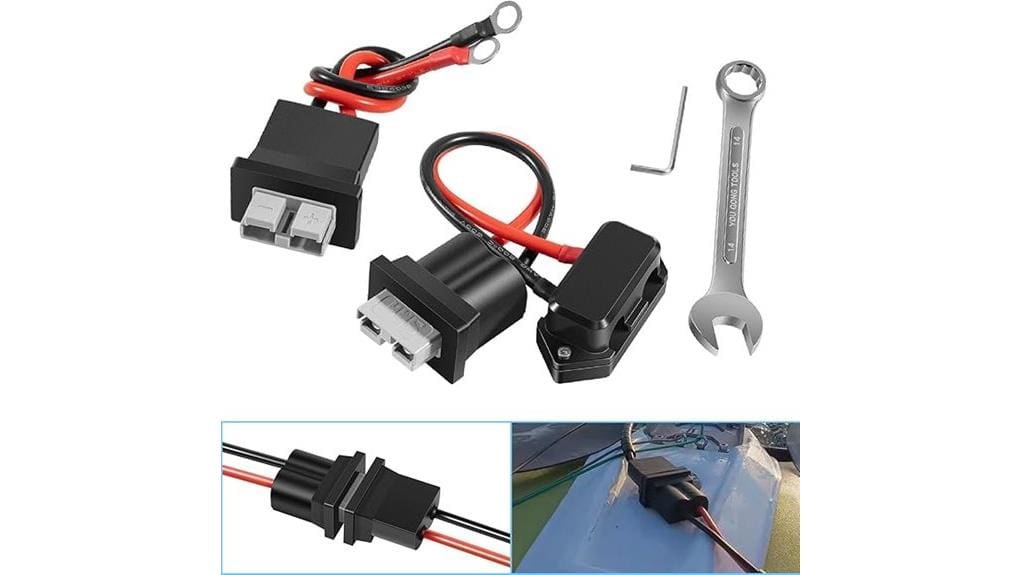
You’ll get a ready-to-install, weather-sealed 8‑gauge quick‑connect kit that lets you swap 12V trolling motors and smart battery boxes fast without crimping or soldering. The silicone‑sealed connectors handle up to 50 A continuous, include a covered connection pad, Allen key and terminal wrench, and suit select Newport, NK and kayak motors. Install is tool-light and modular, but check seals, torque and cable routing for chafe. Keep going and you’ll find step‑by‑step installation, compatibility notes and a performance checklist.
Some Key Takeaways
- Kit includes two pre-terminated 8‑gauge silicone‑sealed quick‑connects, a covered connection pad, Allen key, and battery terminal wrench.
- Rated for up to 50 A continuous on 12V systems—suitable for many portable trolling motors and smart battery boxes.
- Plug‑and‑play design eliminates crimping/soldering, speeding installation and reducing failure points.
- Weatherproof seals and covered pad improve corrosion resistance, but inspect seals after saltwater exposure.
- Good choice for kayak anglers and frequent connect/disconnect use; skip if you need >50 A capacity or lower cost.
What These Quick-Connect Kit Parts Are and Who Should Use Them
Think of this kit as a plug-and-play battery hookup: it includes two pre-terminated 8‑gauge quick‑connect/disconnect connectors, a covered connection pad, an Allen key, and a battery terminal wrench so you can install a secure 12V connection without crimping or soldering. You’ll get silicone‑sealed connectors sized for up to 50 A continuous on 12V systems, compatible with select Newport and NK series motors and smart battery boxes. Use it if you value rapid deployment, modularity, and reduced tool needs. Follow marine electronics best practices and standard safety protocols: inspect seals, torque terminals, route wires clear of chafe, and isolate power before service. These kits are also useful for kayak anglers and beginners who need reliable, compact pumps and electrical fittings for small craft bilge pumps.
How the Kit Installs With 12V Trolling Motors and Battery Boxes (Step-By-Step)
Start by placing the boat or kayak on a stable surface, then isolate the battery and motor power — you’ll work on a dead circuit. Mount the covered connection pad at accessible mounting locations near the battery box; secure with included Allen key. Attach pre-terminated connectors to the trolling motor leads, routing 8‑gauge cable to minimize bends. Use the battery terminal wrench and smart battery tools to secure connectors to the battery or smart battery box terminals. Verify polarity, then mate quick-connect housings; silicone rubber seals protect the joins. Finish by stowing excess wire for battery maintenance access and confirming mechanical strain relief. For added safety and convenience when paddling, consider storing and protecting cables with a dedicated paddle float or gear compartment to keep them accessible and dry.
Performance Checklist: Electrical Capacity, Connector Durability, and Weather Protection
With the connections secured and polarity verified, next check the kit’s electrical and environmental performance before regular use. You’ll confirm the 8-gauge conductors support expected current draw up to the system limit (50 A continuous) and measure voltage drop under load. Inspect connector durability by flex-testing silicone housings and verifying mechanical retention; pins should resist axial and rotational force without loosening. Assess sealing integrity by checking for full seat of rubber boots and absence of gaps around terminals. Finally, make sure corrosion inhibitors are present and plan periodic inspections after saltwater or heavy exposure to maintain reliable service. For kayakers and beginners, also verify compatibility with your GPS backup batteries by confirming battery capacity and connector ratings.
Real-World Compatibility: Newport, Kayak, NK-180S, and Common Battery Setups
When you hook this quick-connect kit to Newport NV/X, Kayak series (up to 55 lb), or the NK-180S brushless trolling motors, it delivers a straightforward, 12V-compatible power interface that matches the motors’ wiring and current requirements. You’ll get Newport compatibility out of the box: pre-terminated 8 AWG leads, silicone housings, and a covered connection pad that handle up to 50 A continuous without modification. Kayak integration is simple for portable rigs and smart battery boxes; no crimping or soldering needed. Installation is plug-and-play with supplied Allen key and terminal wrench, giving you reliable, weather-resistant connections for freedom on the water. These connectors also help protect your gear and flotation systems by ensuring secure electrical connections for stern floatation bags.
Buy or Skip? Cost, Pros/Cons, and When This Kit Is the Right Choice
Although the kit isn't the cheapest option, you’ll find its pre-terminated 8 AWG leads, silicone housings, and plug-and-play fittings deliver clear value for portable 12V trolling setups that draw up to 50 A continuous. Do a brief cost analysis: higher upfront cost versus savings in installation time, corrosion resistance, and reduced failure risk. Buy if you value fast, tool-minimal installs for Newport/NK/Kayak motors, smart battery boxes, or frequent connect/disconnect cycles. Skip if on a strict budget, need higher than 50 A capacity, or prefer custom wire runs. Pros: reliable, weatherproof, included tools. Cons: price, limited current headroom. Also consider choosing a mirror compass designed for kayakers when integrating navigation into your battery-powered setup, since a mirror compass can improve sighting and route accuracy.
Some Questions Answered
Can the Connectors Be Used With Lithium Battery Management Systems?
Yes — you can use the connectors with lithium battery management systems if you make sure proper battery integration and BMS compatibility. The 8‑gauge, 50 A continuous rating suits many 12V lithium setups and the silicone‑sealed housings protect connections. You’ll want to confirm your BMS voltage/current limits and wiring scheme, keep polarity correct, and use the included terminal wrench and Allen key for secure, tool‑free installation to maintain safe, reliable operation.
Are Replacement Silicone Housings Available Separately?
No — replacement housings aren’t sold separately through the kit’s standard channel. If you need replacement housings, contact the manufacturer or authorized dealers to request replacement parts or silicone options; they can often supply OEM silicone options or compatible aftermarket replacement housings. You’ll want to confirm fit for the pre-terminated plugs and 8-gauge wires. Keep serial/model info handy so they can verify compatibility and shipping for replacement housings.
Do the Connectors Meet Any Marine Electrical Certifications?
No, the connectors don’t list specific marine ratings or formal safety standards certification. You’ll get robust silicone housings and 8‑gauge wiring rated for 50 A continuous, designed for marine use, but the product documentation doesn’t cite UL, ABYC, or IP/marine-specific certificates. If you need certified compliance, you’ll want parts explicitly marked with marine ratings and recognized safety standards or consult the manufacturer for test reports before using them in regulated applications.
Can the Kit Handle Brief Peak Currents Above 50 A?
Yes — you can expect brief peaks above 50 A, but don’t push them long. The 8‑gauge wiring and premium contacts tolerate short surges, yet thermal stress rises with duration and elevated contact resistance will amplify heating. You should monitor peak duration and make certain ventilation; repeated or prolonged peaks will degrade seals and increase resistance. If you want sustained higher currents, upgrade wiring, connectors, or use a higher‑rated kit to preserve reliability.
What Is the Expected Service Life With Saltwater Exposure?
Expect a multi-year service life in saltwater if you rinse and maintain the connectors; corrosion testing suggests silicone housings and 8-gauge conductors slow degradation but won’t make them immune. You’ll want routine inspections and consider sacrificial anodes on nearby metal fittings to protect the assembly. If you neglect care, lifespan drops markedly; with proper maintenance you can realistically expect several seasons to a few years before replacement.