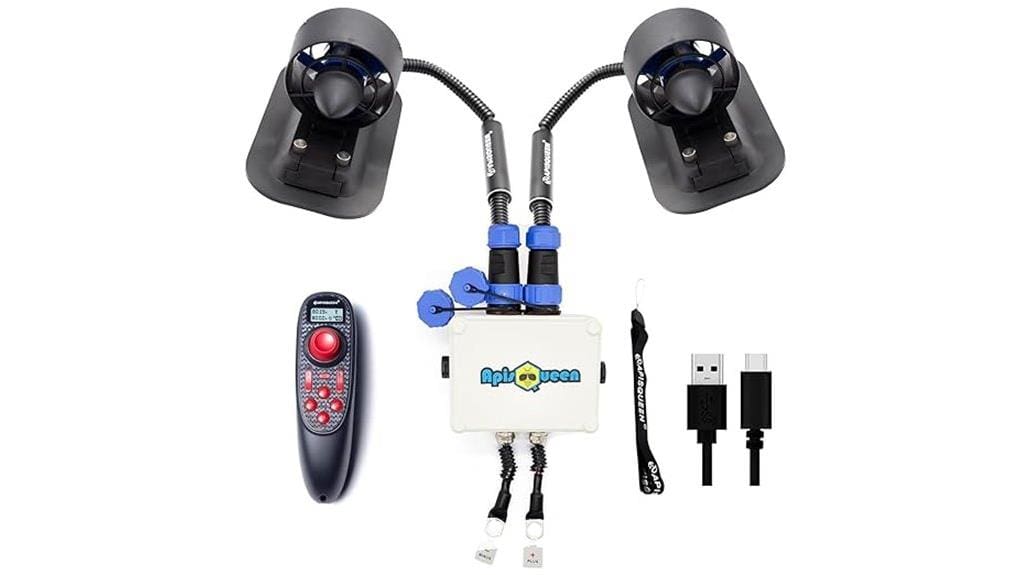

You’ll find the U2 12–16V thruster set gives reliable, waterproof low-speed thrust ideal for small boats, kayaks, and lightweight ROVs. Each compact unit uses a 500KV brushless motor with bidirectional ESCs and IP68 protection, so you’ll get steady station-keeping and precise reversals on 3S systems. Build quality is solid though check cable gland seals. Plan short power runs, fused leads, and proper receiver setup for neutral deadband. Continue for installation tips, power sizing, and practical limits.
Some Key Takeaways
- Rated for 12–16V (best on 11.1–12.6V 3S LiPo) with reliable low-speed thrust for 1–3 km/h maneuvers.
- Includes CW/CCW thrusters, two IP68 ESCs, waterproof receiver case, mounting bases, screws, charger, and tools.
- Durable one-piece composite housings and five-core silicone cables provide good saltwater resistance, but check cable exit seals.
- Requires fused battery leads, short heavy-gauge wiring, and receiver endpoint tuning for centered neutral and minimal deadband.
- Best for small boats, ROVs, trolling, and station-keeping; combined thrust (~7.5 lbs) limits heavy payloads and strong-current use.
Real-World Performance and Specifications
Although rated for 12–16V and up to 7.5 lbs total thrust per set, you'll find the U2 pair performs most predictably on a 3S LiPo (11.1–12.6V) where the 500KV brushless motors deliver steady low-speed torque for 1–3 km/h maneuvers. You’ll use thrust testing to confirm real output: expect consistent peak near spec but lower continuous thrust under load. Bidirectional ESC control gives precise reversals for station-keeping and turns. Construction and IP68 ESC emphasize waterproofing longevity; proper sealing and cable routing extend service life. You’ll prioritize battery choice and mounting to get reliable, freedom-oriented propulsion. For kayakers and beginners looking to add propulsion, consider mounting options and transducer arm compatibility to ensure secure installation and optimal performance.
What You Get in the Box and Build Quality
Having confirmed performance expectations on a 3S LiPo, you’ll next want to inspect what arrives and how it’s built. You get CW and CCW thrusters, two IP68 ESCs, a waterproof receiver case, non-waterproof transmitter, waterproof box, mounting bases, screws, USB charger and tools. Components feel rugged; the one-piece composite housings suggest material durability against saltwater. Cables are 5-core silicone for flexibility. Pay attention to connector sealing at cable exits and ESC joints—seals and strain relief are satisfactory but worth verifying before deployment. Overall kit gives you practical freedom with dependable, serviceable construction. For field repairs and maintenance, consider learning basic plastic welding techniques to keep housings watertight and extend service life.
How to Install and Wire the U2 Set on a Small Boat or ROV
Before you mount anything, plan the power and control layout so wiring runs are short, protected, and keep the ESCs and receiver dry; map battery positive/negative, ESC input, and signal lines for each thruster and label them. Position CW and CCW units for correct mounting alignment, using the supplied bases; secure with stainless screws. Route the 5-core silicone cables through strain-relieved glands into the waterproof box. Connect ESC power leads to the external battery via fused leads and plug servo signal to the receiver. Perform waterproofing checks, confirm bi-directional ESC pulses, test thrust directions, then secure all covers. Also keep an appropriate backup battery available when operating on open water.
Battery, ESC, and Control: Power, Range, and Behavior to Expect
Plan your power system around a 12–16V (up to 4S LiPo) supply and expect each waterproof bi-directional ESC to draw surge currents during startup and heavy load; fuse the battery positive, use short heavy-gauge leads to each ESC, and keep batteries as close as practical to minimize voltage drop. You’ll see firm throttle response from the brushless 500KV motors; program receiver endpoints so neutral sits centered and deadband is minimal. Manage battery life by matching capacity to expected run time and discharge rate—high C LiPo for punchy bursts, larger Ah for endurance. Monitor ESC temperature and voltage under load. Stay safe on the water by storing batteries in a waterproof container whenever gear is left in the kayak.
Fit-for-Purpose Verdict: Use Cases, Limitations, and Recommendation
While the U2 set delivers reliable thrust and waterproofing that make it well suited for small fishing boats and lightweight ROVs, you should match its 12–16V, 500KV characteristics to your platform's mass and mission profile. For marine applications, use it where low-speed thrust and compact form factor matter: station-keeping, trolling, or small inspection ROVs. Watch payload considerations closely; the set’s 7.5 lbs combined thrust limits useful payload and maneuvering in currents. Don’t expect high-speed transfer or heavy-lift capability. Recommend it if you value simplicity, corrosion resistance, and battery-efficiency for lightweight, freedom-oriented projects. Consider also compatibility with common kayak and small-boat setups and accessories for smoother integration, such as bilge pumps and mounting options.
Some Questions Answered
Can the Thrusters Be Submerged Continuously for Long-Term Deployment?
Yes — you can submerge them long-term if you maintain them. You’ll rely on sealed connectors and the composite, anti‑corrosion housing, but you’ll need biofouling prevention (periodic cleaning, coatings or antifoul devices) and a proper external battery setup. Check cable seals, IP68 ESC enclosures, and mounting integrity regularly. With routine inspections and preventive maintenance you’ll preserve thrust performance and avoid electrical or mechanical failures during extended deployments.
Is the RC Transmitter Compatible With Other Receivers?
No — the RC transmitter isn’t broadly compatible; it depends on protocol compatibility and receiver firmware. You’ll need to confirm the transmitter protocol (likely a proprietary or common RC standard) and match a receiver that supports the same protocol. Use the binding procedure described in the manual: power receiver, enter bind mode, then activate transmitter bind. If protocols mismatch you’ll need a compatible receiver or a different transmitter supporting open protocols.
Can I 3d-Print Replacement Propellers or Guards?
Yes — you can 3D‑print props or guards, but pick filament selection (PETG or nylon) for water strength and chemical resistance. Design in CAD with proper CAD tolerances for shaft fit and blade clearance. Set print orientation to align layers with load paths, reducing delamination. Use higher infill and thicker walls, then do post processing (sanding, epoxy seal) for smooth surfaces and corrosion resistance. Test gently before full use.
What Maintenance Schedule Do the Motors and ESCS Need?
You should inspect motors and ESCs every 3 months, performing annual inspections plus routine checks after heavy use. Clean salt and debris, verify seals and cable integrity, and test motor spin and ESC responses. Apply lubricant application to prop shafts and mounting points lightly every 6 months or after saltwater exposure. Replace worn seals or cables immediately. Keep ESCs dry, monitor temperatures, and log service dates so you stay free to operate with confidence.
Are Spare Parts and Warranty Support Available Internationally?
Yes — you’ll get international warranty coverage and spare sourcing options, but availability varies by region. Contact the seller or manufacturer to confirm warranty terms, claim process, and authorized repair centers in your country. You can source common spares (propellers, cables, ESCs) through official parts channels or reputable aftermarket suppliers. Keep proof of purchase and serial numbers handy to speed warranty service and cross-border parts shipments.