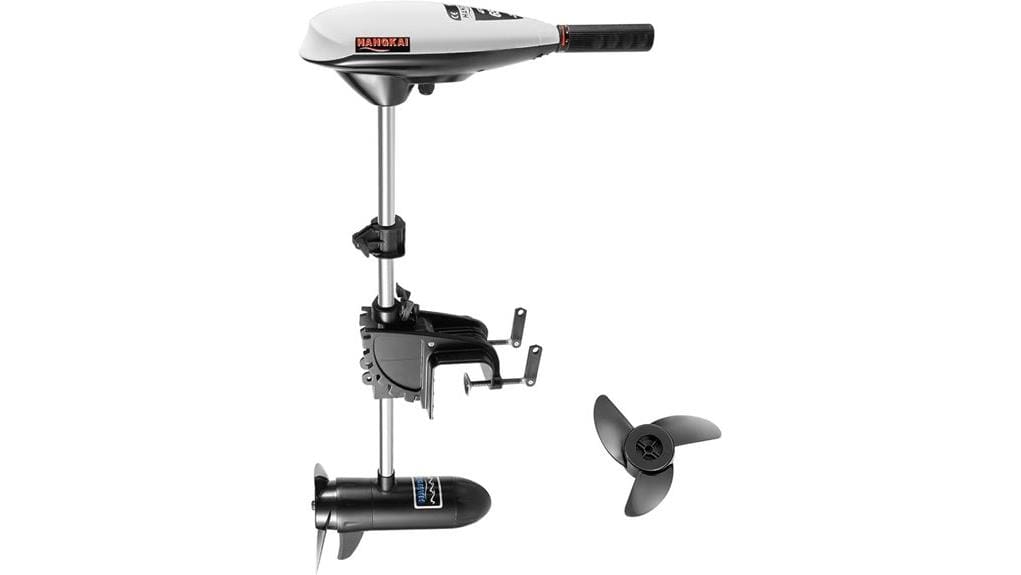

You’ll find the 65 lb, 7‑speed trolling motor gives quiet, controllable thrust ideal for kayaks, jon boats, and small runabouts where stealth and low‑speed finesse matter. It delivers solid low‑end push and predictable ~55 A draw at full load, about 6–8 km/h top speed on light craft, and better station‑keeping than micro units. Controls are ergonomic with cruise and a telescoping handle; construction tolerates occasional saltwater with routine care. Keep going for setup, battery sizing, and mounting tips. The 12v electric outboard motor features a robust design that ensures longevity, even in challenging conditions. Its lightweight construction makes it an excellent choice for portable applications, allowing for easy transport and handling. Additionally, the motor's energy efficiency translates to extended battery life, maximizing your time on the water.
Some Key Takeaways
- 65 lb thrust suits kayaks, jon boats, and small 2–4 m hulls for quiet trolling and precise station‑keeping.
- 7‑speed (5F + 2R) gearing with cruise control gives fine low‑speed adjustment and reduced steering fatigue.
- 12 V, ~660 W motor draws about 55 A at full load; battery capacity must match intended run time.
- 36" shaft and three‑blade prop balance stability and thrust, but heavy loads can induce flex or cavitation.
- Corrosion‑resistant materials and secure mounting work for occasional saltwater if cleaned and maintained regularly.
Quick Verdict: Who the 65lb 7‑Speed Trolling Motor Is Best For
If you want a compact, battery‑powered outboard that balances stealth, control, and enough thrust for small boats, the 65 lb 7‑speed trolling motor fits that role. You’ll find it ideal if you value a silent approach and controlled maneuvering on lakes or sheltered coastal waters. It outperforms portable push‑tills and small gas outboards in noise and simplicity, while offering more thrust than micro electric units. Choose it for kayaks, Jon boats, or small yachts where 2–4 m hulls need efficient, low‑noise propulsion. It’s for anglers who want fishing stealth, range, and straightforward installation. For added peace of mind when fishing from a kayak, pair it with an appropriate anchor weight to improve station‑keeping and stability.
Real-World Performance: Thrust, Speed, Battery Draw, and Handling on Small Boats
When you push the 65 lb trolling motor into service on a small boat, expect its 660 W / 12 V motor to deliver solid low‑speed thrust for trolling and precise station‑keeping while drawing about 55 A at full load; that translates to roughly 660 W of electrical demand, which will halve run time compared with lighter micro‑motors when using the same battery capacity. You’ll see 6–8 km/h top speeds on light loads, strong low‑end push for drift control, and predictable wake behavior that’s minimal compared with outboards. Manage battery longevity by matching battery amp‑hour capacity to planned speeds and duty cycles. For extended trips or frequent use, consider carrying a compact emergency power bank to top up electronics and safety gear on the water, especially for kayaking enthusiasts.
Controls and Ergonomics: 7‑Speed Gearing, Telescoping Handle, Cruise Control, and Mounting
Because the 65 lb trolling motor combines a 7‑speed (5 forward + 2 reverse) gear range with cruise control and an adjustable handle, you get precise low‑speed trimming and straightforward course corrections without constant hand adjustments. You’ll appreciate the telescoping handle reach (50–65 cm) for ideal stance; shorter boats favor compact reach, longer decks need full extension. Grip comfort is good for extended runs; rubberized contours reduce fatigue. Control placement and button layout prioritize thumb access to speed and cruise toggles, letting you steer free of distraction. Mounting is secure and straightforward, supporting quick removal for transport. If you’re new to paddling, choosing the right anchor and setup can improve stability and safety on the water kayak anchors.
Durability and Build: Materials, Saltwater Suitability, Propeller, and Shaft Design
Having covered control ergonomics, it's worth examining how the motor's construction holds up under real-world use. You get stainless steel and painted alloys that improve corrosion resistance compared with basic cast parts, making the unit practical for occasional saltwater runs. The three-blade propeller balances thrust and efficiency; watch for blade cavitation at high RPMs versus larger-diameter designs. The 36" shaft minimizes shaft flex on small boats, though heavy loads can induce bending over time. Hull-mount and bracket fit feel robust; prop design resists seaweed fouling better than open-face types, preserving stealth and range. For inflatable-kayak users, having the right essential gear on hand makes installation and occasional maintenance much easier.
Buying Checklist and Setup Tips: Battery Sizing, Mounting, Common Issues, and Alternatives
If you plan to get the 65 lb electric trolling motor, prioritize matching the power draw to a proper 12 V deep-cycle battery and a secure mount before anything else. Choose battery capacity (Ah) to cover 55 A draw—estimate runtime and add reserve; compare lead‑acid, AGM, and lithium regarding weight, battery chemistry, cost, and cycle life. Verify clamp spacing and bracket fit for your 2–4 m boat; prefer stainless mounting hardware. Route cables for corrosion resistance and tidy cable management; fuse close to battery. Watch for cavitation, overheating, and loose fasteners. Consider higher‑thrust or pod alternatives if load or depth demands exceed specs. Also consider adding a Power Pole or similar anchoring option if you plan frequent shallow-water stops.
Some Questions Answered
Can It Be Used With a Dual‑Battery Setup and Automatic Switching?
Yes — you can use a dual-battery setup with automatic switching. You’ll want a Battery isolator or a Switching relay to prevent backfeed and protect batteries; isolators allow simultaneous charging, relays switch under load. Compare solid‑state isolators for fast, maintenance‑free operation versus mechanical relays for simplicity and cost. Make sure the isolator/relay is rated above the motor’s 55 A draw, wire and fuse accordingly, and mount components for free movement and easy access.
Is the Motor Compatible With Bow‑Mount Adapters or Transom Mounts?
Yes — you can fit it to a transom with the included bracket, and you can adapt for bow‑mounting using third‑party adapters. You're getting clear transom‑compatibility out of the box; bow‑mounting requires an adapter plate or clamp system sized for the 36" shaft and clamp gap. Compare bracket hole spacing and shaft length before purchase. You'll retain steering ergonomics and cruise control, but expect minor rigging for ideal bow placement.
What Maintenance Schedule Prevents Corrosion in Saltwater Use?
Rinse after every saltwater use, then dry and inspect; you’ll do a full check monthly (bolts, seals, prop) and deep service annually (brush contacts, grease pivot points, replace worn seals). Use regular rinsing with fresh water and corrosion inhibitor after each trip, and install sacrificial anodes replaced when 50% consumed. Compare intervals to usage intensity; heavier use or harsh conditions mean shorter service cycles to preserve freedom on the water.
Are Replacement Propellers or Spares Readily Available?
Yes — replacement propellers and spares are generally available; you can source OEM and aftermarket options through dealers and online marketplaces. You’ll compare materials, blade pitch, and hub fitment to match shaft size and performance. Buy balanced props or request prop balancing to reduce vibration and extend motor life. Keep spares aboard for quick swaps; compatible third‑party props often offer improved durability or efficiency versus stock units.
Does the Unit Include Built‑In Overcurrent or Thermal Protection?
No, the unit doesn't advertise integrated thermal cutoff or current sensing protection on the board; you shouldn't assume built‑in overcurrent or thermal protection. You should fit an external breaker, fuse, or DC motor controller with current sensing and thermal cutoff to protect wiring and the 12 V motor. That gives you selectable trip curves, reset options, and freedom to customize protection for your battery, load and boating conditions. When choosing a trolling motor, it’s important to consider the goplus electric trolling motor features to ensure you’re getting the best performance on the water. The lightweight design combined with multiple speed settings offers versatility for different fishing conditions. Additionally, factors like battery efficiency and ease of installation can significantly enhance your boating experience.