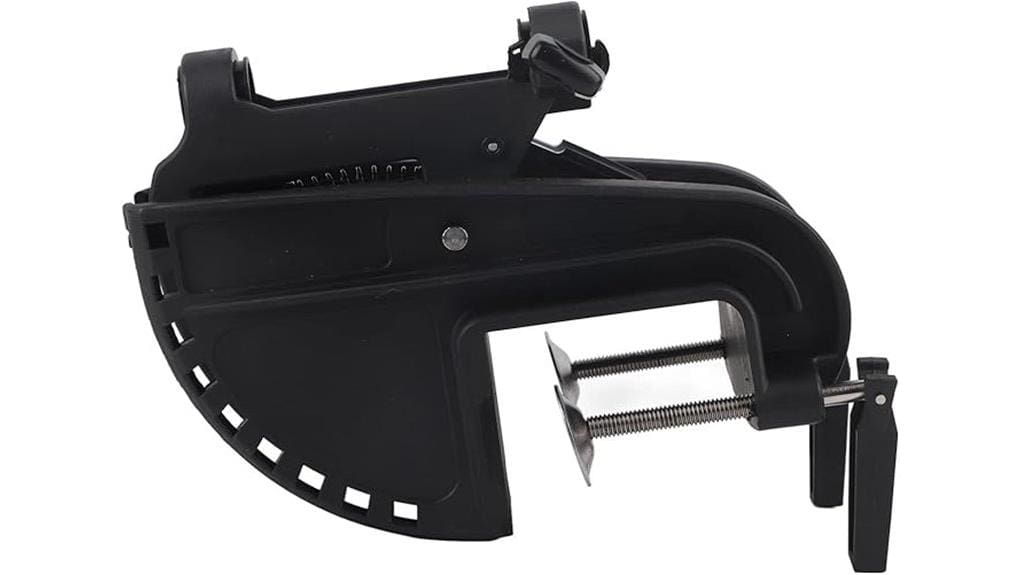
You’ll get a compact, heavy-duty 12V thruster bracket that clamps 28–50 lb motors securely and lets you swap units fast with a quick-release. It uses a plastic suspension holder with adjustable clamping and spring preload to keep alignment under load, and indexed detents at 0°/45°/90° lock rotation. Installation on kayaks or inflatables needs backing plates and drainage consideration. Expect durable polymer parts with replaceable spring and routine inspections — continue for full fit, install, and maintenance notes.
Some Key Takeaways
- Suitable for 28–50 lb 12V thrusters; clamps and mounts accommodate common bolt patterns and shaft diameters.
- Quick-release design enables fast installation and removal with minimal tools, ideal for kayaks and inflatables.
- Adjustable rotation with indexed detents (0°/45°/90°) provides stable, repeatable thrust direction under load.
- Polymer body and reinforced joints resist UV/saltwater, though pivot bushings and spring are wear points.
- Recommend backing plates on inflatables, periodic inspections after 100–200 hours, and carrying spare spring/bushings.
Quick Verdict and Who This Thruster Bracket Is Best For
While compact and simple to mount, the 12V Electric Motor Thruster Bracket gives you a sturdy, adjustable platform that handles 28–50 lb thrusters reliably. You’ll appreciate mount stability under load and precise weight distribution that keeps craft trim and responsive. The bracket’s adjustable rotation and high-quality spring reduce vibration, improving user comfort during extended runs. Installation’s quick release design saves time and minimizes tools, so you’re free to launch faster. This bracket suits paddlers and inflatable-boat owners who want dependable control without complexity — those who value straightforward, durable gear that preserves mobility and autonomy on the water. Choose the right removable fin for your kayak adventures by matching fin size and style to your boat’s handling needs and typical water conditions for best performance removable fins.
How the Bracket Fits 28, 36, 46, and 50 Lb Thrusters
Moving from overall suitability to specifics, the bracket matches 28, 36, 46, and 50 lb thrusters by combining a standardized mounting interface with adjustable clamping and rotation stops. You’ll find the mount tolerance engineered to accept common bolt patterns and shaft diameters without shims, so alignment stays true under load. Clamping range and spring preload let you secure lighter 28 lb units or heavier 50 lb models while maintaining correct weight distribution to the hull. Rotation stops lock angles at 0°/45°/90°, preventing torque-induced drift. The result: predictable mechanical behavior, easy swapping, and confident, free movement on the water. This setup is ideal for anglers using Power Pole systems who need reliable, adjustable motor mounting for kayak maneuvering and station-keeping with a power pole focus.
Installing the Plastic Suspension Holder on Kayaks and Inflatables
Start by positioning the plastic suspension holder where it will sit on the transom or inflatable tube, ensuring the mount surface is clean and free of obstructions. You’ll align mounting templates to mark fastener locations, verifying symmetry and clearance for the thruster shaft. Use marine-grade screws or straps per material, torqueed to spec. For inflatables, distribute load with backing plates or adhesive pads. Confirm drainage considerations so water won’t pool at the mount—angle slightly or add drains where possible. Finish with a functional check: secure spring action, no interference with hull contours, and quick-release operation for freedom on the water. Consider using foam roof blocks to protect the hull and distribute loads when transporting or mounting accessories.
Rotation and Angle Adjustment: Real-World Performance and Limits
Because the bracket offers a 90-degree rotation range, you can fine-tune thrust direction to match currents, wind, and hull trim without tools. You adjust smoothly using indexed detents that define rotation limits and prevent overtravel. In practice you'll set coarse angles quickly and then micro-adjust for pointing accuracy; angle repeatability is within a single detent step, so re-mounting or repeated deployments return predictable orientation. Under load the mechanism holds without slippage, though extreme lateral force approaches the designed rotation limits. Overall the system gives you precise, tool-free control for freer, confident maneuvering on varied water conditions. Choose mounting points that align with your kayak's hull and center of gravity for best performance and balance when using all-terrain kayak carts.
Durability, Spring Quality, and Safety Observations With Pros/Cons
While the bracket's polymer body and reinforced joints resist UV and saltwater degradation under typical use, you should expect wear points around the pivot and spring seat where repeated cycles concentrate stress. You’ll appreciate the high-quality spring and fine workmanship; spring longevity hinges on cycle count and corrosion control. Perform periodic load testing after 100–200 hours and after heavy impacts. Pros: lightweight, precise fit for 28–50 lb thrusters, easy install, predictable failure modes. Cons: replaceable spring required long-term, pivot bushings may abrade, plastic fatigue possible under extreme load. Safety: inspect before each outing and carry spares. Kayakers should also pack an essential repair kit tailored for thruster components when heading out.
Some Questions Answered
Can the Bracket Be Left Installed During Transport?
Yes — you can leave the bracket installed during transport if you secure transport properly. You’ll use tie downs and the quick release feature to lock the thruster, preventing movement. Make certain vibration damping is in place to protect fasteners and plastic under road or wave shocks. Check springs and mounting points before departure; tighten as needed so the bracket stays reliable and lets you enjoy freedom without worrying about gear damage.
Is the Bracket Uv-Resistant for Prolonged Sun Exposure?
Yes — the bracket’s materials resist sunlight degradation and it’s designed after uv testing to maintain strength. You’ll find the plastic suspension holder uses UV-stable polymers and a high-quality spring with protective finishes, so prolonged sun exposure won’t quickly embrittle or deform the mount. You can expect reliable, precise performance on kayaks and inflatables over time, though extreme, continuous exposure may still warrant periodic inspection and maintenance.
Does It Interfere With Kayak Storage or Stacking?
No — it won’t cause significant storage interference. You’ll mount the bracket low-profile so kayak stacking remains practical; its compact dimensions and 90-degree rotation let you fold the thruster close to the hull. When you’re stacking or storing multiple kayaks, position brackets similarly to maintain uniform clearance. The durable plastic and spring keep alignment stable, so you’ll retain freedom to stack and store without unexpected obstructions or damage.
Can I Mount Two Brackets Side-By-Side?
Yes — you can mount two brackets side-by-side. You’ll need to assess weight distribution carefully so each bracket supports its thruster without overloading the transom. Make certain spacing prevents mounting interference between housings, controls, or paddle access. Use reinforced attachment points and verify spring tension and alignment to avoid binding. Trial-fit both units, then tighten incrementally. This lets you maintain freedom on the water with dependable, balanced propulsion.
Are Replacement Springs or Parts Available?
Yes — replacement springs and parts are available. You can source spring availability through the manufacturer or authorized dealers; they'll list compatible items and part numbers. Check hardware compatibility, including bracket compatibility, before ordering to guarantee springs, pins, and mounting bolts match your bracket model and thruster size. You’ll want to confirm dimensions, material grade, and load ratings. If unsure, request technical specs or a compatibility chart to maintain reliable, safe operation and freedom on the water.