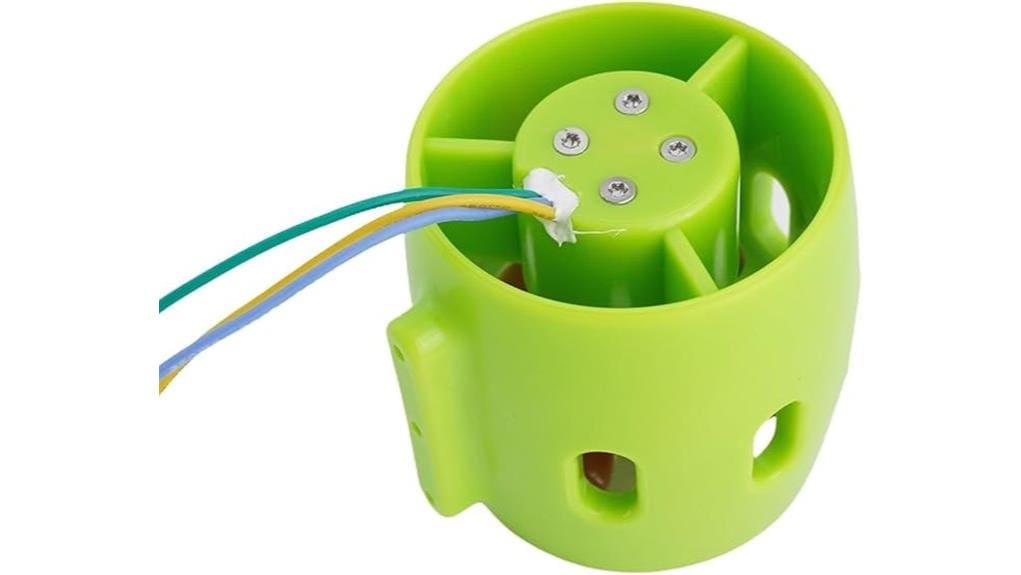

You’ll get a compact 12–24V brushless thruster that reliably converts 30–200 W into predictable thrust for kayaks and small craft. It’s rated ~300 KV for stable RPM performance, utilizes stainless-steel bearings and aluminum housing for corrosion resistance and heat shedding, and propeller geometry reduces cavitation while focusing thrust. Mounting is bolt-on friendly (74×75 mm, 162 g) for transoms or skegs, with depth monitoring recommended. Keep going and you’ll find detailed specs, install tips, and troubleshooting.
Some Key Takeaways
- 12–24V brushless thrusters deliver reliable, tunable thrust (30–200W) ideal for kayaks and small craft needing controllable assist.
- Compact 74×75mm, 162g housings mount easily on transoms or skegs without significant trim or weight penalties.
- Stainless-steel bearings and aluminum-alloy housings improve durability and heat shedding for repeated paddling deployments.
- Propeller design and cavitation mitigation maximize efficiency and stealth while preserving battery life and thrust consistency.
- Inspect seals, prop fit, cable waterproofing, and depth rating before use; rinse and maintain bearings after saltwater exposure.
Performance Snapshot: Thrust, Power Range (30–200W), and Deep-Water Capability
Although compact, this brushless underwater thruster delivers measurable thrust across a 30–200 W power band, so you can match output to mission needs for RC boats, canoes, or underwater robots. You’ll evaluate thrust vs. power to optimize battery endurance while maintaining maneuverability; lower power prolongs runtime, higher power yields burst acceleration. Deep-water capability means you can operate at significant depths without losing performance, but you’ll monitor thermal and pressure limits. Propeller and flow design support cavitation mitigation, preserving efficiency and stealth. Use controlled power windows to balance thrust, endurance, and structural safety for liberated exploration. These thrusters are well suited for small watercraft and paddling enthusiasts who may mount them on decks or hulls for auxiliary propulsion deck-mount pumps.
Electrical and Mechanical Specs That Matter: 12–24V, 300KV, Bearings, Housing, and Propeller Design
When you match the thruster’s 12–24 V input and 300 KV rating to your battery and controller, you get predictable RPM response and a clear power-to-thrust envelope for tuning performance. You’ll exploit the 30–200 W range efficiently when your ESC provides clean current and waterproof connectors maintain integrity. Stainless steel bearings lower axial play, preserving shaft alignment under load; aluminum alloy housing sheds heat and resists corrosion. Propeller geometry converts torque into focused thrust—blade pitch, diameter, and skew matter. Prioritize thermal management to avoid motor saturation during sustained runs, and choose components that free you to push limits reliably. Use waterproof marine charts to plan trips and ensure your equipment choices match the conditions you’ll encounter.
Real-World Fit: Mounting, Size (74×75 Mm), Weight (162 G), and Installation for Kayaks and Small Boats
Think about how the thruster’s compact 74 × 75 mm footprint and 162 g mass change your mounting options and center-of-gravity considerations: that size lets you bolt it to transoms, skegs, or custom brackets without large cutouts, while the light weight minimizes trim shifts and keeps installation simple. You’ll design mounting brackets for secure shear loads and quick removal. Position the unit to preserve freeboard and avoid cavitation from hull turbulence. Route and secure cables with deliberate cable management to prevent chafing and strain on connectors. Use corrosion-resistant fasteners, test alignment, and verify thrust vector before final sealing. For beginner kayakers, consider using purpose-built carrying straps to help transport the kayak and thruster assembly safely between launch sites.
Use Cases and Tested Results: RC Boats, Control Boats, Canoes, Fishing Gear, and Underwater Robots
Dial the thruster into each platform and you'll immediately notice its compact form and high thrust-to-weight ratio make it versatile across RC boats, control boats, canoes, fishing rigs, and small underwater robots. You’ll get predictable thrust at 12–24V, enabling fine-tuned maneuvering for control boats and nimble RC models. In canoes and fishing setups, you’ll rely on efficient battery management to extend run time without sacrificing torque. Underwater robots benefit from low weight and precise response; monitor signal latency when integrating controllers to preserve stability. Tested results show consistent propulsion, rapid spin-up, and repeatable thrust curves under variable loads. Top Gear for Kayakers recommends pairing the thruster with a rugged action camera mount for documenting trials and performance camera mounting.
Buying Checklist and Troubleshooting: Durability, Depth Rating, Maintenance, and When to Choose This Thruster
Although compact, this thruster's aluminum-alloy housing and stainless-steel bearings demand inspection against corrosion and impact damage before deployment. You’ll verify seal integrity, propeller fit, and Kv/power compatibility with your 12–24V system. Check depth rating against your mission profile; design supports significant depths but confirm maximum depth for continuous use. For maintenance, schedule rinses, lubricant checks, and bearing inspections; document corrosion prevention measures and replace seals at signs of wear. Troubleshoot by isolating power, testing motor at low volts, and swapping props. Keep serials and purchase records for warranty handling and replacement planning when failure risks threaten your freedom. Also inspect associated gear like hand pumps and mounting hardware for seawater damage and proper fit before each trip.
Some Questions Answered
Is This Thruster Waterproofed for Saltwater Exposure Long-Term?
No — you shouldn’t assume long-term saltwater sealing. You’ll need corrosion testing and electrochemical monitoring to verify performance; add a sacrificial anode and apply marine grease at interfaces. Watch for osmotic blistering on painted surfaces and consider a biocide coating to deter fouling. Routine inspection and maintenance will prolong life. Without those measures, long-term saltwater exposure will accelerate degradation despite the aluminum alloy shell and stainless bearings.
What Connector Types and Wiring Harness Are Required?
You’ll need waterproof connectors for the motor body, a battery harness compatible with 12–24V leads, a separate signal cable for ESC telemetry, and quick disconnects for rapid maintenance. Use marine-grade, sealed circular connectors for power, shielded multi-core cable for signals, and inline fuses on the battery harness. Guarantee corrosion-resistant terminals and matching pin layouts on the ESC. Test continuity and IP rating before deployment.
Does the Motor Include a Built-In Electronic Speed Controller?
No — it doesn't include an integrated controller. You’ll need an external ESC matched to a 12–24V, 300 KV brushless motor and 30–200 W range. Choose throttle options (PWM, proportional RC, or voltage-controlled) based on your control system and waterproofing needs. Use a waterproof ESC enclosure or potting, secure stainless connections, and select an ESC with appropriate thermal and current margins to preserve deep-water capability and reliable thrust performance.
Are Spare Propellers and Replacement Parts Available?
Yes — you can get spare propellers and replacement parts. You’ll source OEM propellers, stainless bearings, and aluminum housings from the manufacturer or authorized dealers. Parts fit the 74×75 mm motor form factor and match the 12–24V, 300 KV specifications to preserve thrust and depth rating. You’ll want to verify part numbers and water-seal integrity before purchase. Keep spare propellers on hand to maintain freedom of operation.
What Warranty and Customer Support Options Exist?
You get a limited warranty covering manufacturing defects for a defined period; you'll need proof of purchase for claims. For technical issues, responsive support is available via email and phone; they'll diagnose failures, authorize repairs or replacement parts, and advise on deep-water operation limits. You'll handle returns per the warranty terms and shipping policy. Keep serial numbers and usage logs to speed up claims and preserve your autonomy when troubleshooting.