Find sun‑warmed flats next to a deep channel or tight contour lines on your topo app, then scan with your fishfinder for wood, rock or bait arches; anchor or drift upwind and fan‑cast slow jigs, Ned rigs, shaky heads or a long‑cast Rat‑L‑Trap, letting baits sink fully and using long pauses, varying twitches and firm hooksets on taps, while watching temps (warmer pockets near 60°F help) and carrying braid with a 3‑ft fluoro leader, safety gear, and spare leaders to keep you fishing smarter — more tactics follow.
Some Key Takeaways
- Target sun‑warmed flats and sheltered backwater sloughs adjacent to deep water where winter bass concentrate.
- Use topo/Navionics to mark tight contour lines, channel swings, and isolated structure before paddling.
- Run a fishfinder slowly along mapped edges, marking dense bottom arches and bait layers with GPS waypoints.
- Present very slow baits—jigs, Ned rigs, shaky heads, drop shots—letting lures touch bottom with long pauses.
- Rig braid for casting distance with a 3‑ft 10–12 lb fluorocarbon leader, and fan‑cast marked structure while drifting or anchored.
Choose Where to Fish: Slow‑Water Flats, Main‑Channel Breaks, and Backwater Sloughs
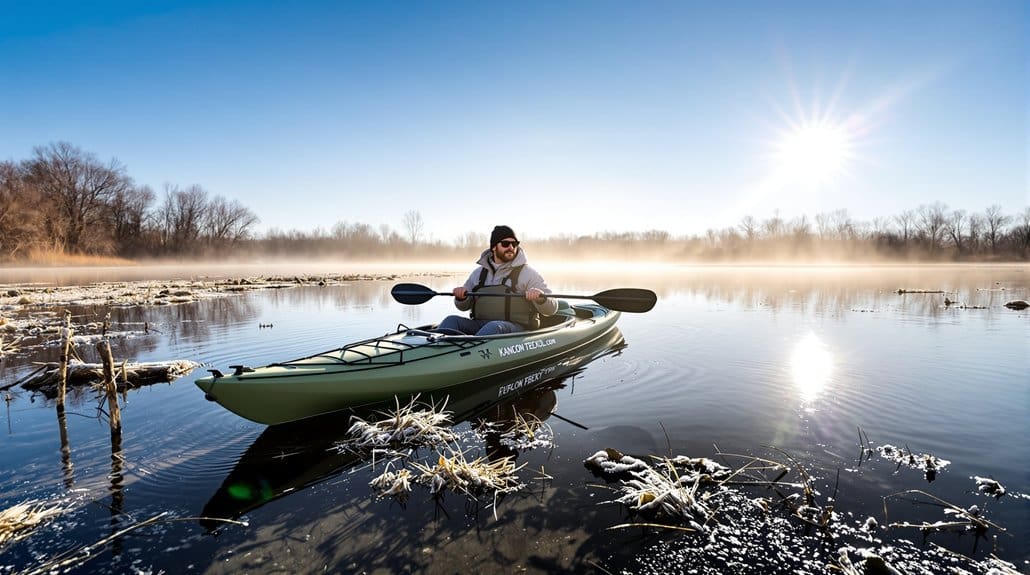
When you're planning a winter kayak trip, start by picking a few specific zones to work—slow, sun‑warmed flats that sit next to deep water, the sharp breaks along the main channel, and any sheltered backwater sloughs or deep creek pools—because bass will tuck into those places to save energy and ambush bait. You’ll scan Navionics or topo maps for main‑channel breaks and steep contour edges, mark wood, rock, bridge pilings and channel swings, and then paddle to sun‑facing flats that warm faster, especially on bright days, since Winter Bass Fishing can get concentrated there. Use your fishfinder to find condensed marks along ledges, hold position, and pitch slow, bottom‑contact baits to each likely pocket until you force a reaction. Bring essential gear like a reliable foot bilge pump to keep your kayak safe and dry on chilly outings.
Read Water Temperature and Weather to Time Your Moves
Because bass are temperature‑driven in winter, you’ve got to read the water and sky like they’re part of your tackle, so bring a good thermometer or rely on your fishfinder’s temp readout, note surface and mid‑depth temps as you run spots, and watch trends — bass get noticeably livelier as water pushes toward 60°F and really slow down under about 50°F, so if you see pockets or ledge seams that are a few degrees warmer, work those first. Watch weather too: cold fronts shove fish deep into main channels, while sunny breaks or warm rain pull them up near warmed banks and inflows, so time moves with pressure and wind notes, probe changeover zones quickly, and shift if temps stay marginal. Bring a hypothermia kit and cold-water safety gear for every trip to stay prepared in case of immersion.
Use Electronics and Topo Apps to Find Bottom‑Oriented Bass
Start by scanning your Navionics or topo app for tight contour lines, steep breaks and main creek channels, those condensed lines tell you where bottom‑oriented bass like to sit and where flats or channel swings tuck up against deeper water. Then run your fishfinder slowly along those mapped features to confirm short marks or faint arches hugging the bottom, mark GPS waypoints for any structure you find—bridges, rock piles or drop‑offs—so you can come back and fan‑cast the same spot from the yak. When you get a positive read, drift or anchor upwind and pitch a jig, ned rig or football jig right over the sonar target, keep your presentations very slow and let the bait sit on the bottom, because in winter patience plus the right GPS‑backed structure usually makes the difference. Also consider a portable fish finder with sonar imaging to quickly locate schools, structure and bottom detail while paddling.
Reading Contour Lines
Think of the map on your screen as a secret blueprint, and learn to read those tight, crowded contour lines because they point to steep drop-offs and shifting edges where winter bass hug the bottom; pull up Navionics or your favorite topo app, zoom until contour lines tighten into dark bands, then plan to run parallel to those lines with your fishfinder on so you can spot small arches or streaks clinging to the bottom instead of scattered targets out in open water. You’ll look for channel swings where the main channel meets flats, favor darker, condensed contour areas near visible cover, and when your screen shows a promising seam, fan-cast slowly right along that contour line, working tight casts into every pocket, log, or rock shadow until you prove the spot. For reliable on-water mounting and to keep your electronics secure during those slow, precise drifts, use purpose-built kayak fish finder mounts like those from Perfect Kayak Fish Finder Mounts for dependable stability and positioning (kayak fish finder mounts).
Marking Hard Structure
Now that you can read those tight contour lines, use your fishfinder and topo app together to start marking the hard spots where winter bass actually hug the bottom. You’ll hunt steep contour breaks, channel swings, and isolated wood or rock piles, watching for clustered arches or short streaks on the sonar screen that sit tight to the bottom, then drop a GPS waypoint on Navionics or your mapping app. When bait shows suspended above structure, mark both depths, because bass often sit on the bottom under bait, so plan presentations that reach bottom first and rise slowly. In rivers, spotlight current breaks and bridge pilings, save labeled waypoints, and fan-cast those points with slow jigs or ned rigs until you locate the pocket where freedom feels like a fish on the line. For kayak anglers gearing up, consider adding a transducer arm to your setup to keep electronics secure and sonar clear for marking structure transducer arm.
Rig and Gear Setup for Long Casts and Slow Presentations
Start with a 7-foot medium‑heavy trigger rod and a 6.3:1 baitcaster spooled with 20–30 lb braid, and tie a 3‑ft 10‑12 lb fluorocarbon leader loop‑to‑loop so you’ll get long casts, good control, and a subtle hookset when fish are slow. Favor a longer, stiffer rod for extra whip and leverage to sweep jigs and football jigs along the bottom without spooking fish, but when you switch to finesse baits like Ned rigs or small swimbaits, drop to 10–12 lb fluoro straight to the eye for better action and less line visibility. Carry stout hooks, heavy trailers for bottom baits, and reliable knots like a Palomar or FG‑to‑loop, and keep a Rat‑L‑Trap tied directly to braid with a 3‑ft fluoro leader as an all‑purpose backup so you can fan‑cast and adjust sink and retrieve on the fly. We also recommend choosing gear and kayaks designed for anglers to improve comfort and fishing efficiency on the water, including features like rod holders and storage angler kayaks.
Rod And Reel Combo
Pick up a 7-foot medium-heavy trigger rod paired with a 6.3:1 baitcasting reel and you’ll instantly notice how much easier long casts and controlled, slow presentations become, because that combo gives you the casting whip to hurl a Rat-L-Trap or crankbait a long way and the gear ratio plus backbone to work it slowly without getting pulled off the strike. For Fishing from your kayak, feel for a medium-heavy blank that still has a forgiving tip, spool it with braid for sensitivity if you want low stretch, and carry a second, medium-action rod rigged lighter for finesse work, so you can switch fast when fish go small; pick reels with crisp drag and comfortable handles, test casts before launch, and keep confidence high. Consider outfitting your kayak with rod holders and other gear to make switching rigs and managing tackle easier on the water.
Line, Leader & Knots
You’ve got the right rod-and-reel muscle for long casts and slow presentations, but the way you string everything together will make or break how those lures behave and how many strikes you actually feel, so let’s set up your line and leaders like you mean business. You’ll run 20–30 lb braid for distance, tie a 3-foot 10–12 lb fluoro leader with a loop-to-loop or double uni to keep lure action and lower visibility, and carry spare pre-tied 1, 3 and 6 foot combos so you can swap fast when wind or depth shifts. For finesse baits use 6–8 lb fluoro or 8–12 lb mono, for plugs use a loop knot to braid, and for heavy bottom jigs use a short 25–30 lb fluoro shock leader with an FG or Palomar knot, especially in cold water. Gear Up for Kayak Adventures recommends keeping a compact tackle box organized for quick swaps and easy access to leaders and knots for on-the-water adjustments, which is key for efficient kayak fishing tackle box essentials.
Low‑and‑Slow Lures: Jigs, Ned Rigs, Shaky Heads, and Drop Shots
When water cools into the low‑60s and below, fish slow down and you’ll want to match that pace with low‑and‑slow baits—think jigs, Ned rigs, shaky heads, and drop shots—so plan to fish very deliberately, let each bait sink fully, and work it with subtle moves and long pauses that invite sluggish bass to bite. In Winter, pick a 3/8–1/2 oz jig in natural craw colors, bounce it on rock or wood, trail a Rage Craw to mimic a lethargic meal, or flip a light 1/10–1/8 oz Ned rig with a 3‑inch swimbait into tight cover, and use a shaky head with gentle vertical shakes, pausing long, or a drop shot to hover bait over flats, fish near zero retrieve, re‑fish strike zones, and only speed up as temps climb above the mid‑40s.
When to Switch Up: Using Rat‑L‑Trap and Reaction Baits After Slow Tactics
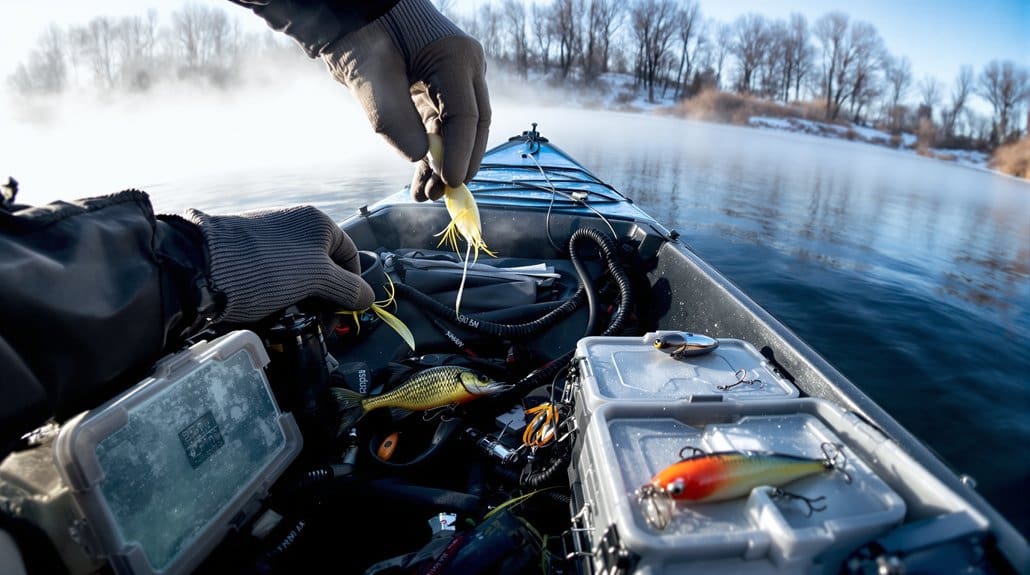
If you’ve been rolling slow baits for an hour with nothing to show, it’s time to shake things up and toss a Rat‑L‑Trap, because that little crankbait covers water fast and forces reaction strikes from bass that won’t chase a jig. You’ll want braid with a 3‑ft fluorocarbon leader tied with a loop knot to keep the trap’s action and cut down bite‑offs while you fan‑cast spots, and you’ll vary retrieves—steady cranking, stop‑and‑drop, letting it sink more—to match depth and mood. If nothing hits subsurface, cast long, let it fall deep, then start a slow retrieve to tempt lethargic winter bass, and when you feel a tap, set with authority, those treble hooks need a firm hookset.
Surface Options: High‑Roller Props and How to Trigger One‑Time Topwater Strikes
After you’ve shaken things up below the surface with a Rat‑L‑Trap and the bites slow, switch your focus to high‑roller propeller topwaters — they cast far from a kayak, make a lot of commotion, and can pull a single, explosive strike from a lethargic peacock or largemouth that wouldn’t chase a crankbait. You’ll want a 7' medium‑heavy rod and a 6.3:1 reel for long casts and solid hooksets, watch water conditions for sunny shallow edges, wood or rock seams, and current breaks when temps warm toward the mid‑60s, and carry several prop profiles to change pitch and cadence after a follow. Cast past the target, retrieve with short pauses that keep the prop turning, expect one‑time hits, and be ready to change lure or rhythm if fish hesitate.
Retrieve Patterns and Pause‑and‑Wait Hookset Timing
You’ll want to slow everything down and pay close attention to timing, because in cold water bass move sluggishly and bites often come on a pause or the fall, so keep your rod tip deliberate, make small pulls or twitches, and give the bait time to sit where a fish can inspect it. You’ll twitch jigs just 1–2 small rod‑tip moves every 5–10 seconds, lift 6–12 inches and let the lure fall back, and on moving baits roll slowly, then stop and count 2–5 seconds so the lure sinks into range, because winter fish often take on the drop. Watch for line hesitation or a subtle heavy feel, set the hook firmly, and vary pauses so you don’t become predictable.
Structure Targets and Casting Patterns From a Kayak
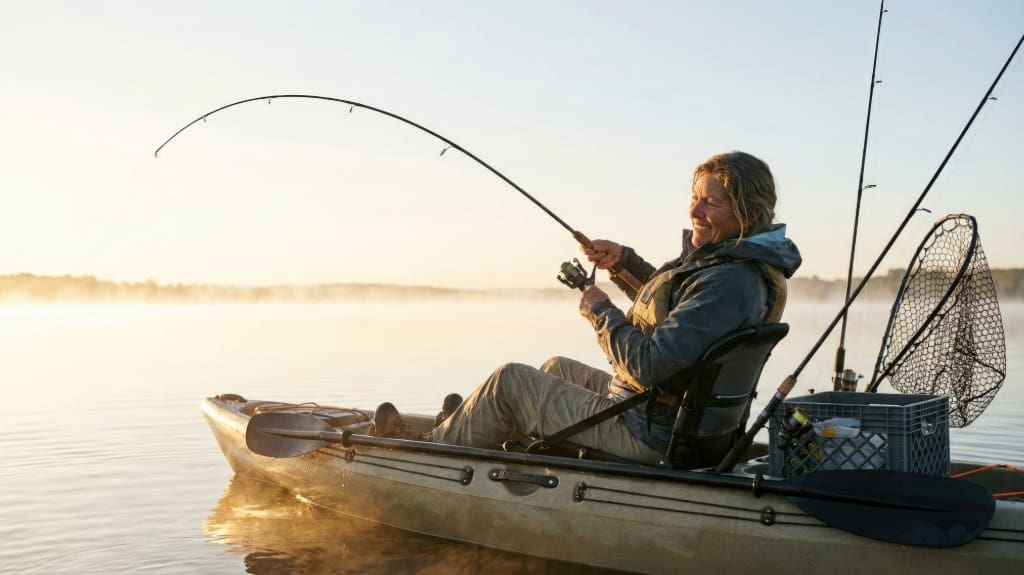
When you’re in a kayak, think like a detective: look for channel swings, bridge pilings, and sharp drop-offs on your Navionics chart, then aim your casts just beyond those steep contours where bass like to hold in colder water, because getting your bait into deeper edges and current breaks is the whole point. You’ll fan-cast along main creek channels and steep shifts, stopping every 10–15 feet of drift to let a jig or ned rig sink, sit, then twitch, and you’ll work wood piles, laydowns, and rock seams by worming baits slowly through cover with pauses, keeping casts tight to the same micro-area after a bite, using your finder to lock onto marks and focus on water near edges and current breaks for repeated, targeted casts.
Cold‑Weather Safety, Positioning, and Practical Kayak Tips for Staying on Fish
You’ve found the seams and structure where bass hang, but now you’ve got to keep yourself safe and stay on those fish without freaking them out, so start by dressing for the water more than the air — layered, waterproof clothing, insulated waders or a drysuit, and a non‑inflatable PFD are worth the extra bother because a dunk in 50°F water will shut you down fast. In winter time you’ll want a long 7' medium‑heavy rod and a 6.3:1 reel to cast long from your kayak, a fishfinder to locate channel seams, and an anchor or drift‑anchor to hold position slowly over contours, because presenting baits on the bottom matters; when you can’t hold station, fan‑cast a Rat‑L‑Trap on a short leader, pack throw rope, whistle, comms, an extra dry layer and emergency blanket.
Some Questions Answered
What's the Best Paddle Stroke to Stay Quiet Near Fish?
Use a Feathered Sweep, keeping blades light and angled so your paddle slips through quietly, you control speed and wake, and you don’t spook fish. Stay low, paddle slow, feather to reduce slap, watch for wind shifts and your wake path, and keep a spare blade tape for noise checks. First try short, soft sweeps near cover, feel resistance, adjust feather angle, and settle into a smooth rhythm that keeps you invisible and free.
How Do I Keep My Hands Warm Without Losing Dexterity?
You’ll keep your hands warm without losing dexterity by combining thin, touchscreen-friendly liners under waterproof gloves, heated grips for your paddle and kayak throttle, and a small rechargeable hand-warmer in a pocket near your wrists, so you’ve heat where it matters, but fingers stay nimble; check battery life, fit, and weatherproofing before you go, and practice gear swaps on shore so you’re calm and quick when fish show.
Can I Use Braided Line for Winter Finesse Presentations?
Yes, you can use braided line for winter finesse, but consider sensitivity, stretch, and knot choices; braid gives feel and thin diameter, so pair it with a fluorocarbon leader for stealth and some shock absorption, use strong knots like FG or double uni, downsize lure weight so bites register, carry extra leaders, a knot tool, and lighter fluorocarbon in 6–10 lb range, and practice gentle casts and controlled retrieves to keep presentations subtle.
What Clothing Layers Work Best for Sudden Wet Exposure?
You want waterproof insulation next to a breathable shell, start with a moisture-wicking base layer, add a synthetic or wool midlayer for insulation that stays warm wet, then wear a waterproof breathable outer shell with taped seams, and carry a spare set in a drybag. Look for sealed zippers, adjustable cuffs, and quick-dry gloves, and if you flip, get out, change layers fast, and heat up with warm drinks.
How Often Should I Check and Recalibrate My Fishfinder?
Check and recalibrate your fishfinder at least every season, and after any big impact, software update, or battery change—routine recalibration keeps readings honest. First, confirm clear transducer mounting, then run a shallow and deep sweep to compare depth and structure, adjust sensitivity and speed settings, and mark false echoes; carry basic tools, a spare cable, and your manual, and trust your eyes when sonar and what you see don’t match, tweak again.